Alan Moore - Jerusalem
Здесь есть возможность читать онлайн «Alan Moore - Jerusalem» весь текст электронной книги совершенно бесплатно (целиком полную версию без сокращений). В некоторых случаях можно слушать аудио, скачать через торрент в формате fb2 и присутствует краткое содержание. Год выпуска: 2016, Издательство: Liveright Publishing Corporation, Жанр: Современная проза, на английском языке. Описание произведения, (предисловие) а так же отзывы посетителей доступны на портале библиотеки ЛибКат.
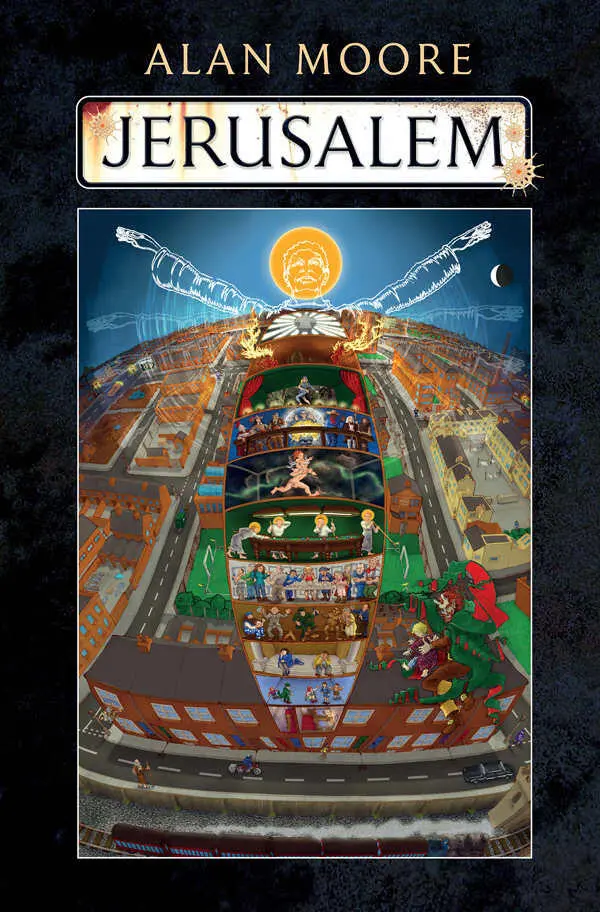
- Название:Jerusalem
- Автор:
- Издательство:Liveright Publishing Corporation
- Жанр:
- Год:2016
- ISBN:нет данных
- Рейтинг книги:4 / 5. Голосов: 1
-
Избранное:Добавить в избранное
- Отзывы:
-
Ваша оценка:
Jerusalem: краткое содержание, описание и аннотация
Предлагаем к чтению аннотацию, описание, краткое содержание или предисловие (зависит от того, что написал сам автор книги «Jerusalem»). Если вы не нашли необходимую информацию о книге — напишите в комментариях, мы постараемся отыскать её.
Disappeared lanes yield their own voices, built from lost words and forgotten dialect, to speak their broken legends and recount their startling genealogies, family histories of shame and madness and the marvellous. There is a conversation in the thunderstruck dome of St. Paul’s cathedral, childbirth on the cobblestones of Lambeth Walk, an estranged couple sitting all night on the cold steps of a Gothic church-front, and an infant choking on a cough drop for eleven chapters. An art exhibition is in preparation, and above the world a naked old man and a beautiful dead baby race along the Attics of the Breath towards the heat death of the universe.
An opulent mythology for those without a pot to piss in, through the labyrinthine streets and pages of Jerusalem tread ghosts that sing of wealth and poverty; of Africa, and hymns, and our threadbare millennium. They discuss English as a visionary language from John Bunyan to James Joyce, hold forth on the illusion of mortality post-Einstein, and insist upon the meanest slum as Blake’s eternal holy city. Fierce in its imagining and stupefying in its scope, this is the tale of everything, told from a vanished gutter.
Jerusalem — читать онлайн бесплатно полную книгу (весь текст) целиком
Ниже представлен текст книги, разбитый по страницам. Система сохранения места последней прочитанной страницы, позволяет с удобством читать онлайн бесплатно книгу «Jerusalem», без необходимости каждый раз заново искать на чём Вы остановились. Поставьте закладку, и сможете в любой момент перейти на страницу, на которой закончили чтение.
Интервал:
Закладка:
Without breaking his leisurely, unhurried pace, Tom had looked back and down across the shoulder of his stripy humbug jacket, studying the pair of phantom children, who were dutifully scampering after him, their trailing after-images completely swallowed within the much larger ones that he himself was leaving in his wake.
“So who’s the little cherub with you, then? We’ve not been introduced. Wiz it somebody else I should remember? Christ, it’s not John Weston, wiz it? Ha HARR!”
Bill, by now laughing himself at the very thought that Michael Warren might grow up into the mutually-acquainted chemical and human train wreck that the troubadour had named, had shaken his head in denial, briefly growing new ones as he did so.
“No. No, this wiz Michael Warren, and ’e’s the same age as what ’e’ looks. ’E’s technically dead at present, like, but back in 1959 he’s in a coma or what-have-you for ten minutes, and then ’e’ll be goin back Downstairs and back to life. ’E’s Alma Warren’s little brother. You remember Alma.”
Tom had stopped in his ponderous tracks, close to the foot of the dilapidated stairs.
“Well of course I can remember Alma. I’m cremated, I’m not senile. She read that stuff at my funeral about me being … manly … in my stature, and about how I’d bust three of her settees, the disrespectful cow. So this is Alma’s brother. Michael. Michael. Do you know, I think I met you when I turned up to play at that birthday party you were holding for your aunt, who’d died the day before and couldn’t make it. O’ course, you wiz so much older then. You’re younger than that now. HaHAAAAR! I’m pleased to meet you, Alma’s brother.”
Tucking his impressive walking-stick beneath his arm, Tom had bent over and elaborately shaken hands with Michael, the child’s tiny paw engulfed in the musician’s fist up to the forearm.
“You know, this lot that I’m playing with tonight, Holes In BlackT-Shirts — its Jack Lansbury, Tony Marriot, the Duke and all that lot — I got the name out of a dream I had about your sister. She’d got my three kids all lying on a railway track and said that if a train ran over them, then they’d become invisible. Her idea was that when they were invisible, we’d dress them up in her old shirts and put a show on called “Holes In Black T-Shirts”. HaHAAR! Good old Alma. Even in your dreams she was value for money!”
After that ringing endorsement, they’d begun to mount the creaking spectral staircase to the main bar of the Jolly Smokers. Which was where they were now, cringing in the shelter of the mountainous performer, peering nervously between his teddy-decorated legs at the demented horror of the scene beyond.
It wasn’t Texas Chainsaw horror, lacking both the colour and the blood. This was a Dr. Caligari horror shot on hazardous and decomposing film stock, eerie black and white scenarios melting into a rash of supernovas from the heat of the projector. Writhing hieroglyphic filigrees of murderous graffiti were gouged into all the scarred and ancient tables, scrawled on each available bare area of wall in hundred-year-old palimpsests of bile and bitterness. There was a light like rotten silver trickling over every pin-sharp detail of the resurrected alehouse, dripping from pump-handles fashioned out of horse skulls, glinting on the cracked ghost-mirror, hung behind the optics, in which nothing was reflected but an empty, fire-damaged room. In actuality, the front bar of the Jolly Smokers did not appear fire-damaged, but then neither was it empty.
Every badly-varnished barstool, every corner alcove with its threadbare, stained upholstery was fully occupied by the degenerate spectres of a neighbourhood that had been running down for centuries. The place heaved with belligerent ectoplasm and perspired a morbid jocularity that would have made flesh creep if there’d been any flesh around. Upon a mottled carpet that on close inspection turned out to be different strains of mould on bare wood boards; beneath a nicotine-glazed and oppressively low ceiling that was hung with rusted tankards, verdigris horse brasses and a mummified cat swaying up one corner; in an atmosphere that seemed smoke-saturated on account of all their overlapping after-images, the ugly spirits of the Boroughs jostled and cavorted.
In one corner was George Blackwood, gangster and procurer, sprouting extra arms as he dealt cards, properly ghostly now and not a living man like when Bill and the gang had seen him earlier, down in the 1950s. Blackwood sat across a tilted table from the terrifying ratter, Mick Malone, whose many-headed ferrets bubbled from his jacket pockets, sniffing the rank barroom air, and whose black and white terriers snapped and snarled around his polished work-boots. Having been part of the operation when Phyllis had slipped a ghost-rat under Malone’s bowler, Bill shrank back behind the ample cover that Tom Hall afforded before the rat-catcher saw him.
Gathered round the bar were other revenants Bill recognised, at least the ones who still had normal faces. Old Jem Perrit stood nursing a shot-glass that contained a double measure of the tavern’s home-made Puck’s Hat punch, distilled from the fermented fairy-blossoms. He was cackling uproariously, sharing some dark joke with his companion at the bar. This was Tommy Mangle-the-cat, the local wraith who was a casualty to the ferocious brew, mad-apple cider as Bill usually referred to it. Repeated and prolonged exposure to the potent moonshine had affected Tommy’s mind, which had of course been all that kept his insubstantial form together, with its various components in their proper order. As Bill watched, the dissolute ghost’s bleary eyes were both commencing a slow, slithering trip up one unshaven cheek towards the mostly-toothless mouth that gurned and grimaced disconcertingly slap in the centre of the dead man’s forehead, spraying phantom spittle when it laughed. The awful convolutions of a cauliflower ear, upside down, provided an appropriate centrepiece in the position where you might expect the nose to be. Presumably, the other ear and Tommy’s actual nose were off upon some expedition to the back of the grotesquely scrambled head and would both be returning presently.
Although Mangle-the-cat’s visage was pretty much unbearable to look at, it was not the most disturbing feature of the scene enacted there beside the bar. Along with old Jem Perrit and his carrion laugh, the lesbian bruiser Mary Jane and various assorted Cluniac or Augustan monks, Tommy was having fun watching what was, quite literally, a floor show: somehow struggling in the floorboards at their scuffling feet was an apparently alive and conscious relief-sculpture of a man, made out of living, moving wood. From what Bill could make out through all the whorls of grain and double nail-heads that formed the half-submerged figure’s screaming and contorting countenance, it looked to be a young lad, no more than nineteen at most. His scrawny wooden arms flailed in the air, pine fingers with exquisitely-carved bitten fingernails flexing and clawing as though seeking purchase. His puppet legs thrashed, a bent knee made from seemingly supple planking rising briefly from the surface before straightening and sinking back into the filthy, mildewed timbers. Brutally, Jem Perrit ground one heel upon the trapped form’s nose, pushing its sculpted face back down beneath the arabesques of mould that carpeted the naked boards, guffawing raucously throughout, mocking the animated figurine while forcing its head under so that it could drown in unswept floor.
“Goo on, yer useless little bugger. Get back dayn where yer belong. We dun’t want yer up ’ere!”
The same did not hold true, it seemed, when it came to another apparition made out of unusually limber bits of plank, this one fully emerged and standing sobbing by the bar. This second human marionette appeared to Bill to be a slightly older specimen than his floor-bound and struggling teenage companion, maybe somewhere in his early thirties. Badly overweight and with the loops and knotholes of his carpentry clearly delineated on a shaven skull, the portly doll-thing moaned and wailed, perfectly whittled tears of liquid balsa rolling down his wobbling wooden jowls. This was no doubt because the hairy-arsed butch mauler, Mary Jane, had got him by one lathe-turned forearm and was carving her initials in his splintery and syrup-weeping flesh with a ghost-screwdriver. Wherever the doomed woodentop had come from, Bill observed, he should have known that within a graffiti-smothered dive like this he simply represented a fresh canvas.
Читать дальшеИнтервал:
Закладка:
Похожие книги на «Jerusalem»
Представляем Вашему вниманию похожие книги на «Jerusalem» списком для выбора. Мы отобрали схожую по названию и смыслу литературу в надежде предоставить читателям больше вариантов отыскать новые, интересные, ещё непрочитанные произведения.






Обсуждение, отзывы о книге «Jerusalem» и просто собственные мнения читателей. Оставьте ваши комментарии, напишите, что Вы думаете о произведении, его смысле или главных героях. Укажите что конкретно понравилось, а что нет, и почему Вы так считаете.