Alan Moore - Jerusalem
Здесь есть возможность читать онлайн «Alan Moore - Jerusalem» весь текст электронной книги совершенно бесплатно (целиком полную версию без сокращений). В некоторых случаях можно слушать аудио, скачать через торрент в формате fb2 и присутствует краткое содержание. Год выпуска: 2016, Издательство: Liveright Publishing Corporation, Жанр: Современная проза, на английском языке. Описание произведения, (предисловие) а так же отзывы посетителей доступны на портале библиотеки ЛибКат.
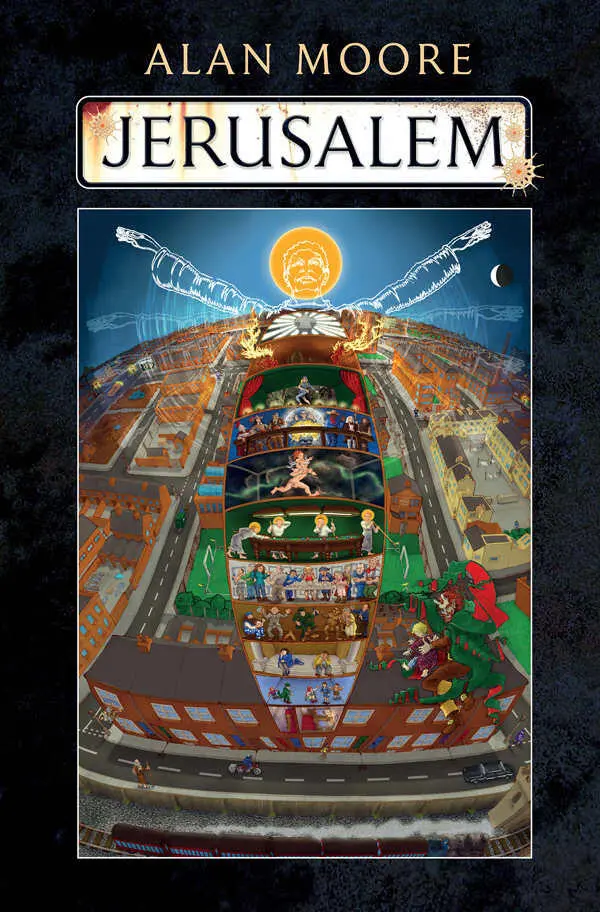
- Название:Jerusalem
- Автор:
- Издательство:Liveright Publishing Corporation
- Жанр:
- Год:2016
- ISBN:нет данных
- Рейтинг книги:4 / 5. Голосов: 1
-
Избранное:Добавить в избранное
- Отзывы:
-
Ваша оценка:
Jerusalem: краткое содержание, описание и аннотация
Предлагаем к чтению аннотацию, описание, краткое содержание или предисловие (зависит от того, что написал сам автор книги «Jerusalem»). Если вы не нашли необходимую информацию о книге — напишите в комментариях, мы постараемся отыскать её.
Disappeared lanes yield their own voices, built from lost words and forgotten dialect, to speak their broken legends and recount their startling genealogies, family histories of shame and madness and the marvellous. There is a conversation in the thunderstruck dome of St. Paul’s cathedral, childbirth on the cobblestones of Lambeth Walk, an estranged couple sitting all night on the cold steps of a Gothic church-front, and an infant choking on a cough drop for eleven chapters. An art exhibition is in preparation, and above the world a naked old man and a beautiful dead baby race along the Attics of the Breath towards the heat death of the universe.
An opulent mythology for those without a pot to piss in, through the labyrinthine streets and pages of Jerusalem tread ghosts that sing of wealth and poverty; of Africa, and hymns, and our threadbare millennium. They discuss English as a visionary language from John Bunyan to James Joyce, hold forth on the illusion of mortality post-Einstein, and insist upon the meanest slum as Blake’s eternal holy city. Fierce in its imagining and stupefying in its scope, this is the tale of everything, told from a vanished gutter.
Jerusalem — читать онлайн бесплатно полную книгу (весь текст) целиком
Ниже представлен текст книги, разбитый по страницам. Система сохранения места последней прочитанной страницы, позволяет с удобством читать онлайн бесплатно книгу «Jerusalem», без необходимости каждый раз заново искать на чём Вы остановились. Поставьте закладку, и сможете в любой момент перейти на страницу, на которой закончили чтение.
Интервал:
Закладка:
Having no one to chat with at that moment, Michael thought that he might take the opportunity to try the dainty pink-and-blue creations for himself. He lifted up the tempting morsel he’d been given, holding it beneath his nose and sniffing its warm perfume. Like the tea, the cake had a delightful yet ambiguous aroma. Michael could tell that it wasn’t aniseed, exactly, that was mixed in with the hints of peach and tangerine, but it was something as distinctive and unusual. He bit into the sapphire-sugared topside and almost immediately his mouth exploded with sensations so immense and intricate he felt his tongue had finally arrived in Heaven with the rest of him. The cake tasted as rich and complicated as, say, a cathedral looked or sounded. The elusive tang of unknown fruits from half-imaginary islands rang around his cheeks like organ music and the airy, crumbling texture was like Sunday light through stained glass. As he swallowed he could feel a tingle starting in the centre of him where his tummy used to be and spreading to his toes, his fingers and the tips of his blonde curls. Feeling as if his spirit had been dipped in the rose scent that people sometimes put on birthday cards, Michael luxuriated in an aftertaste that echoed through the toddler like a hymn. It filled him with a fresh vitality and at the same time was so satisfying that it brought a dreamy and delicious drowsiness. It was a very contradictory experience.
He blew upon his tea as Mrs. Doddridge had suggested, and then took a cautious sip. The taste was like the cakes but clearer and more pleasingly astringent, like a hot breeze blowing through his phantom mind and body rather than like anything substantial. Michael thought that he was as contented and relaxed as he had ever been, sitting with friends in this somehow familiar kitchen that he’d never seen before. The chatter of the other people at the table was receding to a distant murmur — Reggie asking Bill what the best bait would be to lure a ghostly mammoth, Tetsy Doddridge wondering aloud to Marjorie if having two gang-members with the surname Warren might not be confusing for the readership — but Michael was no longer bothering to keep up with the various conversations. He munched on his fairy cake and drank his fairy tea, discovering that these were reawakening in him the thrilling sense of marvel that he’d felt when Phyllis had first pulled him up into Mansoul.
Back then, when it had all been new to him, he’d been completely mesmerised by every surface and each texture, getting lost in woodgrain or the worn pink threads of Phyllis Painter’s jumper. Though he hadn’t noticed it occurring, since then his appreciation of the wonderful displays surrounding him had grown more dull and blunted, as if he were coming to take this extraordinary afterlife and all its finery for granted. Not until his faculties had been enlivened by this vicarage tea-party had Michael realised how complacent he’d become, or how much he was missing. Now he looked around him at the kitchen with its milky morning light and the dear scuffs or marks of wear on its utensils, glorying in all the humble wonders and the profound sense of home that they entailed.
His gaze alighted on the decorative tiling of the fireplace beside him and he saw for the first time its stupefying detail. Each tile had a different scene delineated on it in the graded blue tones of a willow pattern saucer, fine lines of rich navy on a background of an icier and paler shade. After a moment or two, Michael understood that the square panels were arranged in order so that all the separate pictures told a story, like they did in Alma’s comics. If that was the case, it seemed to him that the most sensible place to commence the tale would be the bottom left side of the fire’s surround, next to where he was sitting.
Looking down, he was immediately absorbed in the depicted episode, his enhanced vision swimming in its deep blue intricacies until with a start he comprehended that it was almost an image of himself, a small boy staring at a story told in painted tiles around a fireplace, pictures in a picture in a picture. Michael was more fascinated by this endless regress than he’d been by all the spectacle and sparkle when he’d glimpsed the Attics of the Breath for the first time. Although the infant in the miniature didn’t resemble him, having dark hair styled in a pudding-basin cut and wearing buckled shoes with knee-length britches, Michael felt himself being sucked into the exquisite illustration. He was not sure anymore if he was Michael Warren, sitting in a kitchen eating cake and staring at a tile, or if he was the painted youngster leaning on his mother’s lap as she perched by the fire and pointed to the bible stories on the painted tiles around it. The warm room about him and its crowded table melted to a wet ceramic gloss, became a parlour in another century and doing so acquired a lustrous Prussian tint. His own hands were now cyan outlines on a wash of faint ultramarine and he was …
He was Philip Doddridge, six years old and learning scripture from his mother Monica, her blue-limned right arm round his shoulders as she read from the worn Bible resting on her slippery skirted thighs. She gestured with her other hand towards the Delft tiles round the fire by which she sat, each one emblazoned with a scene from the New Testament, a crucifixion or annunciation to illuminate the passage she was reading to her son. It was a rainy afternoon during the autumn months of 1708 and by the fireside of the drawing-room in Kingston-upon-Thames all things seemed holy. On the mantelpiece a pair of paper fans flanked an ornate brass clock enclosed within a giant bullet of clear glass, and royal blue firelight glistered on a lacquer screen to one side of the hearth. Monica Doddridge’s soft voice continued its instruction while her son’s glance darted back and forth over the beautiful Dutch tiling. Here an enormous Jonah was regurgitated by a whale no bigger than a chubby pike, while not far off a prodigal son in a periwig was welcomed back into the fold. So entranced was the boy in the beguiling tableaux that he almost felt a part of them, a nearly-turquoise figure underneath the glaze, perhaps an infant Jesus lecturing his dumbstruck elders on the temple steps. Becoming lost among the indigo embellishments, Philip composed himself and pulled back from the biblical scenarios before he was immersed completely. He was …
He was Michael Warren. He was sitting in a sunlit kitchen in Mansoul, gathered around a table with five other children and three grownups, all of whom were chattering convivially and paying Michael no attention whatsoever. Wondering what had just happened to him, he let his attention creep back to the tile-work, this time peering cautiously towards the second tile up from the bottom on the left. It didn’t look …
It didn’t look like much of an occasion, on that August morning in the Congregational Church there at Fetter Lane in 1714. Philly was twelve, a sickly sketch in blue fountain-pen ink, sitting between his father and beloved Uncle Philip in the front pew, listening to Mr. Bradbury the minister delivering his morning sermon. Philly’s mother had died suddenly three years before, and the frail, uncomplaining child did not believe his father or his uncle would be with him for much longer. It was not a family that knew rude health, with Philly and his elder sis Elizabeth the only two survivors out of twenty children and the other eighteen all dead before he was even born. A movement in the upper gallery roused Philly from his reverie and looking up he saw a falling handkerchief, a lacy thing with cornflower stippling, caught in its leisurely descent towards the flagged church floor. Everyone gasped except for the boy’s father, Daniel Doddridge, who began to cough. The kerchief was a signal, dropped deliberately by a messenger from Bishop Burnet to announce the passing of Queen Anne, the Stuart monarch who had done so much to harm their Nonconformist cause. Indeed, her latest effort to discomfit them, her Schism Act, was due to be made law that very day. It was a clear attempt to undermine the grand tradition of religious discontent that reached back to John Wycliffe’s Lollards in the fourteenth century or the great radical dissenter Robert Browne two hundred years thereafter. It attacked the faith of Bunyan and his revolutionary affiliates the Muggletonians, Moravians and Ranters, but the Schism Act would almost certainly now be abandoned with the passing of Queen Anne, its instigator. Shuffling on the hard pew Philly felt extremely nervous but was not sure why. Alerted by the signal from the gallery, the minister curtailed his sermon hurriedly and offered up a prayer for their new King, the Hanoverian George the First who had already sworn support for Nonconformity. By now the church was rustling with excited whispers and the thrilling realisation that the hated Anne was dead at last. Smiling with private satisfaction, Mr. Bradbury led the singing of the 89 thPsalm before once more reading sternly from the text. “Go, see now this cursed woman, and bury her; for she is a king’s daughter.” Philly’s ears were ringing as he realised he was present at the dawn of a new age, an era of religious freedom that the boy could scarcely visualise. He felt …
Читать дальшеИнтервал:
Закладка:
Похожие книги на «Jerusalem»
Представляем Вашему вниманию похожие книги на «Jerusalem» списком для выбора. Мы отобрали схожую по названию и смыслу литературу в надежде предоставить читателям больше вариантов отыскать новые, интересные, ещё непрочитанные произведения.







Обсуждение, отзывы о книге «Jerusalem» и просто собственные мнения читателей. Оставьте ваши комментарии, напишите, что Вы думаете о произведении, его смысле или главных героях. Укажите что конкретно понравилось, а что нет, и почему Вы так считаете.