Alan Moore - Jerusalem
Здесь есть возможность читать онлайн «Alan Moore - Jerusalem» весь текст электронной книги совершенно бесплатно (целиком полную версию без сокращений). В некоторых случаях можно слушать аудио, скачать через торрент в формате fb2 и присутствует краткое содержание. Год выпуска: 2016, Издательство: Liveright Publishing Corporation, Жанр: Современная проза, на английском языке. Описание произведения, (предисловие) а так же отзывы посетителей доступны на портале библиотеки ЛибКат.
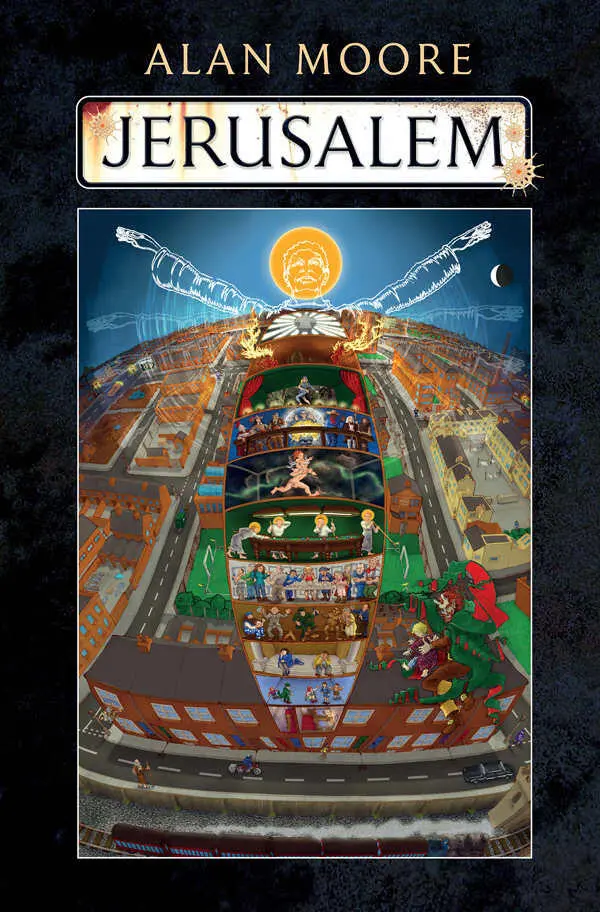
- Название:Jerusalem
- Автор:
- Издательство:Liveright Publishing Corporation
- Жанр:
- Год:2016
- ISBN:нет данных
- Рейтинг книги:4 / 5. Голосов: 1
-
Избранное:Добавить в избранное
- Отзывы:
-
Ваша оценка:
Jerusalem: краткое содержание, описание и аннотация
Предлагаем к чтению аннотацию, описание, краткое содержание или предисловие (зависит от того, что написал сам автор книги «Jerusalem»). Если вы не нашли необходимую информацию о книге — напишите в комментариях, мы постараемся отыскать её.
Disappeared lanes yield their own voices, built from lost words and forgotten dialect, to speak their broken legends and recount their startling genealogies, family histories of shame and madness and the marvellous. There is a conversation in the thunderstruck dome of St. Paul’s cathedral, childbirth on the cobblestones of Lambeth Walk, an estranged couple sitting all night on the cold steps of a Gothic church-front, and an infant choking on a cough drop for eleven chapters. An art exhibition is in preparation, and above the world a naked old man and a beautiful dead baby race along the Attics of the Breath towards the heat death of the universe.
An opulent mythology for those without a pot to piss in, through the labyrinthine streets and pages of Jerusalem tread ghosts that sing of wealth and poverty; of Africa, and hymns, and our threadbare millennium. They discuss English as a visionary language from John Bunyan to James Joyce, hold forth on the illusion of mortality post-Einstein, and insist upon the meanest slum as Blake’s eternal holy city. Fierce in its imagining and stupefying in its scope, this is the tale of everything, told from a vanished gutter.
Jerusalem — читать онлайн бесплатно полную книгу (весь текст) целиком
Ниже представлен текст книги, разбитый по страницам. Система сохранения места последней прочитанной страницы, позволяет с удобством читать онлайн бесплатно книгу «Jerusalem», без необходимости каждый раз заново искать на чём Вы остановились. Поставьте закладку, и сможете в любой момент перейти на страницу, на которой закончили чтение.
Интервал:
Закладка:
“ ’E said about Forbidden Worlds when me an’ Reggie found ’im up in Bath Street flats, but still I didn’t catch on.”
“Well, I knew as I’d seen ’im before when I first faynd ’im in the Attics o’ the Breath. I just couldn’t think where, but now I know. It wiz the show, just up the street there. Well. This changes everything.”
It sounded as if they were talking about him, but Michael couldn’t really make much sense of it. Besides, he’d reached the bottom of the Jacob Flight with everybody else queued up behind him, so he had to concentrate upon the climb. As usual, this was awkward, with the tiny treads too small for even Michael’s feet, but his ascent was much assisted by the ghost-seam’s general weightlessness. In moments he was clambering up onto the shining, milky boardwalk of the Ultraduct.
He stood there rooted to the spot and lit from underneath by the white crystal planks of the unfinished bridge, his small form almost bleached out of existence like a figure in a photo that the light had spoiled. As his five comrades and the helpful builder climbed onto the boards behind him, Michael stared transfixed at the changed landscape that was visible from this new vantage point, this overpass that Phyllis said was built upon a path worn into time itself.
Around them, from horizon to horizon, several different eras were all happening at once. Transparent trees and buildings overlapped in a delirious rush of images that changed and grew and bled into each other, see-through structures crumbling away and vanishing only to reappear and run through their accelerated lives over again, a boiling blur of black and white as if a mad projectionist were running many different loops of old film through his whirring, flickering contraption at the same time, at the wrong speed. Looking west down the raised highway, Michael saw Northampton Castle being built by Normans and their labourers, while being pulled down in accordance with the will of Charles the Second fifteen hundred years thereafter. A few centuries of grass and ruins coexisted with the bubbling growth and fluctuations of the railway station. 1920s porters, speeded up into a silent comedy, pushed luggage-laden trolleys through a Saxon hunting party. Women in ridiculously tiny skirts superimposed themselves unwittingly on Roundhead puritans, briefly becoming composites with fishnet tights and pikestaffs. Horses’ heads grew from the roofs of cars and all the while the castle was constructed and demolished, rising, falling, rising, falling, like a great grey lung of history that breathed crusades, saints, revolutions and electric trains.
The castle, obviously, was not alone in the transforming flood of simultaneous time. Above, the sky was marbled with the light and weather of a thousand years, while there beside the shimmering edifice the town’s west bridge shifted from beaver dams to wooden posts, from Cromwell’s drawbridge to the brick and concrete hump that Michael knew. Now standing next to him, Phyllis gave him a slightly funny look, as if regarding him in a new light. At last she smiled.
“What d’yer think, then? How’s that for a view? I tell yer what, if yer’ve got any business you want answered, you just ask away. I know I might ’ave told yer to shut up and not ask questions all the time, but let’s just say I’ve ’ad a change of ’eart. You ask me anything yer want, me duck.”
Michael just blinked at her. This was a turn-up for the books, and he’d no idea what had brought it on so suddenly. That said, he thought he’d take advantage of this new spirit of openness in Phyllis while it lasted.
“All right, then. Wizzle you be my girlfriend?”
It was Phyllis’s turn now to stare at Michael blankly. Finally she draped a sort of consolation-arm around his shoulder as she answered.
“No. I’m sorry. I’m a bit too old for you. And anyway, when I said about questions, it weren’t questions like that what I meant. I meant about the Ultraduct and things like that.”
Michael looked up at her and thought about it for a moment.
“Oh. Well, then, why can we see all different times from here?”
The whole gang and the builder who had volunteered to be their guide were by now heading slowly for the walkway’s ragged, uncompleted end. Phyllis, who looked immensely grateful for the change of topic, answered Michael’s query with enthusiasm as they walked along together.
“This wiz what time looks like when yer up above it, looking dayn. It’s a bit like if you were in a gret big city, walking in its streets so yer could only see the little bit what you were in at present, and then yer got taken up inter the sky, so you could look dayn and see the ’ole place with all its buildings, all at once. The Ultraduct is mostly used by builders, devils, saints and that lot, when they’re moving through the linger what’s between ’ere and Jerusalem. They’re used to seein’ time like this, so they think nothin’ of it, but to ordinary ghosts it still looks funny. ’Ave a decko at the church along the end ’ere if yer don’t believe me.”
Michael glanced away from Phyllis and towards the jutting and unfinished pier-end that they were approaching. Just beyond the point where the bridge terminated in mid-air was a tremendous visual commotion, churning imagery somewhere between a speeded-up film advertising the construction industry and a spectacular Guy Fawkes Night firework show. He saw the naked prehistoric slope that would be Castle Hill and over this, superimposed, he saw outbuildings of the Norman castle as they rose and fell, a single stone retreat encircled by a little moat, the lonely turret crumbling down to rubble, the surrounding ditch drained and filled in to form a ring of hard dirt lanes around the mound. A wooden chapel bloomed and crumpled into empty grass, with burdened plague-carts blurring back and forth as they delivered human backfill to a briefly-manifested burial pit. The barns and sheds that he’d seen on the site when he’d been back down in the 1670s a little while ago were flickering in and out of being and amongst it all an oblong structure made from warm grey stone was starting to take shape.
At first the building was just walls that knitted themselves into being from the bottom upward, leaving gaps for three high windows on the southern face and two long doorways where the bricks swirled out in an extension to the west, which looked as if they might be loading bays of some sort. Michael noticed that the luminous white walkway he was standing on seemed to be leading straight into the top half of the leftmost door, but was distracted by a slate roof rattling into existence as it unrolled from the eaves, just as a similarly slate-topped porch that had its own brick chimney started to squeeze itself forward from the block’s south side, right under the three windows. Boundaries sprang up a few yards from the property, enclosing it in limestone walls that rose to curious rounded humps where the four corners should have been, only for these to melt into the lower and more sharp-edged forms that Michael was familiar with. At the same time — and all of this was at the same time, from the ancient grassy hillock to the Norman turret and the teetering, ramshackle barns that followed it — he saw the porch with its lone chimney and its steep slate roof collapse into a broader, grander church-front: a Victorian vestibule that had a flagged and iron-gated courtyard spread before it. Looking back towards the nearest, western side he saw that the two lengthy doorframes had been mostly filled in, leaving one small entrance halfway up the wall of the extension, corresponding neatly with the end-point of the Ultraduct. This previously uncompleted juncture of the walkway had apparently been finished in the last few seconds and now fitted perfectly against the chapel, leading smoothly into the suspended doorway. Doddridge Church, now wholly recognisable, exploded into space and time as modern flats and houses licked the skyline to its rear with tongues of brick.
Читать дальшеИнтервал:
Закладка:
Похожие книги на «Jerusalem»
Представляем Вашему вниманию похожие книги на «Jerusalem» списком для выбора. Мы отобрали схожую по названию и смыслу литературу в надежде предоставить читателям больше вариантов отыскать новые, интересные, ещё непрочитанные произведения.








Обсуждение, отзывы о книге «Jerusalem» и просто собственные мнения читателей. Оставьте ваши комментарии, напишите, что Вы думаете о произведении, его смысле или главных героях. Укажите что конкретно понравилось, а что нет, и почему Вы так считаете.