Alan Moore - Jerusalem
Здесь есть возможность читать онлайн «Alan Moore - Jerusalem» весь текст электронной книги совершенно бесплатно (целиком полную версию без сокращений). В некоторых случаях можно слушать аудио, скачать через торрент в формате fb2 и присутствует краткое содержание. Год выпуска: 2016, Издательство: Liveright Publishing Corporation, Жанр: Современная проза, на английском языке. Описание произведения, (предисловие) а так же отзывы посетителей доступны на портале библиотеки ЛибКат.
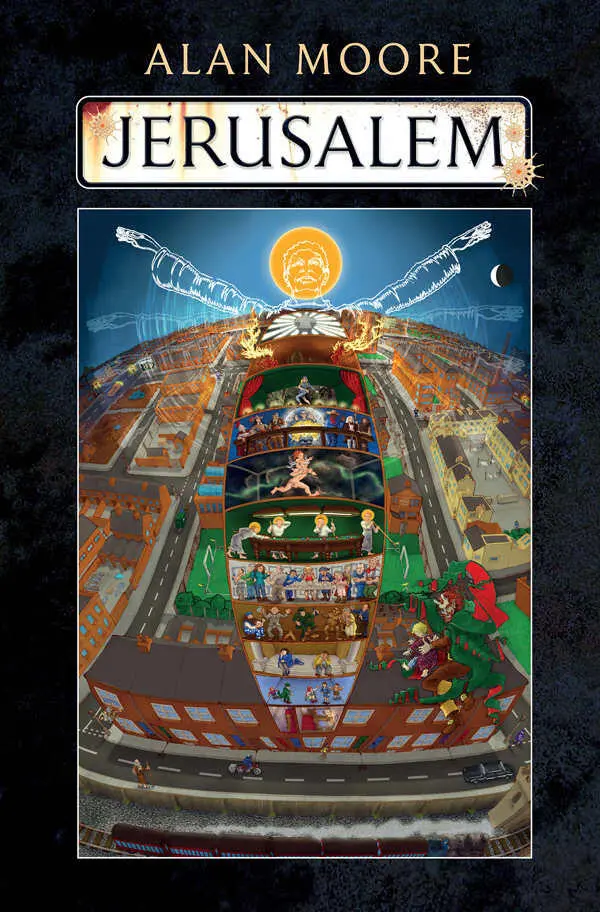
- Название:Jerusalem
- Автор:
- Издательство:Liveright Publishing Corporation
- Жанр:
- Год:2016
- ISBN:нет данных
- Рейтинг книги:4 / 5. Голосов: 1
-
Избранное:Добавить в избранное
- Отзывы:
-
Ваша оценка:
Jerusalem: краткое содержание, описание и аннотация
Предлагаем к чтению аннотацию, описание, краткое содержание или предисловие (зависит от того, что написал сам автор книги «Jerusalem»). Если вы не нашли необходимую информацию о книге — напишите в комментариях, мы постараемся отыскать её.
Disappeared lanes yield their own voices, built from lost words and forgotten dialect, to speak their broken legends and recount their startling genealogies, family histories of shame and madness and the marvellous. There is a conversation in the thunderstruck dome of St. Paul’s cathedral, childbirth on the cobblestones of Lambeth Walk, an estranged couple sitting all night on the cold steps of a Gothic church-front, and an infant choking on a cough drop for eleven chapters. An art exhibition is in preparation, and above the world a naked old man and a beautiful dead baby race along the Attics of the Breath towards the heat death of the universe.
An opulent mythology for those without a pot to piss in, through the labyrinthine streets and pages of Jerusalem tread ghosts that sing of wealth and poverty; of Africa, and hymns, and our threadbare millennium. They discuss English as a visionary language from John Bunyan to James Joyce, hold forth on the illusion of mortality post-Einstein, and insist upon the meanest slum as Blake’s eternal holy city. Fierce in its imagining and stupefying in its scope, this is the tale of everything, told from a vanished gutter.
Jerusalem — читать онлайн бесплатно полную книгу (весь текст) целиком
Ниже представлен текст книги, разбитый по страницам. Система сохранения места последней прочитанной страницы, позволяет с удобством читать онлайн бесплатно книгу «Jerusalem», без необходимости каждый раз заново искать на чём Вы остановились. Поставьте закладку, и сможете в любой момент перейти на страницу, на которой закончили чтение.
Интервал:
Закладка:
Sitting now in his still, relatively spacious Kingsthorpe parlour, stinging from his honourably-withdrawing-not-retreating hairline to his dimpled chin, he tried to reconcile the cluttered confines of his childhood with the streamlined TV Century 21 surroundings of his current middle-age. Mick looked once more at the reflection of his raw face in the glass front of the cabinet, deciding on the strength of his disaster-struck complexion that he must be Captain Scarlet. He tried fitting the mostly contented adult he’d become with the unspeakably contented three-year-old he’d been and found that the connection was surprisingly smooth and continuous, Mick’s recollection of his young self neither clouded by unhappiness nor tainted by that sorry wistfulness he sometimes heard in others’ voices when they talked about their boyhood days. Life had been good then, life was good now. It was just that life was different, in that it was being seen through different eyes, being experienced by a different person, almost.
The most striking thing about the past, at least as Mick remembered it, was not the obvious difference in how people dressed, or what they did, or the technology they did it with. It was something more difficult to grasp or put a name to, that by turn delightful and unsettling sense of strangeness that came over him on handling forgotten photographs, or suddenly recalling some particularly vivid reminiscence. It would come to him as the weak flavour of a fleeting atmosphere, an unrecoverable mood, as singular and as specific to its place and time as the day’s weather or the shapes its clouds made, just that once, never to be repeated. He supposed that the peculiar quality that he attempted to describe was no more than the startling texture of the past, the way it might feel should you brush your memory’s fingertips across its nap. It was the grain of his experience, composed from an uncountable array of unique whorls and bumps, from almost indiscernibly protruding detail. The string netting of the decomposing dishcloth hung by the back door, stiffened and dried into a permanently tented elbow shape, perfumed by dirty water and warm ham. The finger-sized holes in the blocks that edged Gran’s yard-wide flowerbed, beside the faded red and blue check of the path. A secret ant-nest gnawed into the crumbling cement between two courses of the kitchen wall, beside the steps that led down to a lower level of their closed-in yard. That afternoon there’d been the smell of sun-baked brick, black soil, the tinny scent of recent rain.
Now that he thought about it, not without a faint vestigial flicker of resentment, the entire life-threatening incident that had occurred in the back yard that day had been as a direct result of being poor. If he’d not been one of the offspring of the Boroughs then he wouldn’t have been sitting on his mother’s lap in the sunlit back yard sucking the nearly-lethal cough-drop in the first place.
Mick — or Michael as he’d been then — had been suffering from an inflamed gullet for about a week before that point. When Doreen’s homemade remedy of butter-knobs that had been rolled in caster sugar failed to work, she’d wrapped him up and taken him down Broad Street, off the Mayorhold, to the surgery of Dr. Grey. Though neither Mick nor any of his family had thought about it then, he understood now that the doctors who had tended to his neighbourhood must have resented every minute of their unrewarded, undistinguished toil in ministering to such a lowly and benighted area. They’d almost certainly be working harder than their more illustrious colleagues, just by virtue of the Boroughs being what it was and having more ways people could get ill. They must have come to hate the sight of all those over-anxious mothers wearing toffee-coloured coats and tea-towel scarves, parading half-baked snot-nosed children through their practices at the first sneeze. It must have been all they could do to feign an interest in the wheezing brat for the five minutes that it would be in their office. That was clearly the approach that Dr. Grey had taken with Doreen and Mick that time. He’d shone a torch down Michael’s carmine and inflated gullet, grunted once and made his diagnosis.
“It’s a sore throat. Give him cough-sweets.”
Mick’s mum would have no doubt nodded gravely and compliantly. This was a doctor speaking, who’d had training and could write in Latin. This was someone who, by just a glance at the small child she’d brought in with a poorly throat in which it was experiencing soreness, had seen straight away that this was a near-textbook case of Sore Throat that required immediate intervention from a bag of Winter Mixture. Nineteen-fifties social medicine: it must have seemed a step up from the days when laryngitis would be driven out by exorcism. Mick and Alma’s parents had been grateful for it, anyway, and Doreen would have thanked the general practitioner for his advice with touching earnestness before she’d wrestled Mick into his duffle-coat and carried him back down St. Andrew’s Road, possibly stopping off at the newsagent, Botterill’s on the Mayorhold, to buy the medicinal confectionery that had been prescribed.
And that was how he’d come to be in their back yard, in his pyjamas and his scratchy tartan dressing gown, squirming on Doreen’s lap while she perched on the curve-backed wooden chair brought out into the garden from the living room. His mum sat just beneath the kitchen window with her back to it, the rear legs of her seat against the edging of the kitchen drain, a foot or so of gutter running from below the window to a sunken trap close by the ant-nest, hidden near the garden’s three rough steps. The kingdom of the ants had been the property of Mick’s big sister, and, as she’d explained it to him at the time, was hers by legal right of being eldest child. When she was playing Sodom and Gomorrah with the insects, though, to give Alma her due, she’d let Mick be a kind of work-experience avenging angel to her merciless Jehovah. He’d been put in charge of rounding up escapees from the Cities on the Plain, until Alma had fired him for preventing one of his six-legged charges running off by hitting it with half a brick. His sister, who’d been at that moment either drowning or incinerating ants herself, had turned upon him with a look of outrage.
“What did you do that for?”
Little Mick had blinked up at her guilelessly. “It kept escaping, so I stunned it.”
Alma, half-blind even then, had squinted at the ant in question, which had lost a whole dimension, and then squinted at her brother in appalled incomprehension before stamping off to play alone indoors.
Alma had been at home that afternoon by virtue of it being the school holidays, probably wishing she could be out in the park or meadow rather than stuck there in the back garden with her mum and useless croaking bundle of a baby brother. While Doreen and Mick had sat there on the upper strip of path, Mick’s elder sister, then a tubby five- or six-year-old, had batted energetically around the yard’s brick confines like a moth trapped in a shoebox. She’d run up and down the garden’s three stone steps a dozen times, her white knees pumping back and forth like juggled dumplings, then raced in a circle round the nine-foot-by-nine-foot enclosure, half brick paving, half compressed black dirt, that was the bottom of the garden. She’d hidden from nobody in particular, twice in their outside toilet and once in the narrow rectangle of dead-end concrete alleyway that ran along its side, the left-hand side if you were sitting on the bowl and facing out.
That little shed with its slate roof — their outdoor lavatory down at the bottom of the yard without a cistern or electric light — had been most notable to Mick amongst the Warren family’s various anti-status-symbols. Their back toilet, he had realised at the age of six or so, was an embarrassment even within a neighbourhood not known for its amenities. Even their nan, who lived on Green Street in a gas-lit house that had no electricity at all, at least she had a cistern in her lav. Trips to the loo after the sun went down didn’t require a stuttering Wee Willie Winkie candle or a big tin bucket filled near to its brim with water from the kitchen tap, the way they did along St. Andrew’s Road.
Читать дальшеИнтервал:
Закладка:
Похожие книги на «Jerusalem»
Представляем Вашему вниманию похожие книги на «Jerusalem» списком для выбора. Мы отобрали схожую по названию и смыслу литературу в надежде предоставить читателям больше вариантов отыскать новые, интересные, ещё непрочитанные произведения.









Обсуждение, отзывы о книге «Jerusalem» и просто собственные мнения читателей. Оставьте ваши комментарии, напишите, что Вы думаете о произведении, его смысле или главных героях. Укажите что конкретно понравилось, а что нет, и почему Вы так считаете.