Харуки Мураками - Killing Commendatore
Здесь есть возможность читать онлайн «Харуки Мураками - Killing Commendatore» весь текст электронной книги совершенно бесплатно (целиком полную версию без сокращений). В некоторых случаях можно слушать аудио, скачать через торрент в формате fb2 и присутствует краткое содержание. Город: New York, Год выпуска: 2018, ISBN: 2018, Издательство: Alfred A. Knopf, Жанр: Современная проза, на английском языке. Описание произведения, (предисловие) а так же отзывы посетителей доступны на портале библиотеки ЛибКат.
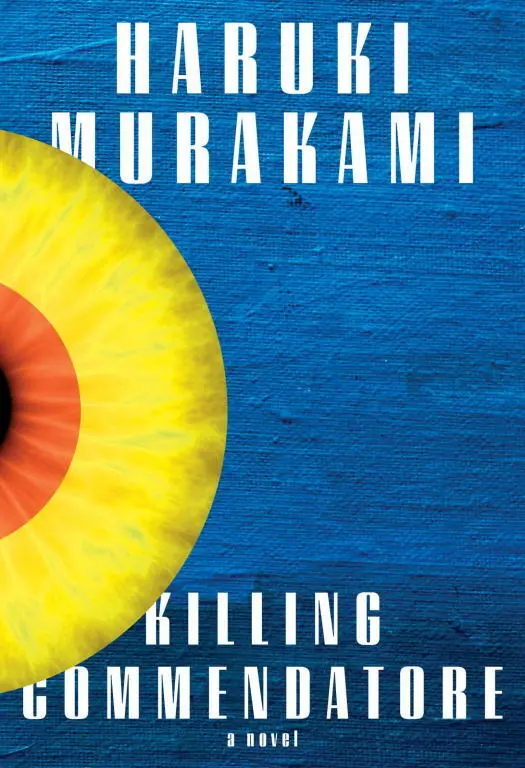
- Название:Killing Commendatore
- Автор:
- Издательство:Alfred A. Knopf
- Жанр:
- Год:2018
- Город:New York
- ISBN:978-0-5255-2005-4
- Рейтинг книги:5 / 5. Голосов: 1
-
Избранное:Добавить в избранное
- Отзывы:
-
Ваша оценка:
Killing Commendatore: краткое содержание, описание и аннотация
Предлагаем к чтению аннотацию, описание, краткое содержание или предисловие (зависит от того, что написал сам автор книги «Killing Commendatore»). Если вы не нашли необходимую информацию о книге — напишите в комментариях, мы постараемся отыскать её.
In Killing Commendatore, a thirty-something portrait painter in Tokyo is abandoned by his wife and finds himself holed up in the mountain home of a famous artist, Tomohiko Amada. When he discovers a previously unseen painting in the attic, he unintentionally opens a circle of mysterious circumstances. To close it, he must complete a journey that involves a mysterious ringing bell, a two-foot-high physical manifestation of an Idea, a dapper businessman who lives across the valley, a precocious thirteen-year-old girl, a Nazi assassination attempt during World War II in Vienna, a pit in the woods behind the artist’s home, and an underworld haunted by Double Metaphors.
A tour de force of love and loneliness, war and art—as well as a loving homage to The Great Gatsby—Killing Commendatore is a stunning work of imagination from one of our greatest writers.
Killing Commendatore — читать онлайн бесплатно полную книгу (весь текст) целиком
Ниже представлен текст книги, разбитый по страницам. Система сохранения места последней прочитанной страницы, позволяет с удобством читать онлайн бесплатно книгу «Killing Commendatore», без необходимости каждый раз заново искать на чём Вы остановились. Поставьте закладку, и сможете в любой момент перейти на страницу, на которой закончили чтение.
Интервал:
Закладка:
He had me on that one.
“So Nanjing fell in December, and many were killed. But what does that have to do with what happened to Tomohiko Amada in Vienna?” I asked.
“I’m getting to that,” Menshiki said. “The Anti-Comintern Pact was signed by Japan and Germany in November of 1936, cementing their alliance, but Vienna and Nanjing were so far apart it’s doubtful much news about Japan’s war in China was getting through to Vienna. In fact, however, Tomohiko Amada’s younger brother, Tsuguhiko, had been part of the assault on Nanjing as a private in the Japanese army. He had been drafted and assigned to one of the units fighting there. He was twenty, and a full-time student at the Tokyo Music School, now the Faculty of Music at the Tokyo University of the Arts. He studied the piano.”
“That’s strange,” I said. “To my knowledge, full-time university students were exempt from the draft at that time.”
“You’re absolutely right. Full-time students were given a deferment until graduation. Yet for some reason Tsuguhiko was drafted and sent to China. In any case, he was inducted in June of 1937 and spent the next twelve months as a private second-class in the army. He was living in Tokyo, but his birth was registered in Kumamoto, so he was assigned to the 6th Division based there. That much is documented. After basic training, he was sent to China, and participated in the December assault on Nanjing. He was demobilized in June of the following year, and was expected to return to the conservatory.”
I waited for Menshiki to continue.
“Not long after his discharge, however, Tsuguhiko Amada took his own life. He slit his wrists with a razor in the attic of the family home, which was where they found him. Right around the end of summer.”
Slit his wrists in the attic?
“If it was toward the end of summer in 1938… then Tomohiko was still an exchange student in Vienna when his brother Tsuguhiko slit his wrists, right?”
“That’s correct. He didn’t return home for the funeral. Commercial air travel was still in its infancy. You could only travel between Austria and Japan by rail and ship. There was no way he could have made it back in time.”
“Are you suggesting that there’s a connection between Tomohiko’s involvement in the failed assassination and his brother’s suicide? They seem to have happened almost simultaneously.”
“Maybe yes, maybe no,” Menshiki said. “That’s in the realm of conjecture. What I’m reporting to you now are the facts our investigation was able to uncover.”
“Did Tomohiko Amada have any other siblings?”
“There was an older brother. Tomohiko was the second son. Tsuguhiko was the third and last. The manner of his death was concealed, though, to protect the family’s honor. Kumamoto’s 6th Division was celebrated as a band of fearless warriors. If word had gotten out that their son had returned from the battlefield bathed in glory only to turn around and kill himself, they could not have faced the world. Still, as you know, rumors have a way of spreading.”
I thanked Menshiki for updating me. Though what the new information meant in concrete terms escaped me.
“I’m planning to dig a bit deeper into this,” he said. “I’ll let you know if we turn up something more.”
“Please do.”
“So then I’ll stop by next Sunday shortly after noon,” Menshiki said. “I’ll drive the Akikawas over to my place. To show them your painting. That’s okay with you, right?”
“Of course. The painting is yours now. You’re free to show it or not to whomever you like.”
Menshiki paused. As if searching for just the right words. “To tell you the honest truth,” he said. “Sometimes I’m very envious of you.” There was resignation in his voice.
Envious? Of me?
What could he possibly be talking about? Why would Menshiki envy me? It made no sense. He had everything, while I had nothing to my name.
“What could you possibly be envious about?” I asked.
“I see you as the kind of person who doesn’t really envy anyone. Am I right?”
I thought for a moment before replying. “You have a point. I don’t think I’ve ever envied another person.”
“That’s what I’m trying to say.”
All the same, I don’t have Yuzu, I thought. She had left me for the arms of another man. There were times I felt abandoned at the edge of the world. Yet even then I felt no envy toward that other man. Did that make me strange?
After our phone call, I sat on the sofa and thought about Tomohiko Amada’s brother slitting his wrists in the attic. It wasn’t the attic of this house, that was for sure. Tomohiko had bought this place after the war. No, Tsuguhiko Amada had committed suicide in the attic of their family home. In Aso, no doubt. Nevertheless, the brother’s death and the painting Killing Commendatore might be connected by that dark, secret room above the ceiling. Sure, it might have been pure coincidence. Or perhaps Tomohiko had his brother in mind when he hid the painting in the attic here. Still, why was Tsuguhiko compelled to take his own life so soon after returning from the front? After all, he had survived the bloody conflict in China and come home with all his limbs intact.
I picked up the phone and dialed Masahiko’s number.
“Let’s get together in Tokyo,” I said. “I have to visit the art supply shop soon to stock up on paints. Maybe we could meet and talk then.”
“Sure thing,” he said, checking his schedule. Thursday just after noon was best for him, so we arranged to have lunch together.
“The art supply store in Yotsuya, correct?”
“That’s the one. I’ve got to pick up fresh canvases, too, and I’m running out of linseed oil. It’ll be quite a load, so I’ll take the car.”
“There’s a quiet restaurant not far from my office. We could have a nice relaxed chat over lunch.”
“By the way,” I said, “divorce papers from Yuzu came in the mail, so I signed and returned them. It looks like our divorce will become official pretty soon.”
“Is that so,” Masahiko said in a subdued voice.
“What can you do? It was just a matter of time.”
“Still, from where I stand it’s a real shame. You guys seemed like such a good match.”
“It was great as long as things were going well,” I said. Just like an old-model Jaguar. A wonderful ride until the problems start.
“So what will you do now?”
“No big changes. Just keep on as I am for the time being. Can’t think of what else to do.”
“Are you painting?”
“Yeah, I’ve got a couple of paintings I’m working on. Not sure what will happen with them, but at least I’m at it.”
“That’s the way to go.” Masahiko hesitated before adding, “I’m glad you called. There’s something I want to discuss with you as well.”
“Something good?”
“It’s just the facts—I can’t say if they’re good or bad.”
“Does it have to do with Yuzu?”
“It’s hard to talk about over the phone.”
“Okay, on Thursday then.”
I ended the call and walked out to the terrace. The rain had stopped, and the cool night air was clear and bracing. I could see stars peeping from the cracks between the clouds. They looked like scattered crystals of ice. Hard crystals, millions of years old, never melting. Hard to their very core. Across the valley, Menshiki’s house glimmered in the cool light of its lanterns.
As I looked at his house, I thought of trust, respect, and etiquette. Especially etiquette. As I expected, though, none of those thoughts led me to any definite conclusions.
37
EVERY CLOUD HAS A SILVER LINING
It turned out to be a long haul from my mountaintop perch on the outskirts of Odawara to downtown Tokyo. I took several wrong turns en route, which ate up a lot of time. My old used car had no navigation system or electronic pass for the highway tolls. (I guess I should have been grateful it came with a cup holder!) It took me ages to find the Odawara-Atsugi Road, and when I moved from the Tomei Expressway onto the Metropolitan Expressway it was jammed, so I opted to get off at the Shibuya exit and drive to Yotsuya via Aoyama Avenue. Even the city roads were crowded, though—just choosing the correct lane was a huge pain in the ass. Parking the car wasn’t easy, either. It seems as if, year after year, the world becomes a more difficult place to live.
Читать дальшеИнтервал:
Закладка:
Похожие книги на «Killing Commendatore»
Представляем Вашему вниманию похожие книги на «Killing Commendatore» списком для выбора. Мы отобрали схожую по названию и смыслу литературу в надежде предоставить читателям больше вариантов отыскать новые, интересные, ещё непрочитанные произведения.






Обсуждение, отзывы о книге «Killing Commendatore» и просто собственные мнения читателей. Оставьте ваши комментарии, напишите, что Вы думаете о произведении, его смысле или главных героях. Укажите что конкретно понравилось, а что нет, и почему Вы так считаете.