Харуки Мураками - Killing Commendatore
Здесь есть возможность читать онлайн «Харуки Мураками - Killing Commendatore» весь текст электронной книги совершенно бесплатно (целиком полную версию без сокращений). В некоторых случаях можно слушать аудио, скачать через торрент в формате fb2 и присутствует краткое содержание. Город: New York, Год выпуска: 2018, ISBN: 2018, Издательство: Alfred A. Knopf, Жанр: Современная проза, на английском языке. Описание произведения, (предисловие) а так же отзывы посетителей доступны на портале библиотеки ЛибКат.
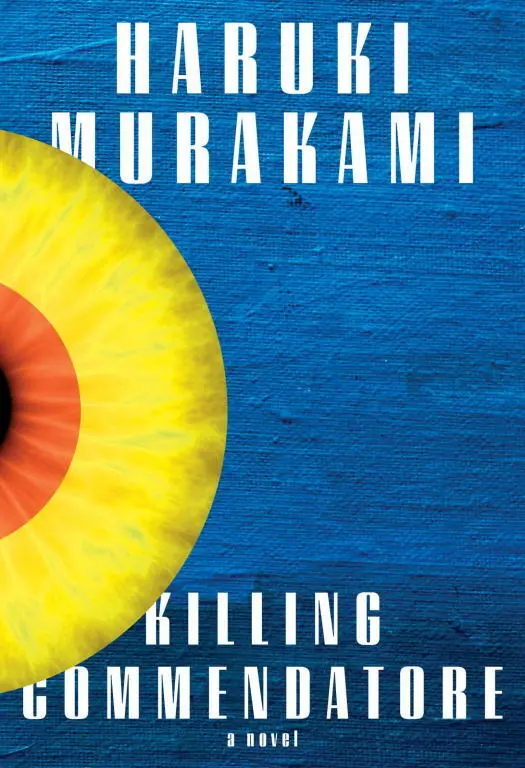
- Название:Killing Commendatore
- Автор:
- Издательство:Alfred A. Knopf
- Жанр:
- Год:2018
- Город:New York
- ISBN:978-0-5255-2005-4
- Рейтинг книги:5 / 5. Голосов: 1
-
Избранное:Добавить в избранное
- Отзывы:
-
Ваша оценка:
Killing Commendatore: краткое содержание, описание и аннотация
Предлагаем к чтению аннотацию, описание, краткое содержание или предисловие (зависит от того, что написал сам автор книги «Killing Commendatore»). Если вы не нашли необходимую информацию о книге — напишите в комментариях, мы постараемся отыскать её.
In Killing Commendatore, a thirty-something portrait painter in Tokyo is abandoned by his wife and finds himself holed up in the mountain home of a famous artist, Tomohiko Amada. When he discovers a previously unseen painting in the attic, he unintentionally opens a circle of mysterious circumstances. To close it, he must complete a journey that involves a mysterious ringing bell, a two-foot-high physical manifestation of an Idea, a dapper businessman who lives across the valley, a precocious thirteen-year-old girl, a Nazi assassination attempt during World War II in Vienna, a pit in the woods behind the artist’s home, and an underworld haunted by Double Metaphors.
A tour de force of love and loneliness, war and art—as well as a loving homage to The Great Gatsby—Killing Commendatore is a stunning work of imagination from one of our greatest writers.
Killing Commendatore — читать онлайн бесплатно полную книгу (весь текст) целиком
Ниже представлен текст книги, разбитый по страницам. Система сохранения места последней прочитанной страницы, позволяет с удобством читать онлайн бесплатно книгу «Killing Commendatore», без необходимости каждый раз заново искать на чём Вы остановились. Поставьте закладку, и сможете в любой момент перейти на страницу, на которой закончили чтение.
Интервал:
Закладка:
At a certain point, it felt as though the walls of the pit were beginning to close in. My heart made a dry sound as it expanded and contracted in my chest. I felt I could hear its valves open and close. The sensation chilled me, as if I were approaching the realm of the dead. That world didn’t strike me as altogether unpleasant, but it was not yet my time to enter.
I returned to my senses with a start. I untangled myself from my train of thought, which had run on without me, then flicked on my flashlight and looked around. The ladder was still where it had been. The sky above my head was the same. I breathed a sigh of relief. For all I knew, the sky could have vanished and the ladder disappeared. Anything could happen in this place.
With great care, I climbed from the pit one rung at a time. Only when I had emerged and was standing on the wet ground did my breathing finally return to normal. It took even longer to get my heartbeat under control. I peered down into the pit one last time. With my flashlight, I illuminated every inch of the dirt floor. But it was just a normal, everyday kind of pit. It was not breathing or thinking, nor were its walls closing in. It just sat there in silence, absorbing the chilly mid-November rain.
I moved the boards back into place and set the rocks on top. I arranged them with care, making sure that they were exactly as they had been before. That way I would know if someone moved them. Then I stuck my rain hat back on my head and walked home along the same path I had come on.
As I walked through the woods, I wondered where the Commendatore had gone. I hadn’t seen him for at least two weeks. Strangely, I missed having him around. Without realizing it, I had come to feel a certain kinship with the two-foot man with the tiny sword at his side, despite his odd way of speaking, his voyeurism when my girlfriend and I were making love, and the fact that I had no clear idea what he was. I hoped nothing bad had happened to him.
When I got home, I went straight to the studio, sat down on the ancient wooden stool (the stool Tomohiko Amada must have used when he was working), and studied Killing Commendatore hanging there on the wall. I often did that when I wasn’t sure what to do—in fact, I studied it endlessly. It was a painting I never tired of, no matter how often I looked at it. It should have been displayed in a museum as a prized example of Japanese art, but instead, it graced the wall of this small studio, and I was the only one who could enjoy it. Before me, it had been hidden in the attic, unseen by anyone.
It’s calling out to me , Mariye had said. Like a caged bird crying to be set free .
The more I studied the painting the more I realized Mariye had hit the nail square on the head—something was desperately struggling to escape that enclosed space. It longed for a place less confined, for freedom. It was the strength of that will that gave the painting its impact. Whether we understood the meaning of the bird and the cage or not.
I felt the urge to paint something that day. Powerfully. I could feel it mounting within me. Like the evening tide coming in. It was still too early, though, to work on Mariye’s portrait. That could wait until next Sunday. And I didn’t feel like going back to The Man with the White Subaru Forester either. As Mariye had pointed out, a dangerous force lurked beneath its surface.
A new canvas sat on the easel, ready for Mariye’s portrait. I sat on the stool studying it for a long time. Yet nothing came to me—no image of what to paint. The blank stayed blank. What should be my subject matter? After a while, at last, the answer rose to my mind.
I stepped away from the easel and took out my big sketchbook. Then I sat on the floor, crossed my legs, leaned back against the wall, and began to draw a chamber of stone in pencil. Not my usual soft pencil but a much harder one. It was a sketch of the strange pit we had found under the pile of rocks in the woods. I had just come from there, so it was fresh in my mind, and I rendered it in as much detail as possible. I drew the intricately fitted wall of stones. I drew the ground around the pit, and the beautiful pattern of the wet fallen leaves. The stand of pampas grass that had once hidden the pit lay flattened by the backhoe.
As I sketched, the eerie sensation that I was merging with the pit returned. It wanted me to draw it. Accurately, and in great detail. In response, my hand moved without conscious guidance. It was a pure act of creation, and it brought with it a kind of joy. When I returned to my senses, I realized that a length of time had passed (I had no idea how much), and that the page in my notebook was covered with pencil lines.
I went to the kitchen, gulped down several glasses of cold water, reheated the coffee, and carried a cup back to the studio. I placed the open sketchbook on the easel and sat down to take a second look, this time from farther away. There was the pit in the woods, in realistic detail. It looked somehow alive. Even more alive than the real thing. I got off the stool and examined it up close, then studied it again from a different angle. Only then did it hit me how much it looked like a woman’s genitals. The clump of pampas grass flattened by the backhoe resembled her pubic hair to a T.
I shook my head and smiled a wry smile. I mean, how Freudian can you get? I imagined some egghead critic fulminating on the drawing’s psychological implications: “This black, gaping hole, so reminiscent of a woman’s solitary genitalia, must be understood functionally, as a symbolic representation of the artist’s memories and unconscious desires.” Or something of the sort. Seriously!
Yet try as I might, I couldn’t get the connection between the strange circular pit in the woods and a woman’s sex out of my head. So when the phone rang a short while later, I had a hunch it would be my married girlfriend.
And it was.
“Hi,” she said. “Some free time just opened up, and I was wondering if I might stop by.”
I glanced at my watch. “Sounds good. Let’s have lunch together.”
“I’ll pick up something simple on the way,” she said.
“Great idea. I’ve been working since morning, so I haven’t prepared anything.”
She ended the call. I made the bed, picked my clothes up off the floor, folded them, and returned them to the chest of drawers. I washed the breakfast dishes in the sink and put them away.
Then I went to the living room, placed my usual record—Richard Strauss’s Der Rosenkavalier , conducted by Georg Solti—on the turntable, and read on the sofa while I waited for her to arrive. What kind of book was Shoko Akikawa reading, I wondered? What could have so captivated her?
My girlfriend showed up at twelve fifteen. Her red Mini pulled up in front of my house and she got out, a paper bag from the grocery store in her arms. Although a quiet rain was still falling, she carried no umbrella. Wearing a yellow vinyl raincoat with a hood, she walked quickly to my door. I met her there, took the bag, and brought it to the kitchen. She removed the raincoat, exposing the brilliant green turtleneck underneath. Beneath the sweater were two very attractive bulges. Her breasts weren’t as large as Shoko’s, but they suited me just fine.
“Have you been at it all morning?”
“Yeah,” I said. “But it’s not a commission. I felt like drawing, so I came up with something on my own, just for fun.”
“Just passing the time, huh?”
“Yeah, a bit like that.”
“Are you hungry?”
“Not all that much.”
“That’s good,” she said. “Why don’t we eat afterward, then?”
“Fine by me,” I said.
“You were awfully passionate today. Is there a special reason?” she asked. It was afterward, and we were lying in bed.
Читать дальшеИнтервал:
Закладка:
Похожие книги на «Killing Commendatore»
Представляем Вашему вниманию похожие книги на «Killing Commendatore» списком для выбора. Мы отобрали схожую по названию и смыслу литературу в надежде предоставить читателям больше вариантов отыскать новые, интересные, ещё непрочитанные произведения.







Обсуждение, отзывы о книге «Killing Commendatore» и просто собственные мнения читателей. Оставьте ваши комментарии, напишите, что Вы думаете о произведении, его смысле или главных героях. Укажите что конкретно понравилось, а что нет, и почему Вы так считаете.