Харуки Мураками - Killing Commendatore
Здесь есть возможность читать онлайн «Харуки Мураками - Killing Commendatore» весь текст электронной книги совершенно бесплатно (целиком полную версию без сокращений). В некоторых случаях можно слушать аудио, скачать через торрент в формате fb2 и присутствует краткое содержание. Город: New York, Год выпуска: 2018, ISBN: 2018, Издательство: Alfred A. Knopf, Жанр: Современная проза, на английском языке. Описание произведения, (предисловие) а так же отзывы посетителей доступны на портале библиотеки ЛибКат.
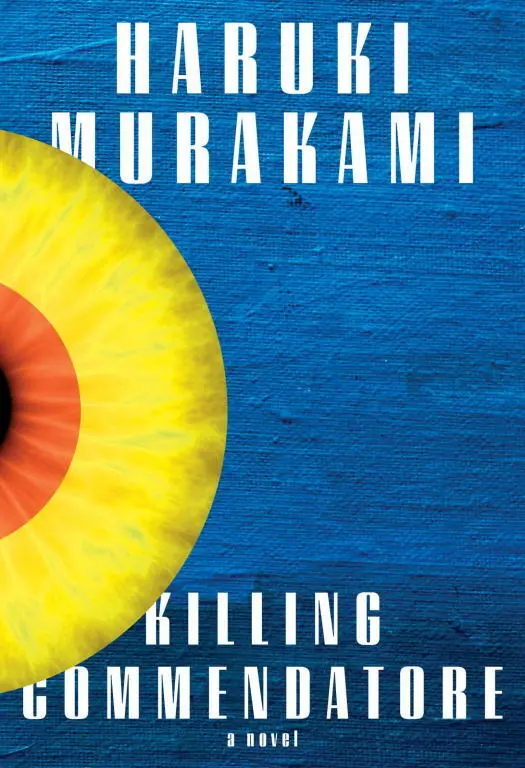
- Название:Killing Commendatore
- Автор:
- Издательство:Alfred A. Knopf
- Жанр:
- Год:2018
- Город:New York
- ISBN:978-0-5255-2005-4
- Рейтинг книги:5 / 5. Голосов: 1
-
Избранное:Добавить в избранное
- Отзывы:
-
Ваша оценка:
Killing Commendatore: краткое содержание, описание и аннотация
Предлагаем к чтению аннотацию, описание, краткое содержание или предисловие (зависит от того, что написал сам автор книги «Killing Commendatore»). Если вы не нашли необходимую информацию о книге — напишите в комментариях, мы постараемся отыскать её.
In Killing Commendatore, a thirty-something portrait painter in Tokyo is abandoned by his wife and finds himself holed up in the mountain home of a famous artist, Tomohiko Amada. When he discovers a previously unseen painting in the attic, he unintentionally opens a circle of mysterious circumstances. To close it, he must complete a journey that involves a mysterious ringing bell, a two-foot-high physical manifestation of an Idea, a dapper businessman who lives across the valley, a precocious thirteen-year-old girl, a Nazi assassination attempt during World War II in Vienna, a pit in the woods behind the artist’s home, and an underworld haunted by Double Metaphors.
A tour de force of love and loneliness, war and art—as well as a loving homage to The Great Gatsby—Killing Commendatore is a stunning work of imagination from one of our greatest writers.
Killing Commendatore — читать онлайн бесплатно полную книгу (весь текст) целиком
Ниже представлен текст книги, разбитый по страницам. Система сохранения места последней прочитанной страницы, позволяет с удобством читать онлайн бесплатно книгу «Killing Commendatore», без необходимости каждый раз заново искать на чём Вы остановились. Поставьте закладку, и сможете в любой момент перейти на страницу, на которой закончили чтение.
Интервал:
Закладка:
The Commendatore pointed his tiny index finger at the spot where his heart was. But the thought of that heart inevitably recalled my sister’s. I could remember her operation as if it were yesterday. How delicate and difficult it had been. Saving a malfunctioning heart was a formidable task. It required a team of specialists and gallons of blood. Yet destroying a heart was so easy .
“Such thinking will get us nowhere,” the Commendatore said. “If my friends wish to save Mariye Akikawa, then do the deed. Even if my friends do not want to. Trust me. Jettison all feelings, and close your mind. But not your eyes. My friends must keep them open.”
I stepped behind the Commendatore and raised the knife. But I couldn’t bring it down. Sure, it might be only one of a thousand deaths for an Idea, but it was still extinguishing a life as far as I was concerned. Was this not the same order the young lieutenant had given Tsuguhiko Amada in Nanjing?
“Negative! It is not the same,” said the Commendatore. “My friends are doing this at my behest. It is I who am asking my friends to kill me. So that I may be reborn. Be strong. Close the circle at once.”
I closed my eyes and thought of the girl I had throttled in the love hotel in Miyagi. Of course, she and I had been pretending. I had squeezed her throat gently, so as not to kill her. I had been unable to do it long enough to satisfy her. Had I continued, I might indeed have strangled her to death. On the bed of that love hotel, I had glimpsed the deep rage within myself for the first time. It had churned in my chest like blood-soaked mud, pushing me closer and closer to real murder.
I know where you were and what you were doing , the man had said.
“All right, now bring it down,” the Commendatore said. “I know my friends can do it. Remember, my friends will not be killing me. My friends will be slaying your evil father. The blood of your evil father shall soak into the earth.”
My evil father?
Where did that come from?
“Who is the evil father of my friends?” the Commendatore said, reading my mind. “I believe your path crossed with his not long ago. Am I mistaken?”
Do not paint my portrait any further , the man had said. He had pointed his finger at me from within the dark mirror. It had pierced my chest like the tip of a sharp sword.
Spurred by that pain, I reflexively closed my heart and opened my eyes wide. I cleared all thought from my mind (as Don Giovanni had done in Killing Commendatore ), buried my emotions, made my face a blank mask, and brought the knife down with all my might. The sharp blade entered the Commendatore’s tiny chest precisely where he had pointed. I felt the living flesh resist. But the Commendatore himself made no attempt to fend off the blow. His fingers clutched at the air, but apart from that he did not react. Still, the body he inhabited did all that it could to avoid its looming extinction. The Commendatore was an Idea, but his body was not. An Idea may have borrowed it for its own purposes, but that body would not meekly submit to death. It possessed its own rationale. I had to overcome that resistance through brute force, severing its life at the roots. “Kill me,” the Commendatore had said. But I was actually dispatching another someone ’s body.
I wanted to drop the knife, drop everything, and run from the room. But the Commendatore’s words echoed in my ears. “If my friends wish to save Mariye Akikawa, then do the deed. Even if my friends do not want to.”
So I pushed the blade even farther into the Commendatore’s heart. If you’re stabbing someone to death, there’s no halfway. The tip of the knife emerged from his back—I had run him through. His white garment was dyed crimson. My hands were drenched in blood. But the blood did not spew into the air as it did in Killing Commendatore . This is an illusion, I tried to convince myself. I was murdering a mere phantom. My act was purely symbolic.
Yet I knew I was fooling myself. Perhaps the act was symbolic. But it was no phantom that I was killing. Without question, my victim was made of flesh and blood. It may have been barely two feet tall, a fabrication created by Tomohiko Amada’s brush, but its life force was unexpectedly strong. The point of my blade had broken the skin and several ribs on its way to the heart, then passed through to the back of the chair. No way that was an illusion.
Tomohiko Amada’s eyes were open even wider now, riveted on the scene unfolding before him. My murder of the Commendatore. No, for him it must have been the murder of someone else. Who was he seeing? The Nazi official whose assassination he had helped plot in Vienna? The young lieutenant who had given his brother a Japanese sword and ordered him to behead three Chinese prisoners in Nanjing? Or that evil something , something more fundamental, that lay at the root of those events? I could only guess. I could not read the expression on Tomohiko Amada’s face. Though his mouth gaped open, his lips were motionless. Only his tongue continued its futile quest to form words of some kind.
At last, the strength left the Commendatore’s neck and arms. His whole body went slack, like a marionette whose strings had been cut. I responded by pushing the knife even farther into his heart. All movement in the room came to a standstill; the scene was now a frozen tableau. It stayed that way for a long time.
Tomohiko Amada was the first to move. Once the Commendatore had lost consciousness and collapsed, the strength to focus his mind evaporated. He sighed deeply and closed his eyes. Slowly and solemnly, like lowering the shutters. As if to confirm: Now I have seen what I needed to see. His mouth was still open, but his lolling tongue was tucked out of sight. Only his yellow teeth were visible, like a ramshackle fence circling an empty house. His face was free of pain. The torment had passed. He looked peaceful and relaxed. I guessed he was back in the twilight world, where thought and pain did not exist. I was happy for him.
I finally relaxed my arm and drew the blade from the Commendatore’s body. Blood spewed from the wound. Exactly as in Killing Commendatore . The Commendatore himself spilled lifelessly into the chair. His eyes were open, his mouth contorted in agony. His ten tiny fingers clawed the air. Dark blood pooled around his feet. He was dead. How much blood had come from that tiny body!
Thus did the Commendatore—or the Idea that had taken his form—meet his end. Tomohiko Amada had sunk back into his deep sleep. Standing next to the Commendatore’s body, Masahiko’s bloody knife in my right hand, I was the only conscious person left in the room. My labored breathing should have been the only sound. Should have been. But something was moving. I sensed it as much as I heard it, to my alarm. Keep your ears open , the Commendatore had told me. I did as he had instructed.
Something is in the room. I could hear it moving. Bloody knife in hand, I stood frozen like a statue, scanning the room, searching for the source of the sound. Out of the corner of one eye, I spotted something near the far wall.
Long Face was there.
Killing the Commendatore had lured Long Face into this world.
52
THE MAN IN THE ORANGE CONE HAT
The scene in the room now matched the lower left-hand corner of Tomohiko Amada’s Killing Commendatore . Long Face had poked his head out of a hole, and was raising its square cover with one hand as he peeked at what was taking place. His hair was long and tangled, and a thick black beard covered much of his face. His elongated head was shaped like a Japanese eggplant, narrow with a jutting chin and bulging eyes. The bridge of his nose was flat. For some reason, his lips glistened like a piece of fruit. His body was small but well proportioned, as if a normal person had been shrunk in size. Just as the Commendatore made you think of a scaled-down copy of a human being.
Читать дальшеИнтервал:
Закладка:
Похожие книги на «Killing Commendatore»
Представляем Вашему вниманию похожие книги на «Killing Commendatore» списком для выбора. Мы отобрали схожую по названию и смыслу литературу в надежде предоставить читателям больше вариантов отыскать новые, интересные, ещё непрочитанные произведения.



Обсуждение, отзывы о книге «Killing Commendatore» и просто собственные мнения читателей. Оставьте ваши комментарии, напишите, что Вы думаете о произведении, его смысле или главных героях. Укажите что конкретно понравилось, а что нет, и почему Вы так считаете.