Харуки Мураками - Killing Commendatore
Здесь есть возможность читать онлайн «Харуки Мураками - Killing Commendatore» весь текст электронной книги совершенно бесплатно (целиком полную версию без сокращений). В некоторых случаях можно слушать аудио, скачать через торрент в формате fb2 и присутствует краткое содержание. Город: New York, Год выпуска: 2018, ISBN: 2018, Издательство: Alfred A. Knopf, Жанр: Современная проза, на английском языке. Описание произведения, (предисловие) а так же отзывы посетителей доступны на портале библиотеки ЛибКат.
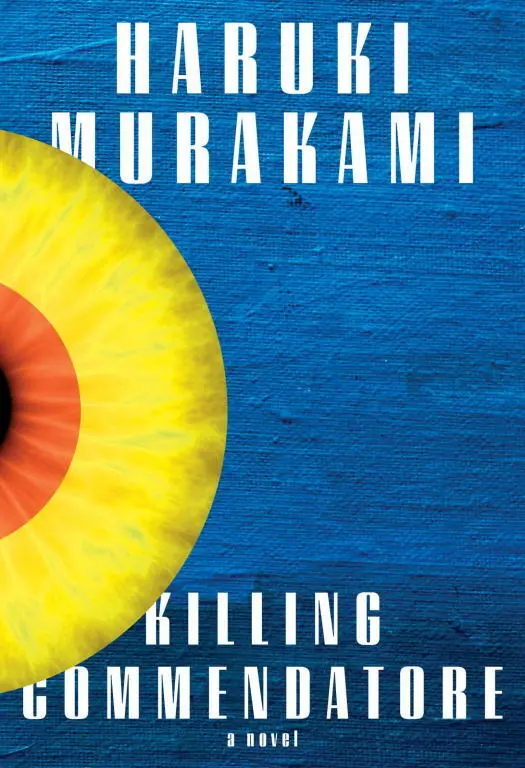
- Название:Killing Commendatore
- Автор:
- Издательство:Alfred A. Knopf
- Жанр:
- Год:2018
- Город:New York
- ISBN:978-0-5255-2005-4
- Рейтинг книги:5 / 5. Голосов: 1
-
Избранное:Добавить в избранное
- Отзывы:
-
Ваша оценка:
Killing Commendatore: краткое содержание, описание и аннотация
Предлагаем к чтению аннотацию, описание, краткое содержание или предисловие (зависит от того, что написал сам автор книги «Killing Commendatore»). Если вы не нашли необходимую информацию о книге — напишите в комментариях, мы постараемся отыскать её.
In Killing Commendatore, a thirty-something portrait painter in Tokyo is abandoned by his wife and finds himself holed up in the mountain home of a famous artist, Tomohiko Amada. When he discovers a previously unseen painting in the attic, he unintentionally opens a circle of mysterious circumstances. To close it, he must complete a journey that involves a mysterious ringing bell, a two-foot-high physical manifestation of an Idea, a dapper businessman who lives across the valley, a precocious thirteen-year-old girl, a Nazi assassination attempt during World War II in Vienna, a pit in the woods behind the artist’s home, and an underworld haunted by Double Metaphors.
A tour de force of love and loneliness, war and art—as well as a loving homage to The Great Gatsby—Killing Commendatore is a stunning work of imagination from one of our greatest writers.
Killing Commendatore — читать онлайн бесплатно полную книгу (весь текст) целиком
Ниже представлен текст книги, разбитый по страницам. Система сохранения места последней прочитанной страницы, позволяет с удобством читать онлайн бесплатно книгу «Killing Commendatore», без необходимости каждый раз заново искать на чём Вы остановились. Поставьте закладку, и сможете в любой момент перейти на страницу, на которой закончили чтение.
Интервал:
Закладка:
“Affirmative! As far as my friends are concerned, I shall be dead and gone. One of the countless deaths an Idea must undergo.”
“Isn’t there a danger that the world itself will be altered when an Idea is killed?”
“How could it be otherwise?” the Commendatore said. Again, he raised one eyebrow, Lee Marvin–style. “What would be the meaning of a world that did not change when an Idea was extinguished? Can an Idea be so insignificant?”
“But you think I should still kill you, even though the world would be altered as a result.”
“My friends set me free. And now my friends must kill me. Should my friends fail in that task, the circle would remain open. And a circle once opened must then be closed. There are no other options.”
I looked at Tomohiko Amada, lying on the bed. His eyes seemed to be trained on the chair where the Commendatore was sitting.
“Can Mr. Amada see you?”
“It is about now that he should be seeing me,” the Commendatore said. “And hearing our voices too. A few moments hence, he will begin to grasp the import of our discourse. He is marshaling all his remaining strength to that end.”
“What do you think he was trying to convey in Killing Commendatore ?”
“That is not for me to say. My friends should ask the artist,” the Commendatore said. “Since he is right before you.”
I sat back down in my chair and drew close to the man stretched out on the bed.
“Mr. Amada, I found the painting you stored in the attic. I am quite sure you meant to hide it. You would not have wrapped it so thoroughly had you planned to show it to anyone. But I unwrapped it. I know that may displease you, but my curiosity got the better of me. And once I discovered how superb Killing Commendatore was, I couldn’t let it out of my sight. It is a great painting. One of your best, no question. At this moment, almost no one knows of its existence. Even Masahiko hasn’t seen it yet. A thirteen-year-old girl named Mariye Akikawa has, though. And she went missing yesterday.”
The Commendatore raised his hand. “Please, let him rest. His brain is easily overtaxed—it cannot handle more than this at one time.”
I stopped talking and studied Tomohiko Amada’s face. I couldn’t tell how much had sunk in. His face was still expressionless. But when I looked more closely I could see a glitter in the depths of his eyes. Like the glint of a sharp penknife at the bottom of a deep spring.
I began talking again, this time with frequent pauses. “My question is, what was your purpose in painting that picture? Its subject matter, its structure, and its style are so different from your other works. It makes me think you were using it to communicate a very personal message. What is the painting’s underlying meaning? Who is killing whom? Who is the Commendatore? Who is the murderer Don Giovanni? And who is that mysterious bearded fellow with the long face poking his head out of the ground in the lower left-hand corner?”
The Commendatore raised his hand again. I drew up short.
“Enough questions,” he said. “It will take a while for those to permeate.”
“Will he be able to answer? Does he have enough strength left?”
“No,” the Commendatore said, shaking his head. “I doubt my friends will obtain answers. He does not have the energy for that.”
“Then why did you have me ask?”
“What my friends imparted were not questions, but information. That my friends had found Killing Commendatore in the attic, that its existence was known to my friends. It is the first step. Everything begins from there.”
“Then what is the second step?”
“When my friends slay me, of course. It is the second step.”
“And is there a third step?”
“There should be, of course.”
“Then what is it?”
“Have you still not yet figured this out, my friends?”
“No, I haven’t.”
“By reenacting the allegory contained within that painting, we shall lure Long Face into the open. Into this room. By dragging him out, my friends shall win back Mariye Akikawa.”
I was speechless. What world had I stepped into? There seemed no rhyme or reason to it.
“It is a hard thing, without question,” the Commendatore intoned. “Yet there is no alternative. Hence my friends must dispatch me now, without further ado.”
We waited for the information I had given Tomohiko Amada to complete its journey to his brain. That took some time. Meanwhile, I tried to put to rest some of my doubts by peppering the Commendatore with questions.
“Why,” I asked, “did Tomohiko Amada remain silent about what had happened in Vienna even after the war had ended? I mean, no one was standing in his way at that point.”
“The woman he loved was brutally executed by the Nazis,” the Commendatore answered. “Slowly tortured to death. Their comrades were slain in a similar fashion. In the end, their plot was a wretched failure. Only through the offices of the Japanese and German governments did he barely escape with his life. The experience savaged him. He had been arrested and detained by the Gestapo for two months. They subjected him to extreme torture. Their violence was unspeakable, but they took care not to kill him, nor to leave any physical scars. Yet their sadism left his nerves in tatters—and as a result, something within him was extinguished. Placed under the strictest orders, he bowed to the inevitable and remained silent. Then he was forcibly repatriated to Japan.”
“Not long before,” I said, “Tomohiko Amada’s younger brother had taken his own life, probably because of the trauma of his own war experience. He had been part of the Nanjing Massacre, and committed suicide right after his discharge from the army. Correct?”
“Affirmative. Tomohiko Amada lost many loved ones in the whirlpool of those years. He himself was sorely damaged. As a result, his anger and grief put down deep roots. The hopeless, impotent realization that, no matter what he did, he could not stand against the torrent of history. As the sole survivor, he must also have felt an immense guilt. Hence he never spoke a word of what happened in Vienna, even after the gag was removed. It is as though he was unable to speak.”
I looked at Tomohiko Amada’s face. But I could detect no reaction as yet. I couldn’t tell if he heard us or not.
I spoke. “Then at some point—we don’t know exactly when—he created Killing Commendatore . An allegorical painting that expressed all he could not say. He put everything into it. A brilliant tour de force.”
“He took that which he had been unable to accomplish in reality,” the Commendatore said, “and gave it another form. What we might call ‘camouflaged expression.’ Not of what had in fact happened, but of what should have happened .”
“Nevertheless, he bundled the painting up tight and hid it in the attic, out of public view,” I said. “Although he had radically transformed the events, they were still too raw to reveal. Is that what you mean?”
“Precisely. It distills the pure essence of his living spirit. Then, one day, my friends happened upon it.”
“So are you saying all of this began when I brought the painting out into the light? Is that what you meant by ‘opening the circle’?”
The Commendatore said nothing, just extended his hands palms up.
Not long after, we noticed Tomohiko Amada’s face turning pink. (The Commendatore and I had been watching him closely for any change.) At the same time, as if in response, the small, mysterious light that had been flickering deep in his eyes began to rise slowly to the surface. Like an ascending deep-sea diver gauging the effects of the water pressure on his body. The veil covering Amada’s eyes also lifted, until, finally, both were wide open. The person lying before us was no longer a frail, desiccated old man on the verge of death. Instead, he was someone whose eyes brimmed with a determination to hang on to this world as long as he could.
Читать дальшеИнтервал:
Закладка:
Похожие книги на «Killing Commendatore»
Представляем Вашему вниманию похожие книги на «Killing Commendatore» списком для выбора. Мы отобрали схожую по названию и смыслу литературу в надежде предоставить читателям больше вариантов отыскать новые, интересные, ещё непрочитанные произведения.






Обсуждение, отзывы о книге «Killing Commendatore» и просто собственные мнения читателей. Оставьте ваши комментарии, напишите, что Вы думаете о произведении, его смысле или главных героях. Укажите что конкретно понравилось, а что нет, и почему Вы так считаете.