Джоха Альхарти - Celestial Bodies
Здесь есть возможность читать онлайн «Джоха Альхарти - Celestial Bodies» весь текст электронной книги совершенно бесплатно (целиком полную версию без сокращений). В некоторых случаях можно слушать аудио, скачать через торрент в формате fb2 и присутствует краткое содержание. Год выпуска: 2018, ISBN: 2018, Издательство: Sandstone Press Ltd, Жанр: Современная проза, на английском языке. Описание произведения, (предисловие) а так же отзывы посетителей доступны на портале библиотеки ЛибКат.
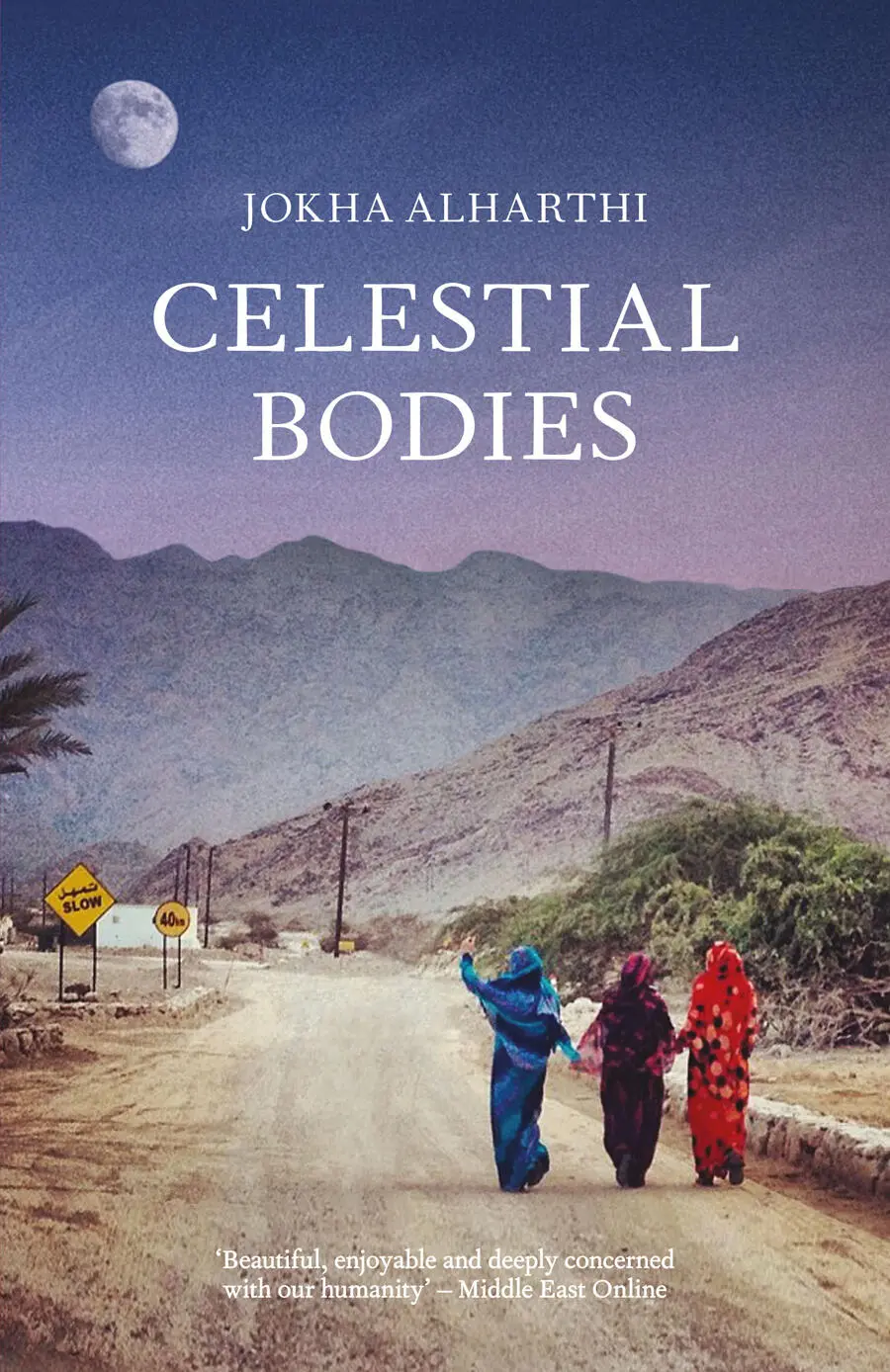
- Название:Celestial Bodies
- Автор:
- Издательство:Sandstone Press Ltd
- Жанр:
- Год:2018
- ISBN:978-1-912240-16-6, 978-1-912240-17-3
- Рейтинг книги:5 / 5. Голосов: 1
-
Избранное:Добавить в избранное
- Отзывы:
-
Ваша оценка:
Celestial Bodies: краткое содержание, описание и аннотация
Предлагаем к чтению аннотацию, описание, краткое содержание или предисловие (зависит от того, что написал сам автор книги «Celestial Bodies»). Если вы не нашли необходимую информацию о книге — напишите в комментариях, мы постараемся отыскать её.
Celestial Bodies — читать онлайн бесплатно полную книгу (весь текст) целиком
Ниже представлен текст книги, разбитый по страницам. Система сохранения места последней прочитанной страницы, позволяет с удобством читать онлайн бесплатно книгу «Celestial Bodies», без необходимости каждый раз заново искать на чём Вы остановились. Поставьте закладку, и сможете в любой момент перейти на страницу, на которой закончили чтение.
Интервал:
Закладка:
Ankabuta
On the 25th of September 1926, Ankabuta was roaming the sparse expanse outside of town, bending over to pick up the few branches she could find, when the first pangs came. As she saw to the birth of her own daughter, with a rusty knife to separate the baby’s life from her own, the men gathered in Geneva signed an accord. Their signatures abolished slavery and criminalised the slave trade. It was Ankabuta’s fifteenth birthday but she was as unaware of that as she was that the world held a place called Geneva.
Ankabuta ripped her dusty head veil in half to make a wrapping for her newborn baby, and she stuffed the other half up herself to stop the blood. Barefoot, her face uncovered, she walked back to al-Awafi. At Shaykh Said’s house — which with the birth had just gained another slave-girl — the women helped her inside. Ankabuta lay down on the reed matting and witnessed her daughter’s date-feeding ritual. The women had crushed a date and put it gently in the newborn’s mouth, taking it out seconds later, just as women of the Prophet’s time, they’d always heard, had done. When they lay the baby down beside her, Ankabuta burst into tears at the sight of the tiny wrinkled body wrapped in half her head scarf. It was the only cloth she owned that hadn’t been ripped apart by the wood she had to gather. Yes, it was only a white one — not dyed indigo like her other one, which was nearly in shreds — but it was strongly woven and held its shape. If it hadn’t turned the colour of dust she would have said it was new, and now here she had lost it.
A week later the shaykh announced that the newborn girl’s name was Zarifa. Unfortunately, because things had been so bad since the spoilage of the date harvest, he would not be in a position to slaughter a ritual animal. Sixteen years later he would sell the girl to Merchant Sulayman. She would become a slave worker and a concubine. She would be his beloved, and the only woman who was ever close to him, while he was the only man she would love and respect, and that until the day of her death. In him she saw her liberator from the insults of Shaykh Said’s sons, and the beloved who showed her the pleasures of the body, as the instigator of the game of harshness and jealousy. In the end, he was the elderly shaykh who returned to her embrace to die.
Abdallah
At first Zayid was coming back to al-Awafi every Friday, handing out fruit, even to his neighbours. He hardly ever took off his uniform, even when he was with Suwayd, listening to him play his oud. But when no one poured coffee for him at the wake after Zayd died, leaving him to pour it himself, he knew that the villagers would never see him as a real officer. In their eyes he would always be Zayid, the son of Maneen, the wretch who begged from folks. Al-Awafi’s people were firm believers in the past; they did not look to the future. Gradually Zayid stopped engaging in the life of the village. After he found an Indian maidservant for his father, his visits dwindled, until he was only making the obligatory appearances on the major holy feast days.
Years after his father’s murder we heard suddenly that Zayid had got married. He did not come back to al-Awafi for the occasion. His bride — Hafiza’s second and prettiest daughter — became his wife with a celebration at the Muscat Sheraton. The wedding party he arranged there was not attended by anyone from their village except the bride, her two sisters and her mother.
Hafiza couldn’t have been more than seventeen when she got pregnant for the first time. Her mother Saada seized her by her hair and started pummelling her, but the neighbour women winked and let Saada know what the word was in the neighbourhood. No surprises here, Saada, she’s cut from the same cloth! Before her, it was her father’s sister, the slut was always lolling in the streets, wasn’t she? So her mother left her alone. When the baby girl slipped out of her mama’s body, her skin several shades darker than her mother’s or grandmother’s, Saada asked Hafiza again. Who is this bastard’s father? Hafiza answered as she had before. I told you, Mama, if it wasn’t Zaatar then it was either Marhun or Habib. Her mother shook her head and left her to her own devices.
When Hafiza emerged from her forty days of confinement Judge Yusuf sentenced her to a hundred lashes. Her mother stuffed a big canvas sack with whatever old rags and shirts she could find and tied it onto Hafiza’s back hoping she wouldn’t feel the lashes. I snuck in along with the other boys — we hid among the crowds that had collected to watch the punishment carried out. But not even two years later, Hafiza delivered her second daughter. This time, the baby had very pale skin. And the sentence changed. By then, Judge Yusuf was a magistrate under the jurisdiction of the Sultan, though earlier he had regarded himself as issuing his judgements under the last Imam Ghalib bin Ali’s authority, even after the Imam was defeated and had to leave Oman. The Sultan’s government did not prescribe the Sharia punishments for adultery, and so Judge Yusuf did not order the woman whipped. Some of the elders proposed that Hafiza be sent to prison but no one paid much attention any more. People whispered that the newborn looked a lot like Shaykh Said’s youngest son: she was his spitting image, in fact, they said. Yet again, though, Hafiza said she wasn’t certain who the father was. That’s when she got her nickname, Bas ish-Shaab, Everyone’s Bus. Three more years and her third daughter appeared. This one looked more or less like her own mother, and she was the last of the daughters. Soon after, someone steered Hafiza to birth control pills.
Did I doze off? Why am I so thirsty? Zarifa used to warn me about going to sleep thirsty. The sleeper who’s parched, she would always say, finds his soul has left him to search, looking for something to quench his thirst. I always drank two or three glasses of water before going to bed, afraid that my soul would leave me and never return, like the man who fell asleep thirsty and his soul left him to drink from a big water jar. While it was in there drinking the lid was clamped over this soul of his. It couldn’t go back to him. As they were getting ready to bury him the next morning, someone lifted the lid to get a drink himself, and the man’s soul came rushing back to him.
After I stole my father’s rifle for the magpies that I never tasted, my father hung me upside down and tied up in the well, to punish me, and I did go to sleep even though I was very thirsty. Many nightmares later, Masouda finally relented and told me about my mother.
Abdallah, my boy, the proverb-maker says: Daytime’s for people but night-time’s for the jinn. Your mama, God rest her soul in paradise, was out walking at night. She just flung away a pebble that got in her sandal perhaps. She didn’t know it, but she’d hit the jinni-woman’s son in the head. That jinni-woman was the servant of the Shaykhs of the Jinn. She came to your mama and she said, Pull up the basil bush in the courtyard, its smell draws vipers, and soon your son will get old enough to play there and he’ll be bitten. Your mama, God take her soul to paradise, thought the jinni-woman was a poor and ordinary woman and she believed her. So at dawn she cut down the basil bush, which angered the Shaykh of the Jinn who lived beneath it. He made the poor woman sick. Two or three days, no more, and she was dead, may God keep her soul in Paradise.
When I got older, and when Shanna tried to tempt me out on the farm and I said no, she pulled her clothes together around herself and screamed, Your mama isn’t dead, she’s alive! They bewitched her and then they took her away. They put a plank of wood where she’d been lying down, and your papa buried it, and so your mother lost her mind. The wizard took her mind away and made her his servant. My father saw her once at night, outside town. She was all in white.
Читать дальшеИнтервал:
Закладка:
Похожие книги на «Celestial Bodies»
Представляем Вашему вниманию похожие книги на «Celestial Bodies» списком для выбора. Мы отобрали схожую по названию и смыслу литературу в надежде предоставить читателям больше вариантов отыскать новые, интересные, ещё непрочитанные произведения.










Обсуждение, отзывы о книге «Celestial Bodies» и просто собственные мнения читателей. Оставьте ваши комментарии, напишите, что Вы думаете о произведении, его смысле или главных героях. Укажите что конкретно понравилось, а что нет, и почему Вы так считаете.