Джоха Альхарти - Celestial Bodies
Здесь есть возможность читать онлайн «Джоха Альхарти - Celestial Bodies» весь текст электронной книги совершенно бесплатно (целиком полную версию без сокращений). В некоторых случаях можно слушать аудио, скачать через торрент в формате fb2 и присутствует краткое содержание. Год выпуска: 2018, ISBN: 2018, Издательство: Sandstone Press Ltd, Жанр: Современная проза, на английском языке. Описание произведения, (предисловие) а так же отзывы посетителей доступны на портале библиотеки ЛибКат.
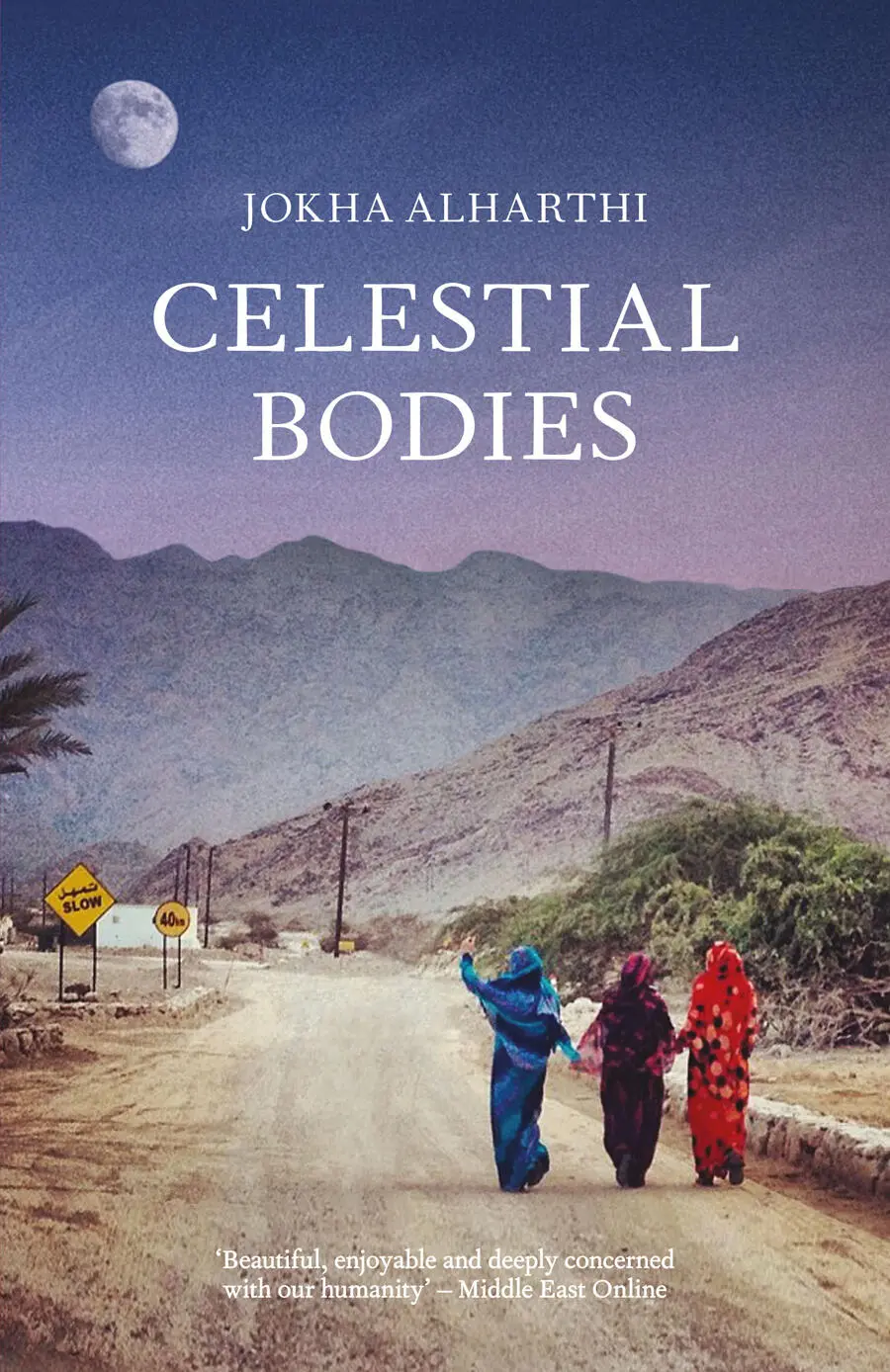
- Название:Celestial Bodies
- Автор:
- Издательство:Sandstone Press Ltd
- Жанр:
- Год:2018
- ISBN:978-1-912240-16-6, 978-1-912240-17-3
- Рейтинг книги:5 / 5. Голосов: 1
-
Избранное:Добавить в избранное
- Отзывы:
-
Ваша оценка:
Celestial Bodies: краткое содержание, описание и аннотация
Предлагаем к чтению аннотацию, описание, краткое содержание или предисловие (зависит от того, что написал сам автор книги «Celestial Bodies»). Если вы не нашли необходимую информацию о книге — напишите в комментариях, мы постараемся отыскать её.
Celestial Bodies — читать онлайн бесплатно полную книгу (весь текст) целиком
Ниже представлен текст книги, разбитый по страницам. Система сохранения места последней прочитанной страницы, позволяет с удобством читать онлайн бесплатно книгу «Celestial Bodies», без необходимости каждый раз заново искать на чём Вы остановились. Поставьте закладку, и сможете в любой момент перейти на страницу, на которой закончили чтение.
Интервал:
Закладка:
Neither exertion nor acceptance can I claim to possess
only a mere affinity in which I find my pride
Nor have I strength to wish myself into their clutches
how can my wished-for goal be theirs and not be wrong?
My purpose is to see no willed-for purpose there
the essence of will this is, the wish-eye of the blind.
As time went on, Najiya began reacting to Azzan’s nervous poetic intensity by recoiling from any mention of poetry, Or at least she tried to place limits on it in her own mind, by reducing anything smacking of poetry to her own fancies about these poets who had loved life, or who had gone over the edge as a result of meeting beautiful women, among whom she saw herself, of course, and especially Layla, beloved of al-Majnun, the Crazed.
Abdallah
My aunt is enormously tall. When I was little I used to think of her as a skeletal minaret soaring over a mosque and casting a threadlike shadow. Something about the fact that she was taller than Zarifa aggravated me, though she couldn’t compete with Zarifa in overall bulk. That, at least, made me feel a bit better. Zarifa’s bosom was splendidly ample for a little boy to snuggle into and sleep. When she hugged me her hands and arms practically buried me alive. My aunt, on the other hand, had no chest to speak of. Gold rings brightened her thin white hand. Both wrists were swaddled in a dozen heavy, intricately-worked bracelets that made their own distinct clanging whenever she lifted an arm to point her thin fingers aggressively at someone. I couldn’t imagine her hands engaged in any activity, except for poking their skinny fingers imperiously into the faces of others.
I did not understand the secret behind her never-ending presence in my father’s house even though she had been married to a maternal cousin of hers who lived in another town. She was scornful of everyone and treated them with an eccentric, exaggerated etiquette that belittled them mercilessly. She didn’t have much to say. When the neighbourhood women came by, out of politeness, when she was in our house, she would barely touch their hands in greeting, quickly and ostentatiously pulling back her own heavily hennaed fingertips, inviting them to sit down as she made a clear sign to Zarifa to bring the coffee in quickly. They would sit down and exchange hasty, abrupt words, almost cutting each other off, as if the fact of her severe presence prevented them from holding more drawn-out or relaxed conversations. As soon as they finished their dates and coffee my aunt would shift in her seat and they would get up to leave immediately as if shrugging the duty of the visit off their shoulders. There was an unspoken understanding that they were absolutely not to bring their children. My aunt despised children more than she did anything or anyone else.
The sharp crevices in my aunt’s face contrasted with Zarifa’s broad, flat face. She was the only one who treated Zarifa like any other slave and would never acknowledge her status — which everyone recognised even if no one ever said anything — as the person in charge of my father’s household, not to mention his long-time mistress. My aunt was determined, even throughout the long stretches when my father was very ill, to sit right outside his room, opposite the doorway, just so that her presence would prevent Zarifa from ever slipping in to see him.
She and my father practised an elaborate ritual of mutual respect that was acutely embarrassing in its obvious artificiality. But for these long strings of greetings they exchanged, which followed exactly the same pattern every time, they never said a word to each other. Only when I was much older did I understand the extent to which their demonstrations of respect carried a profound contempt that extended to hatred. If she was directing a silent war against Zarifa, my father’s presence and the fact of their relationship enabled Zarifa to show her enmity toward my aunt in front of us: we little ones, all of the slaves, and indeed everyone in al-Awafi. Zarifa usually focused her disparagements of my aunt on her lack of luck with men: she had been divorced twice, by two brothers and, Zarifa said, that dry, sticklike body of hers was barren.
But Zarifa could not completely conceal her fear of my aunt. Perhaps that’s why, soon after my father died, she left the Big House and went to join her son in Kuwait.
Asma
After a three-day shopping trip to Muscat with her prospective son-in-law and his mother, Salima returned to al-Awafi loaded down with Asma’s wedding things, which she had gotten from the shops in Matrah where you could find every conceivable wedding item. But, she confided to Muezzin-Wife, she wasn’t overjoyed with her purchases. There’s nicer things out there, she said, and Asma deserves them. But her father — may God ease his path — refused to set a dowry payment for the bridegroom.
Is my daughter a piece of merchandise to be sold? That’s what he snapped at me when I asked. Her dowry will be the same as anyone else’s, he said to me. So her fiancé only paid two thousand riyals, since he wasn’t asked to come up with any more than that. His mama was silent the whole time. It seems that she’s been away from her home town too long to remember how we do things here.
Still, Salima spread out the purchases for display, as they watched: Asma, Khawla, the muezzin’s wife, Judge Yusuf’s widow, Umm Nasir and three more women who lived nearby. Their outstretched hands competed to turn over and examine the shimmering silk fabric that Mayya would make into dishdashas and sirwals, all heavily embroidered, for the bride. Salima brought out the translucent head wrappings, green cloth embroidered along the edges in gold flowers, and others with sequins sewn into their borders.
Though she did her best to resist, at least for a few minutes, Khawla had to reach for the shiny pair of high-heeled sandals: Salima levelled a warning glance at her as she tried them on. Once everyone had had her say about the fabrics, Salima opened the perfume chest: two bottles of French perfume that Salima had bought because the mother of the groom insisted, though she would have preferred to put the money into a third vial of pure oud perfume.
Muezzin-Wife laughed. Salima, oud has turned your senses! Surely one bottle is enough for this bride.
Salima answered earnestly. How can you have a bride without plenty of oud? Look at the incense, I bought two kinds for her: real, pure Cambodian aloes-wood oil and the best incense, from Salalah. Khawla, heat up some coals and we’ll try it out.
Khawla jumped up and hurried toward the kitchen. Asma was muttering. Mama, incense chokes me. I wish you had bought me more perfume instead.
Quiet, you don’t understand anything, Salima said, bringing out the chest that held the gold. Did you ever hear of a bride getting married without incense? What an awful scandal that would be!
The women’s shining eyes replicated and doubled the gold’s lustre as they inspected it: a heavy link necklace, one with several thin strands, rings bearing a variety of stones, and a diamond ring, a gift from the groom’s mother. There were also thin bangles and one broad and heavy spiked bracelet.
In our days the jewellery was silver, remarked one of the neighbours. Praise God — how times have changed.
True, said another, it was silver, but at least we had anklets, enough to announce that one of us was coming with the ringing they made against each other, and the bracelets we wore high up on our arms. And the hair ornaments, too.
Salima was clearly irritated. You know girls these days, they don’t like wearing anklets or our heavy armlets.
Of course not, said Asma. I don’t want to wear things that are going to scratch up my legs and feet.
Читать дальшеИнтервал:
Закладка:
Похожие книги на «Celestial Bodies»
Представляем Вашему вниманию похожие книги на «Celestial Bodies» списком для выбора. Мы отобрали схожую по названию и смыслу литературу в надежде предоставить читателям больше вариантов отыскать новые, интересные, ещё непрочитанные произведения.










Обсуждение, отзывы о книге «Celestial Bodies» и просто собственные мнения читателей. Оставьте ваши комментарии, напишите, что Вы думаете о произведении, его смысле или главных героях. Укажите что конкретно понравилось, а что нет, и почему Вы так считаете.