Джоха Альхарти - Celestial Bodies
Здесь есть возможность читать онлайн «Джоха Альхарти - Celestial Bodies» весь текст электронной книги совершенно бесплатно (целиком полную версию без сокращений). В некоторых случаях можно слушать аудио, скачать через торрент в формате fb2 и присутствует краткое содержание. Год выпуска: 2018, ISBN: 2018, Издательство: Sandstone Press Ltd, Жанр: Современная проза, на английском языке. Описание произведения, (предисловие) а так же отзывы посетителей доступны на портале библиотеки ЛибКат.
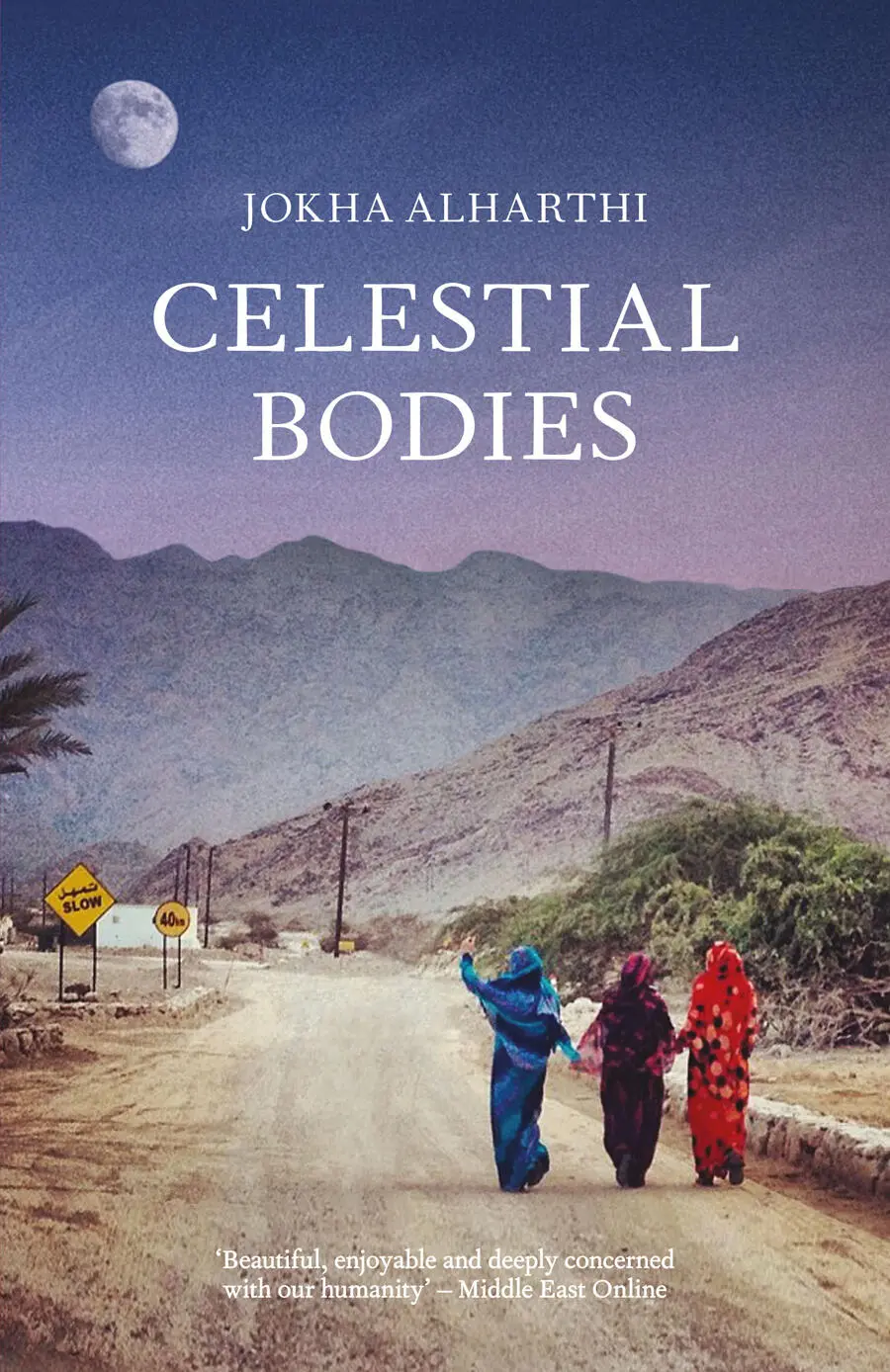
- Название:Celestial Bodies
- Автор:
- Издательство:Sandstone Press Ltd
- Жанр:
- Год:2018
- ISBN:978-1-912240-16-6, 978-1-912240-17-3
- Рейтинг книги:5 / 5. Голосов: 1
-
Избранное:Добавить в избранное
- Отзывы:
-
Ваша оценка:
Celestial Bodies: краткое содержание, описание и аннотация
Предлагаем к чтению аннотацию, описание, краткое содержание или предисловие (зависит от того, что написал сам автор книги «Celestial Bodies»). Если вы не нашли необходимую информацию о книге — напишите в комментариях, мы постараемся отыскать её.
Celestial Bodies — читать онлайн бесплатно полную книгу (весь текст) целиком
Ниже представлен текст книги, разбитый по страницам. Система сохранения места последней прочитанной страницы, позволяет с удобством читать онлайн бесплатно книгу «Celestial Bodies», без необходимости каждый раз заново искать на чём Вы остановились. Поставьте закладку, и сможете в любой момент перейти на страницу, на которой закончили чтение.
Интервал:
Закладка:
Your son went mad, Zarifa. No, it wasn’t on account of the viper he married, that woman who was so rebellious and so disrespectful to her mother, it wasn’t she who insinuated these ideas in his head. It was the seed, the one his father carefully planted before he could disappear.
Ayy, Habib! The more I wanted to forget you and the wretched trouble you made, the larger your seed grew in my eyes, grew and grew until the pressure was too great and my eyes exploded.
Merchant Sulayman — who raised him and supported him, and put him through school — he called the raving mad old man .
Can’t he see that we grew up by the grace of that old man? If it weren’t for him, we’d be begging in the streets now or calling out to passers-by for a mouthful of rice, like pitiful Maneen does.
Free... we are free.
This boy Sanjar wants to disrespect you and leave, just like his wife the viper scorned her mother and left her to the charity of the neighbourhood women.
Poor, poor Masouda. Yes, she was jealous of you, Zarifa, all those days when you didn’t have to go out into the desert at sunrise to gather wood as she did. All of your work was inside the house, and when you went out to draw water from the falaj, you used the outing as an opportunity to visit the women you liked in the neighbourhood. But she, poor thing, had to bend double from the burden of the wood on her back, day after day, year after year.
She was patient about all the toil and misery, and about her husband. No sooner would Zayd finish with one woman than he would go after another. What do you have to say, Zarifa? Seek God’s forgiveness! The dead deserve only mercy. God have mercy on him, he was also my relative. And the proverb-maker says: Your nose is still your own even if it’s putrid to the bone. God give him mercy.
Now, here’s her girl Shanna, with eyes like a tiger’s — but who do you blame, Zarifa? You insisted that Sanjar marry her because you worried over him. Are you at peace now? He wants to go far away, and he says to you, Come with us.
Go with you where? So, we should leave the land that’s ours, the place where we live, the country of our family and our ancestors for some strange world where we don’t know the people or what’s what? And Merchant Sulayman — who will watch after him? Who will bake his bread? His sister whose nose is permanently in the air? What she did to poor Fatima, to that poor woman, mother of Abdallah! God give her mercy. People have no mercy in this world.
How can you leave al-Awafi, Zarifa, when you barely know any other spot in God’s wide world? It’s all your fault, Habib, all of it. The words you kept repeating in front of Sanjar when the boy was still in nappies.
Your wild savage laugh in the depths of the night still tears my heart apart. Your country and your ancestors’ country? What ancestors, Zarifa? Your ancestors aren’t from here. They were as black as you are, they were from Africa, from the lands from where they stole you, all of you, and sold you.
It’s useless, Zarifa, to try telling this man that no one stole you. That you were born a slave because your mother was a slave and that’s the way life is. That slavery passes to you from your mother. That no one stole you, and al-Awafi is your place, its people are yours.
Habib spat in your face whenever you said such things to him. He did not want to banish that memory, to forget the terrifying journey that ended his calm, pleasant life in Makran. The second child of his mother who had five boys in all, he remembers everything: the local gangs that attacked their village wanting money, or perhaps to pay old scores; the merchants, a jumble of Baluchs and Arabs, who bought them, there on the plains; the filthy crammed ships those merchants packed them into; the eye disease that spread fast from one child to the next on shipboard; his mother’s screaming for her other children, who’d been shoved onto other boats; the nursing baby who died of smallpox while on her breast, so the slave traders snatched him away and threw him into the sea.
We are free. They stole us, and then they sold us! he would scream in the middle of the night, at dawn, in the zar exorcisms: Free! They did us wrong, they destroyed us. Free!
He and his mother were sold when they reached the east coast of Oman. The slave traders sold them to other slave traders, until finally Merchant Sulayman bought them. Habib’s mother wept for years. People in al-Awafi were sympathetic when they heard her story, but no one could find out where her other children had been sent, and as for her being returned to her own land, that was out of the question. Anyway, highwaymen and pirates would simply steal her and sell her again. There was no doubt about that in anyone’s mind.
Azzan and Qamar
Azzan held Najiya’s face between his hands as he repeated the lines that Majnun had said to his Layla.
Light the dimness with your glow once the full moon dips
and shine in the sun’s stead whilst lazy dawn tarries
Your radiance outdoes the brightest sun there be:
it can never thieve your smile, steal your pearly mouth
The resplendent night, your countenance! tho’ the full moon rise
a moon bereft of your breast, of this graceful throat I see
Whence would the morning sun ever find a ready kohl-stick
to etch for its pale face these languid eyes of yours?
What starry siren can mime coy Layla when her form spirals away
or her eyes, the winsome startled pools of the sands’ wild mare?
Najiya laughed quizzically. The sands’ wild mares?
Azzan stroked her face. This is the most beautiful sort of animal, Qamar, and Layla’s Crazed Lover tells you for certain, Qamar, my Moon, that your beauty is a gift from the Creator. That from you streams more light than the sun and moon together can ever give, and that your eyes are more beautiful than the eyes of the wild desert mare.
Her beauty was so strong it hurt him; her sharp glow splintered his chest with a murky roiling pain. All he could do then was to recite poetry to her. Before she knew him, names like al-Mutanabbi, Ibn al-Rumi, al-Buhturi, and Majnun Layla — Layla’s Crazed Lover — were just pale ghosts from books, lifeless figures that belonged to the hated world of school and the boring books full of words they’d had to memorise. Azzan made these dead images breathe. Najiya began to feel al-Mutanabbi’s insomnia, his ambitions and his frustrations, as if they were her own. She imagined al-Buhturi sitting on the right hand of the Caliph Mutawakkil, the two of them gazing out across the lake that al-Buhturi immortalised in his poetry. The image of Imru’l-Qays pursued by the night that lowered its curtains over him like the waves of the sea dazzled her. Now, she would end her long evening chats with Azzan by chanting Imru’l-Qays’s words — al-yawmu khamrun wa-ghadan amrun — Wine we’ll drink today, tomorrow’s command they’ll bray — to remind him of the heavy tasks that were waiting for her the next day. Though she felt some sympathy for al-Maarri in his blindness, she didn’t understand his poems nor did she like his insistence that the surface of the earth is made of nothing but the remnants of bodies. Najiya was all for life. She was passionate about it, and poetic lines that celebrated love and the tribal zeal of old delighted her. She could not warm up to poems of quiet contemplation, a puritan withdrawal from life, or the Sufi mystical way.
It didn’t help that Azzan would sink into a state of gloom at the very thought of the late Judge Yusuf with whom he had learned this poetry and the Sufi way of spiritual passion that sat so uneasily now, for him, with his cravings for Najiya. One day she witnessed Azzan slide into an unfathomable grief after he began repeating the lines by Shaykh Said, son of Khalfan al-Khalili, who had been, he told her, an important scholar and political leader of their region in the nineteenth century, the right-hand man of the Imam Azzan, son of Qays, and at the same time a man of steely will who could renounce worldly things.
Читать дальшеИнтервал:
Закладка:
Похожие книги на «Celestial Bodies»
Представляем Вашему вниманию похожие книги на «Celestial Bodies» списком для выбора. Мы отобрали схожую по названию и смыслу литературу в надежде предоставить читателям больше вариантов отыскать новые, интересные, ещё непрочитанные произведения.





Обсуждение, отзывы о книге «Celestial Bodies» и просто собственные мнения читателей. Оставьте ваши комментарии, напишите, что Вы думаете о произведении, его смысле или главных героях. Укажите что конкретно понравилось, а что нет, и почему Вы так считаете.