Джоха Альхарти - Celestial Bodies
Здесь есть возможность читать онлайн «Джоха Альхарти - Celestial Bodies» весь текст электронной книги совершенно бесплатно (целиком полную версию без сокращений). В некоторых случаях можно слушать аудио, скачать через торрент в формате fb2 и присутствует краткое содержание. Год выпуска: 2018, ISBN: 2018, Издательство: Sandstone Press Ltd, Жанр: Современная проза, на английском языке. Описание произведения, (предисловие) а так же отзывы посетителей доступны на портале библиотеки ЛибКат.
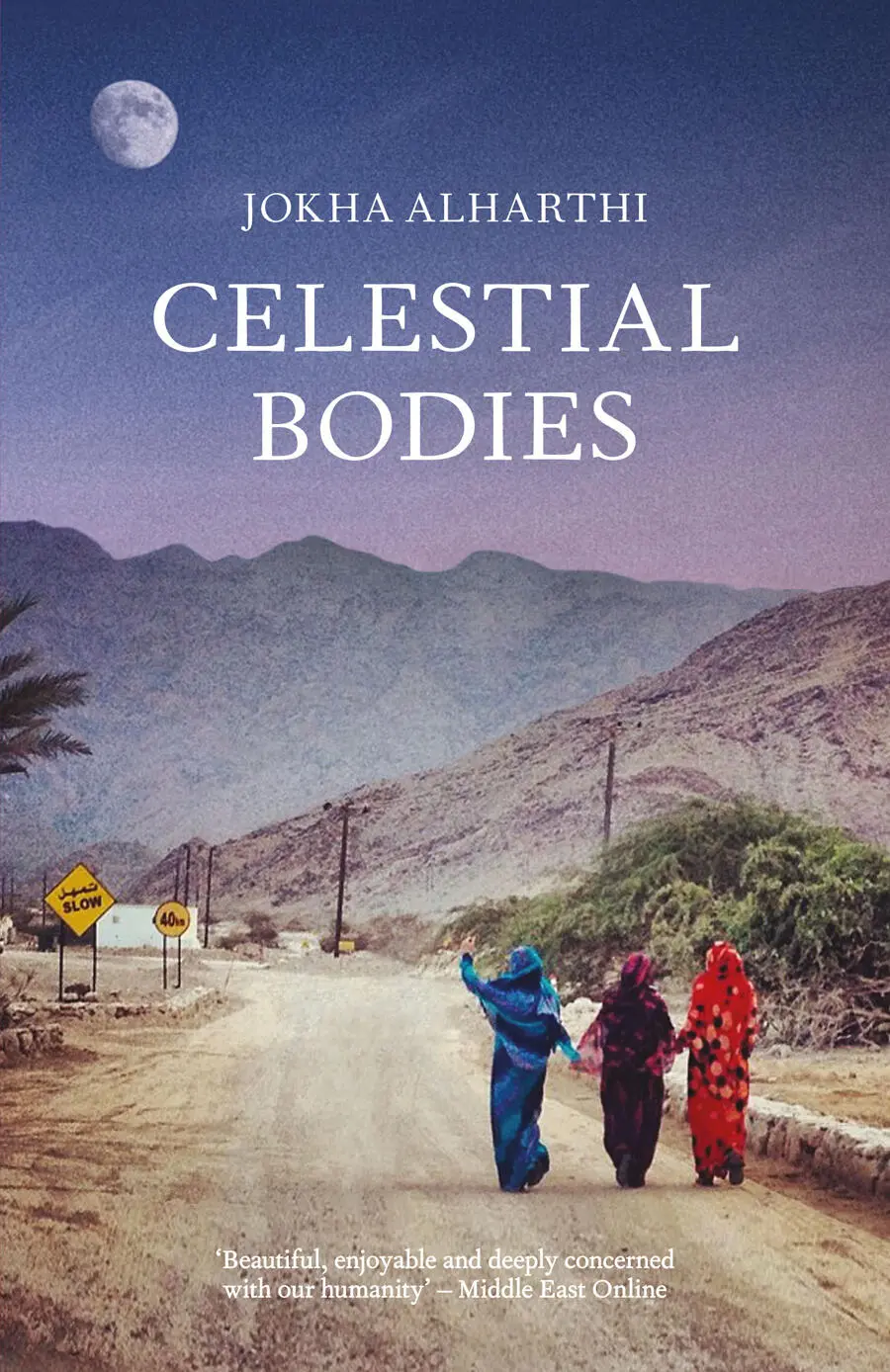
- Название:Celestial Bodies
- Автор:
- Издательство:Sandstone Press Ltd
- Жанр:
- Год:2018
- ISBN:978-1-912240-16-6, 978-1-912240-17-3
- Рейтинг книги:5 / 5. Голосов: 1
-
Избранное:Добавить в избранное
- Отзывы:
-
Ваша оценка:
Celestial Bodies: краткое содержание, описание и аннотация
Предлагаем к чтению аннотацию, описание, краткое содержание или предисловие (зависит от того, что написал сам автор книги «Celestial Bodies»). Если вы не нашли необходимую информацию о книге — напишите в комментариях, мы постараемся отыскать её.
Celestial Bodies — читать онлайн бесплатно полную книгу (весь текст) целиком
Ниже представлен текст книги, разбитый по страницам. Система сохранения места последней прочитанной страницы, позволяет с удобством читать онлайн бесплатно книгу «Celestial Bodies», без необходимости каждый раз заново искать на чём Вы остановились. Поставьте закладку, и сможете в любой момент перейти на страницу, на которой закончили чтение.
Интервал:
Закладка:
He spoke through clenched teeth. Listen to me. Merchant Sulayman raised me and, yes, he put me through a little schooling, and he found me a wife, but it was all for his own self-interest, all because he meant me to serve him, and to have my wife as his servant too, and then my children later on. No, Zarifa, no! Merchant Sulayman has no claim on me. We are free — the law says so, free, Zarifa. Open your eyes. The world has changed but you just keep on saying the same words over and over: ya hababi, ya sidi , my master, my honoured master. While everybody’s gotten educated and gotten jobs, you’ve stayed exactly where you always were, the slave of Merchant Sulayman like that is all there is. He’s just an old man who can’t even keep his hands steady! Open your eyes, Zarifa. We are free, and everyone is his own master, and no one owns anyone else. I am free and I can travel wherever and whenever I like and I can name my children whatever I want to name them. If it’s what you want, then stay with him, the old fool. Fine. Just stay then.
Zarifa was on the point of slapping him, an automatic response left over from all those years of devilish boyhood — years which weren’t so far behind them, after all. Too quick for her, he stepped back and with her hand missing him, she lost her balance, teetered and fell, colliding with the base of the wall.
A woman from the village happened to be in the same alleyway. Hearing Zarifa’s sobs, she ran over. Like a woman in mourning, Zarifa threw her arms up and clapped them around her shoulders. Their heads together, shaking, they sobbed. The boy’s gone, the boy’s gone and left me, he talks just like his father. He’s making no sense, like his papa, and he’s going away like him too. Free, free! That’s what he always says. His father tormented me with such talk. I couldn’t believe it when Habib left and now his son here sounds just like him. Free, not slaves! What does any of this matter to me? I want my son here with me. That viper woman of his puts ideas in his head, she tells him to leave me and go away, she wants my heart to burn to ashes. And where’s he to go? What’ll he work at? Who will feed him and keep him safe? My son, my boy, my only one, he’s gone, gone...
The other woman, her arms around Zarifa, was sobbing just as hard.
But it wasn’t Sanjar’s wife, Shanna, who’d had the idea, even if she was ready enough to encourage it.
Soon after Shanna’s father, Zayd, had died, the year before, Zarifa announced to the young woman that she would betroth her to Sanjar. Shanna had been delirious with joy. Getting married meant getting out of her collapsing house and away from her family, and that was the most she could hope for. Marrying any man on the face of the earth would do that. Sanjar had nothing, of course, but she’d learned that he was hoping to go away sooner or later, leaving this entire country behind. She was bored with al-Awafi — its people, its animals, the mountains and farms — and she shared Sanjar’s fierce yearning for a new life in a place far away where there weren’t any poor people, or where at least, maybe, they could climb out of the poverty that dogged them here. She was fed up with being poor, with the filth and the begging that went along with having nothing. She was tired of a life that held no touch of style or refinement, or — and this was likely worse — a life in which she was always able to see nice things but never to have them. She was tired of carrying water on her head every morning and evening, of the smoke from their cooking fires and the dust cloud she stirred up whenever she had to sweep the house. But what really disgusted her, more than al-Awafi and its people and animals and poverty and service, was her mother Masouda.
Ever since Shanna had opened her eyes on life, this mother of hers had been a bent and twisted creature — a crooked form whose lashless eyes were swollen and whose hands were ever dry and cracked. When Shanna got older, she would hear that her mother’s permanently bowed back was the result of constantly stooping over the short-handled broom she’d always used to sweep the courtyard, and of course from carrying heavy loads of firewood day after day.
Shanna avoided Masouda as much as she possibly could and showed her aversion as thoroughly as a girl could do without stirring up too many comments or rumours. And as if this ill-starred mother’s misery weren’t enough, her husband’s death had left her in a peculiar condition. She’s gone out of her mind, of course, Shanna muttered to herself repeatedly, just as she said to everyone else. She could not understand how her father could have felt anything at all for this woman who had spent her entire life carrying wood and sweeping the floor. It had always astonished Shanna to find the two of them spending the long evenings talking, even laughing together sometimes. Her father was a strong man — why, he was known as the fellow who could hoist two huge sacks of rice or two enormous bags of dates without any show of stress. For her mother, he had built this house out of gypsum with his own hands. He’d had the means to marry another woman but he didn’t. He stuck with this strange wife of his, seemingly fond of her and her odd ways. Many times, Shanna had said to herself, If he had married someone else then maybe now she, Shanna, would have brothers and sisters who could share some of the irritating burden of this mother. But as Zarifa — soon to become her mother-in-law — would always say, The beast of burden is made for burdens.
How could she know what might have happened, anyway? Likely those imaginary brothers and sisters would have washed their hands of her mother, because she was only their father’s elder wife, and they would have left Shanna with all the misery and toil of taking care of her. In any case Sanjar would emigrate as his father had done before him and then Shanna would be rid of the worry and the drudgery. She would no longer have to hear this monotonous tinny insistent voice that made the base of her skull vibrate. I’m over here! It’s Masouda. I’m Masouda and I’m here. Always that voice, embarrassing Shanna in front of the neighbours and shaming her before all the people of al-Awafi.
She hated them. She hated them all.
Abdallah
No sooner did Muhammad free himself of his obsessive attachment to the whirling fan than he became engrossed in another game: opening and shutting the door. He spent all of his waking hours yanking it open and then banging it shut, over and over, with never a pause. We tried desperately to interest him in some other activity, anything, or to get him to repeat the few unconnected words he could pronounce. All was in vain.
When I left the house, Muhammad would always insist that his mother stay immediately next to him as he opened and closed the door. She did not say a word. When I’d had enough of the company of my friends and the cafés we sat in, I would return home to find the two of them exactly as I had left them. Muhammad would be repeating his random words like a parrot, his mother there at his side. Eventually, out of sheer exhaustion he would collapse and fall sleep. She would go to sleep immediately, waking up only when he did.
One day I came back when Mayya was taking a bath. The sound of the door opening and shutting, opening and shutting, opening and shutting, began to erode my sanity, and it was all I could do to keep from knocking Muhammad’s head against that door of his or cuffing him. I wished he would open the window instead of the door, perch there for a moment, and fly right through it. Yes, I wanted Muhammad to fly out the window like the birds and never come back, if only that would stop this unending, never-changing sound for good.
Salima
Интервал:
Закладка:
Похожие книги на «Celestial Bodies»
Представляем Вашему вниманию похожие книги на «Celestial Bodies» списком для выбора. Мы отобрали схожую по названию и смыслу литературу в надежде предоставить читателям больше вариантов отыскать новые, интересные, ещё непрочитанные произведения.











Обсуждение, отзывы о книге «Celestial Bodies» и просто собственные мнения читателей. Оставьте ваши комментарии, напишите, что Вы думаете о произведении, его смысле или главных героях. Укажите что конкретно понравилось, а что нет, и почему Вы так считаете.