Barbara Vine - The Blood Doctor
Здесь есть возможность читать онлайн «Barbara Vine - The Blood Doctor» весь текст электронной книги совершенно бесплатно (целиком полную версию без сокращений). В некоторых случаях можно слушать аудио, скачать через торрент в формате fb2 и присутствует краткое содержание. Год выпуска: 2003, Издательство: Vintage, Жанр: Современная проза, на английском языке. Описание произведения, (предисловие) а так же отзывы посетителей доступны на портале библиотеки ЛибКат.
- Название:The Blood Doctor
- Автор:
- Издательство:Vintage
- Жанр:
- Год:2003
- ISBN:нет данных
- Рейтинг книги:4 / 5. Голосов: 1
-
Избранное:Добавить в избранное
- Отзывы:
-
Ваша оценка:
The Blood Doctor: краткое содержание, описание и аннотация
Предлагаем к чтению аннотацию, описание, краткое содержание или предисловие (зависит от того, что написал сам автор книги «The Blood Doctor»). Если вы не нашли необходимую информацию о книге — напишите в комментариях, мы постараемся отыскать её.
Barbara Vine (a.k.a. Ruth Rendell) deftly weaves this story of an eminent Victorian with a modern yarn about the embattled biographer, who is watching the House of Lords prepare to annul membership for hereditary peers and thus strip him of his position. Themes of fate and family snake throughout this teasing psychological suspense, a typically chilling tale from a master of the genre.
From Publishers Weekly
This rich, labyrinthine book by Vine (aka Ruth Rendell) concerns a "mystery in history," like her 1998 novel, The Chimney Sweeper's Boy. Martin Nanther-biographer and member of the House of Lords-discovers some blighted roots on his family tree while researching the life of his great-great-grandfather, Henry, an expert on hemophilia and physician to Queen Victoria. Martin contacts long-lost relatives who help him uncover some puzzling events in Henry's life. Was Henry a dour workaholic or something much more sinister? Vine can make century-old tragedy come alive. Still, the decades lapsed between Martin's and Henry's circles create added emotional distance, and, because they are all at least 50 years dead, we never meet Henry or his cohorts except through diaries and letters. Martin's own life-his wife's infertility and troubles with a son from his first marriage-is interesting yet sometimes intrudes on the more intriguing Victorian saga. Vine uses her own experience as a peer to give readers an insider's look into the House of Lords, at the dukes snoozing in the library between votes and eating strawberries on the terrace fronting the Thames. Some minor characters are especially vivid, like Martin's elderly cousin Veronica, who belts back gin while stonewalling about the family skeletons all but dancing through her living room. Readers may guess Henry's game before Vine is ready to reveal it, but this doesn't detract from this novel peopled by characters at once repellant and compelling.
From Library Journal
In her tenth novel writing as Barbara Vine, Ruth Rendell offers a novel of suspense based in 19th-century England and centering on deceit, murder, and various other family skeletons. Martin Nanther, the fourth Lord Nanther, has a comfortable life in present-day London as a Hereditary Peer in the House of Lords and as a historical biographer. He chooses as his most recent subject his own great-grandfather, the first Lord Nanther, physician to the royal family (Victoria and Albert) and an early noted researcher into the cause and transmission of hemophilia. The reader is taken through the family history as Martin painstakingly uncovers some not so savory bits of his own family's past. The story is dense with characters, and the author provides family trees of the two principal families, for which any reader will be eternally grateful. The story lacks the usual page-turner suspense of the Rendell/Vine novels but makes up for that with unusually detailed glimpses into Victorian life and the inner workings of the House of Parliament, which American readers will find particularly intriguing. Recommended for all public libraries. Caroline Mann, Univ. of Portland, OR
The Blood Doctor — читать онлайн бесплатно полную книгу (весь текст) целиком
Ниже представлен текст книги, разбитый по страницам. Система сохранения места последней прочитанной страницы, позволяет с удобством читать онлайн бесплатно книгу «The Blood Doctor», без необходимости каждый раз заново искать на чём Вы остановились. Поставьте закладку, и сможете в любой момент перейти на страницу, на которой закончили чтение.
Интервал:
Закладка:
He’s not interested in Olivia Batho but when I tell him about Jimmy Ashworth and that her child Mary Dawson was almost certainly Henry’s he perks up quite a lot. Do I think Laura Kimball would consent to a DNA test? I tell him he can ask her if he likes, I’m not going to. These genealogists, amateur or otherwise, become so obsessed with their branchings and linkings and twigs going this way and offshoots that way, that they lose all sensitivity as to how family members actually feel. I can see from the look on his face that he wonders if he ought to add to his table a kind of bend sinister jutting out from Henry and culminating in Janet’s grandson Damon, but would rather not. It’s messy, and what about all the other ancestors who might have had ‘entanglements’? He wants to know if I think it would be in bad taste but I absolve myself from involvement in this question.
Everyone orders more drinks but before they come the division bell rings. So I make my way to the Content lobby because we’re voting on the Weatherill Amendment to retain ninety-two hereditary peers, and I’m more content with it than with its alternative which would mean curtains for all of us. A lot of chat usually goes on as we’re passing through to be counted but no one is very talkative today. I’m silent too, lost in thought, and suddenly I understand something. Our child was most probably conceived that night Jude was acquiescent and I, for once in our recent mode of living, positively desirous. And my desire had been stimulated by that erotic dream of the Henry-me character watching the tableau vivant of the Three Graces . Ah well, I say to myself, they all looked like Jude and, anyway, it can’t be helped now. Back in the Peers’ Guest Room Georgie is asking why everyone is allowed to smoke in here. Haven’t they heard of passive smoking and its effect on the unborn child? I think of telling her that my mother smoked forty cigarettes a day all the time she was carrying me, but I don’t. That would be comparable to the tales I often hear in this room of some peer’s noble grandfather, a heavy smoker who died in his sleep at the age of ninety. Someone says over my shoulder that we won the vote by an enormous majority, one of the biggest the Government have had, though in fact it was a cross-bench amendment, supported by the Government.
Jude has, of course, told Georgie and David about her pregnancy. She’ll tell everyone, I know that. Lorraine will get to know the minute she sets foot in our house tomorrow morning. And why not? Part of one’s joy in success, in something achieved, is telling other people. I’m fearful because I remember, though I can never speak of it now, the last time. She carried the foetus for two months and a week and then, one midnight, it bled away from her. Blood – if anyone asked me what I see when I hear or read the word I’d have to say I think of the blood in our bed, all over both of us, and Jude’s tears, her dry sobs and then her tempests of tears.
But no one is going to ask me. Henry might, but he is present at this table (and in David’s table, the genealogical one) only as descendant and ancestor, offspring and progenitor. David cares nothing for him as a man or a doctor. Now he has decided against DNA testing attempts, he dismisses the long liaison between Henry and Jimmy Ashworth as ‘the way those Victorians went on’. But Georgie, who is naturally I suppose interested in these things at the moment, says how happy Henry must have been to know his first child was on the way and looks indignant when I say it’s unlikely.
‘I’d have thought he’d be happy,’ she says. ‘I mean, thrilled . He’s forty-seven, didn’t you say? Forty-seven and this is his first child. He must have been happy.’ This is approaching too closely my own case for comfort. I contrive a smile.
‘He could have married her. She wasn’t a low sort of person, was she? She wasn’t a prostitute.’
‘She probably had been,’ I say.
‘Well, she was no worse than him. He’s a real example of someone with a double standard isn’t he?’
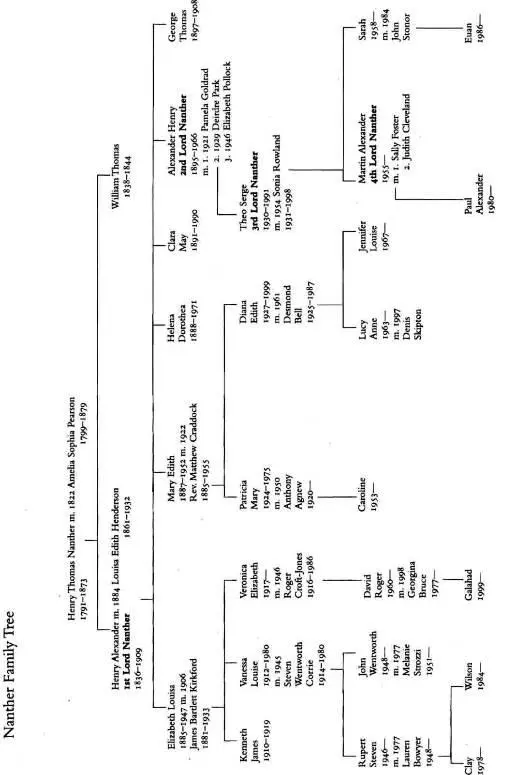
We go into dinner then. Useless to tell the Georgies of this world that it’s impossible to judge the morals and manners of a hundred and twenty years ago by those which prevail today. Henry’s attitude was time specific and that’s all there is to it. David has unfolded his tree and folded it up again mapwise so as to expose only the relevant section. ‘Henry, the one who became Lord Nanther,’ he says, ‘got married the following year. In the October.’ Rather impatiently he goes on, ‘I don’t see there’s anything mysterious about it. He announces his engagement in The Times in August 1883 and gets married in October 1884.’
‘It would have been a very long engagement for the time,’ I say. ‘Long engagements were supposed to be bad for the girl. People thought the man was keeping her hanging on and that was bad for her reputation. But all that’s beside the point because it was Eleanor he got engaged to and her sister Edith he married.’
There’s a mistake in the tree here and David seems suitably chastened. Jude and Georgie want to know why the marriage didn’t take place, though this must be politeness on Jude’s part because she knows already. Our wine and our first course arrive and a waitress with a basketful of the awful bread you get here. Stanley Farrow, passing, pauses at our table and whispers to me what I already know, that we won the vote. David, tucking in to smoked salmon, says, ‘I don’t see how I can get an engagement into my tree. I’d better just forget it, hadn’t I?’
‘You’d better if you’re not going to include Jimmy Ashworth. He wouldn’t have had sexual relations with Eleanor, you can be sure of that.’
This is something else Georgie finds hard to believe. All engaged people do. Everyone she knows moved in to live with the person they were engaged to. I shrug my shoulders and mutter something about times changing. Georgie must have had some sort of answer to her question from Jude because she says, ‘Jude said she died. Eleanor, I mean.’
‘Yes, she died.’
Georgie says people often died young in those days. They got tuberculosis or something you’d have an operation for today or in childbirth. The faintest shadow passes across Jude’s lovely face and I’d like to stick my steak knife into that silly woman’s neck. ‘They got pneumonia,’ Georgie says, ‘and took three weeks to die and knew they were going to die, they knew there was no help for them. You can’t imagine, can you?’ I see she’s an inveterate reader of historical novels of the sensational kind. ‘And then they sort of wasted away, they had something called the green sickness.’
‘Eleanor died a violent death,’ I tell her. ‘The way she died wasn’t just typical of her time. It’s the kind of thing that happens today. She was murdered.’
‘Oh, do tell!’
But I don’t tell. I shake my head and smile. Perhaps because I know Georgie Croft-Jones would get excited and say Henry must have done it or otherwise speculate in wild and inaccurate ways. I say instead that I’m still researching that bit, which isn’t true, I’ve researched as far as I think necessary. But I’m not so circumspect as Jude, I don’t mind white lies in a good cause. And keeping me from losing my temper is a very good cause.
We have coffee. At last the Croft-Joneses want to know what’s happening in the Chamber. It’s the House of Lords Bill, I tell them, what we in here call the Reform Bill. Georgie thinks this means everyone with a title is going to lose it, eldest sons are no longer to inherit and the aristocracy will lose their property. No one’s going to be called ‘Lord’ and ‘Lady’ any more, the whole aristocracy will be swept away in a kind of bloodless French Revolution. As I set her to rights I think to myself that this will very likely be what the whole country thinks before we’re finished with the Bill.
Читать дальшеИнтервал:
Закладка:
Похожие книги на «The Blood Doctor»
Представляем Вашему вниманию похожие книги на «The Blood Doctor» списком для выбора. Мы отобрали схожую по названию и смыслу литературу в надежде предоставить читателям больше вариантов отыскать новые, интересные, ещё непрочитанные произведения.





Обсуждение, отзывы о книге «The Blood Doctor» и просто собственные мнения читателей. Оставьте ваши комментарии, напишите, что Вы думаете о произведении, его смысле или главных героях. Укажите что конкретно понравилось, а что нет, и почему Вы так считаете.