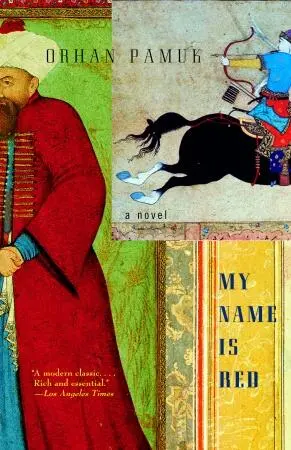
Orhan Pamuk - My Name is Red
Здесь есть возможность читать онлайн «Orhan Pamuk - My Name is Red» весь текст электронной книги совершенно бесплатно (целиком полную версию без сокращений). В некоторых случаях можно слушать аудио, скачать через торрент в формате fb2 и присутствует краткое содержание. Жанр: Современная проза, на английском языке. Описание произведения, (предисловие) а так же отзывы посетителей доступны на портале библиотеки ЛибКат.
- Название:My Name is Red
- Автор:
- Жанр:
- Год:неизвестен
- ISBN:нет данных
- Рейтинг книги:5 / 5. Голосов: 1
-
Избранное:Добавить в избранное
- Отзывы:
-
Ваша оценка:
My Name is Red: краткое содержание, описание и аннотация
Предлагаем к чтению аннотацию, описание, краткое содержание или предисловие (зависит от того, что написал сам автор книги «My Name is Red»). Если вы не нашли необходимую информацию о книге — напишите в комментариях, мы постараемся отыскать её.
When the Sultan commissions a great book to celebrate his royal self and his extensive dominion, he directs Enishte Effendi to assemble a cadre of the most acclaimed artists in the land. Their task: to illuminate the work in the European style. But because figurative art can be deemed an affront to Islam, this commission is a dangerous proposition indeed, and no one in the elite circle can know the full scope or nature of the project.
Panic erupts when one of the chosen miniaturists disappears, and the Sultan demands answers within three days. The only clue to the mystery-or crime?-lies in the half-finished illuminations themselves. Has an avenging angel discovered the blasphemous work? Or is a jealous contender for the hand of Enishte’s ravishing daughter, the incomparable Shekure, somehow to blame?
Orhan Pamuk’s My Name Is Red is at once a fantasy and a philosophical puzzle, a kaleidoscopic journey to the intersection of art, religion, love, sex, and power.
"Pamuk is a novelist and a great one…My Name is Red is by far the grandest and most astonishing contest in his internal East-West war…It is chock-full of sublimity and sin…The story is told by each of a dozen characters, and now and then by a dog, a tree, a gold coin, several querulous corpses and the color crimson ('My Name is Red')…[Readers will] be lofted by the paradoxical lightness and gaiety of the writing, by the wonderfully winding talk perpetually about to turn a corner, and by the stubborn humanity in the characters' maneuvers to survive. It is a humanity whose lies and silences emerge as endearing and oddly bracing individual truths."- Richard Eder, New York Times Book Review
"A murder mystery set in sixteenth-century Istanbul [that] uses the art of miniature illumination, much as Mann's 'Doctor Faustus' did music, to explore a nation's soul… Erdag Goknar deserves praise for the cool, smooth English in which he has rendered Pamuk's finespun sentences, passionate art appreciations, sly pedantic debates, [and] eerie urban scenes."- John Updike, The New Yorker
"The interweaving of human and philosophical intrigue is very much as I remember it in The Name of the Rose, as is the slow, dense beginning and the relentless gathering of pace… But, in my view, his book is by far the better of the two. I would go so far as to say that Pamuk achieves the very thing his book implies is impossible… More than any other book I can think of, it captures not just Istanbul's past and present contradictions, but also its terrible, timeless beauty. It's almost perfect, in other words. All it needs is the Nobel Prize."-Maureen Freely, New Statesman (UK)
"A perfect example of Pamuk's method as a novelist, which is to combine literary trickery with page-turning readability… As a meditation on art, in particular, My Name is Red is exquisitely subtle, demanding and repaying the closest attention.. We in the West can only feel grateful that such a novelist as Pamuk exists, to act as a bridge between our culture and that of a heritage quite as rich as our own."-Tom Holland, Daily Telegraph (UK)
"Readers… will find themselves lured into a richly described and remarkable world… Reading the novel is like being in a magically exotic dream…Splendidly enjoyable and rewarding… A book in which you can thoroughly immerse yourself." -Allan Massie, The Scotsman (UK)
"A wonderful novel, dreamy, passionate and august, exotic in the most original and exciting way. Orhan Pamuk is indisputably a major novelist."-Philip Hensher, The Spectator (UK)
"[In this] magnificent new novel… Pamuk takes the reader into the strange and beautiful world of Islamic art,in which Western notions no longer make sense… In this world of forgeries, where some might be in danger of losing their faith in literature, Pamuk is the real thing, and this book might well be one of the few recent works of fiction that will be remembered at the end of this century."-Avkar Altinel, The Observer (UK)
My Name is Red — читать онлайн бесплатно полную книгу (весь текст) целиком
Ниже представлен текст книги, разбитый по страницам. Система сохранения места последней прочитанной страницы, позволяет с удобством читать онлайн бесплатно книгу «My Name is Red», без необходимости каждый раз заново искать на чём Вы остановились. Поставьте закладку, и сможете в любой момент перейти на страницу, на которой закончили чтение.
Интервал:
Закладка:
“You aren’t confused at all,” said Black.
“Perhaps, but only because these aren’t my own ideas, I learned them from my father over the years.” I said this so he wouldn’t dismiss what I said, assuming that these plans had sprung from my feminine mind.
Next, Black said what I’d heard from every man who wasn’t afraid to admit he found me very intelligent:
“You’re very beautiful.”
“Yes,” I said, “it pleases me to be praised for my intelligence. When I was a child, my father would often do so.”
I was about to add that once I’d grown up my father ceased to praise my intelligence, but I began to weep. As I cried, it was as if I’d left myself and was becoming another, entirely separate woman. Like some reader troubled by a sad picture in the pages of a book, I saw my life from the outside and pitied what I saw. There’s something so innocent in crying over one’s troubles, as though they were another’s, that when Black embraced me, a sense of well-being spread over us both. Yet, this time, as we hugged, this sense of comfort remained there between us, unable to affect the adversaries circling us.
I AM CALLED BLACK
Widowed, abandoned and aggrieved, my beloved Shekure fled with featherlike steps, and I stood as if stunned in the stillness of the house of the Hanged Jew, amid the aroma of almonds and dreams of marriage she’d left in her wake. I was bewildered, but my mind was churning so fast it almost hurt. Without even a chance to grieve properly over my Enishte’s death, I swiftly returned home. On the one hand, a worm of doubt was gnawing at me: Was Shekure using me as a pawn in a grand scheme, was she duping me? On the other hand, fantasies of a blissful marriage stubbornly played before my eyes.
After making conversation with my landlady who interrogated me at the front door as to where I’d gone and whence I was coming at this morning hour, I went to my room and removed the twenty-two Venetian gold pieces from the lining of the sash I’d hidden in my mattress, placing them in my money purse with trembling fingers. When I returned to the street, I knew immediately I’d see Shekure’s dark, teary, troubled eyes for the rest of the day.
I changed five of the Venetian Lions at a perpetually smiling Jewish money changer. Next, deep in thought, I entered the neighborhood whose name I’ve yet to mention because I’m not fond of it: Yakutlar, where my deceased Enishte and Shekure, along with her children, awaited me at their house. As I made my way along the streets almost running, a tall plane tree seemed to reproach me for being overjoyed by dreams and plans of marriage on the very day my Enishte had passed away. Next, as the ice had melted, a street fountain hissed into my ear: “Don’t take matters too seriously, see to your own affairs and your own happiness.” “That’s all fine and good,” objected an ill-omened black cat licking himself on the corner, “but everybody, yourself included, suspects you had a hand in your uncle’s murder.”
The cat left off licking himself as I suddenly caught sight of its bewitching eyes. I don’t have to tell you how brazen these Istanbul cats get when the locals spoil them.
I found the Imam Effendi, whose droopy eyelids and large black eyes gave him a perpetually sleepy look, not at his house, but in the courtyard of the neighborhood mosque, and there I asked him quite a trivial legal question: “When is one obligated to testify in court?” I raised my eyebrows as I listened to his haughty answer as if I were hearing this information for the first time. “Bearing witness is optional if other witnesses are present,” explained the Imam Effendi, “but, in situations where there was only one witness, it is the will of God that one bear witness.”
“That’s just the predicament I find myself in now,” I said, taking up the conversation. “In a situation everyone knows about, all the witnesses have shirked their responsibilities and avoided going to court with the excuse that ”it’s only voluntary,“ and as a result the pressing concerns of those I’m trying to help are being completely disregarded.”
“Well,” said the Imam Effendi, “why don’t you loosen your purse-strings a little more?”
I took out my pouch and showed him the Venetian gold pieces huddled within: The broad space of the mosque courtyard, the face of the preacher, everything was suddenly illuminated by the glimmer of gold. He asked me what my dilemma was all about.
I explained who I was. “Enishte Effendi is ill,” I confided. “Before he dies, he wants his daughter’s widowhood certified and an alimony to be instituted.”
I didn’t even have to mention the proxy of the Üsküdar judge. The Imam Effendi understood at once and said the entire neighborhood had long been troubled over the fate of hapless Shekure, adding that the situation had already persisted too long. Instead of searching for a second witness required for a legal separation at the door of the Üsküdar judge, the Imam Effendi suggested his brother. Now, if I were to offer an additional gold piece to the brother, who lived in the neighborhood and was familiar with the predicament of Shekure and her darling children, I’d be doing a good pious turn. After all, for only two gold coins the Imam Effendi was giving me a deal on the second witness. We immediately agreed. The Imam Effendi went to fetch his brother.
The rest of our day rather resembled the “cat-and-mouse” stories that I’d watched storytellers in Aleppo coffeehouses act out. Because of all the adventure and trickery, such stories written up as narrative poems and bound were never taken seriously even if presented in fine calligraphy; that is, they were never illustrated. I, on the other hand, was quite pleased to divide our daylong adventure into four scenes, imagining each in the illustrated pages of my mind.
In the first scene, the miniaturist ought to depict us amid mustachioed and muscled oarsmen, forging our way across the blue Bosphorus toward Üsküdar in the four-oared red longboat we’d boarded in Unkapanı. The preacher and his skinny dark-complexioned brother, pleased with the surprise voyage, are engaging the oarsmen in friendly chatter. Meanwhile, amid blithe dreams of marriage that play ceaselessly before my eyes, I stare deep into the waters of the Bosphorus, flowing clearer than usual on this sunny winter morning, on guard for an ominous sign within its currents. I’m afraid, for example, that I might see the wreck of a pirate ship below. Thus, no matter how joyously the miniaturist colors the sea and clouds, he ought to include something equivalent to the darkness of my fears and as intense as my dreams of happiness-a terrifying-looking fish, for example-in the depths of the water so the reader of my adventure won’t assume all is rosy.
Our second picture ought to show the palaces of sultans, the meetings of the Divan Council of State, the reception of European ambassadors, and detailed and carefully composed crowded interiors of a subtlety worthy of Bihzad; that is, the picture ought to partake of playful tricks and irony. Thereby, while the Kadi Effendi apparently makes an open-handed “halt” gesture indicating “never” or “no” to my bribe, with his other hand he ought to be shown obligingly pocketing my Venetian gold coins, and the ultimate result of this bribe should be depicted in the same picture: Shahap Effendi, the Shafü proxy presiding in place of the Üsküdar judge. The simultaneous depiction of sequential events could only be achieved through an intelligent miniaturist’s cunning facility in page composition. Thus, when the observer, who first sees me giving a bribe, notices elsewhere in the painting that the man sitting cross-legged on the judge’s cushion is the proxy, he’ll realize, even if he hasn’t read the story, that the honorable judge has temporarily given up his office so his proxy might grant Shekure a divorce.
Читать дальшеИнтервал:
Закладка:
Похожие книги на «My Name is Red»
Представляем Вашему вниманию похожие книги на «My Name is Red» списком для выбора. Мы отобрали схожую по названию и смыслу литературу в надежде предоставить читателям больше вариантов отыскать новые, интересные, ещё непрочитанные произведения.









Обсуждение, отзывы о книге «My Name is Red» и просто собственные мнения читателей. Оставьте ваши комментарии, напишите, что Вы думаете о произведении, его смысле или главных героях. Укажите что конкретно понравилось, а что нет, и почему Вы так считаете.