Orhan Pamuk - My Name is Red
Здесь есть возможность читать онлайн «Orhan Pamuk - My Name is Red» весь текст электронной книги совершенно бесплатно (целиком полную версию без сокращений). В некоторых случаях можно слушать аудио, скачать через торрент в формате fb2 и присутствует краткое содержание. Жанр: Современная проза, на английском языке. Описание произведения, (предисловие) а так же отзывы посетителей доступны на портале библиотеки ЛибКат.
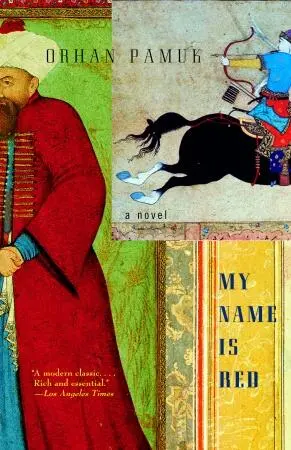
- Название:My Name is Red
- Автор:
- Жанр:
- Год:неизвестен
- ISBN:нет данных
- Рейтинг книги:5 / 5. Голосов: 1
-
Избранное:Добавить в избранное
- Отзывы:
-
Ваша оценка:
My Name is Red: краткое содержание, описание и аннотация
Предлагаем к чтению аннотацию, описание, краткое содержание или предисловие (зависит от того, что написал сам автор книги «My Name is Red»). Если вы не нашли необходимую информацию о книге — напишите в комментариях, мы постараемся отыскать её.
When the Sultan commissions a great book to celebrate his royal self and his extensive dominion, he directs Enishte Effendi to assemble a cadre of the most acclaimed artists in the land. Their task: to illuminate the work in the European style. But because figurative art can be deemed an affront to Islam, this commission is a dangerous proposition indeed, and no one in the elite circle can know the full scope or nature of the project.
Panic erupts when one of the chosen miniaturists disappears, and the Sultan demands answers within three days. The only clue to the mystery-or crime?-lies in the half-finished illuminations themselves. Has an avenging angel discovered the blasphemous work? Or is a jealous contender for the hand of Enishte’s ravishing daughter, the incomparable Shekure, somehow to blame?
Orhan Pamuk’s My Name Is Red is at once a fantasy and a philosophical puzzle, a kaleidoscopic journey to the intersection of art, religion, love, sex, and power.
"Pamuk is a novelist and a great one…My Name is Red is by far the grandest and most astonishing contest in his internal East-West war…It is chock-full of sublimity and sin…The story is told by each of a dozen characters, and now and then by a dog, a tree, a gold coin, several querulous corpses and the color crimson ('My Name is Red')…[Readers will] be lofted by the paradoxical lightness and gaiety of the writing, by the wonderfully winding talk perpetually about to turn a corner, and by the stubborn humanity in the characters' maneuvers to survive. It is a humanity whose lies and silences emerge as endearing and oddly bracing individual truths."- Richard Eder, New York Times Book Review
"A murder mystery set in sixteenth-century Istanbul [that] uses the art of miniature illumination, much as Mann's 'Doctor Faustus' did music, to explore a nation's soul… Erdag Goknar deserves praise for the cool, smooth English in which he has rendered Pamuk's finespun sentences, passionate art appreciations, sly pedantic debates, [and] eerie urban scenes."- John Updike, The New Yorker
"The interweaving of human and philosophical intrigue is very much as I remember it in The Name of the Rose, as is the slow, dense beginning and the relentless gathering of pace… But, in my view, his book is by far the better of the two. I would go so far as to say that Pamuk achieves the very thing his book implies is impossible… More than any other book I can think of, it captures not just Istanbul's past and present contradictions, but also its terrible, timeless beauty. It's almost perfect, in other words. All it needs is the Nobel Prize."-Maureen Freely, New Statesman (UK)
"A perfect example of Pamuk's method as a novelist, which is to combine literary trickery with page-turning readability… As a meditation on art, in particular, My Name is Red is exquisitely subtle, demanding and repaying the closest attention.. We in the West can only feel grateful that such a novelist as Pamuk exists, to act as a bridge between our culture and that of a heritage quite as rich as our own."-Tom Holland, Daily Telegraph (UK)
"Readers… will find themselves lured into a richly described and remarkable world… Reading the novel is like being in a magically exotic dream…Splendidly enjoyable and rewarding… A book in which you can thoroughly immerse yourself." -Allan Massie, The Scotsman (UK)
"A wonderful novel, dreamy, passionate and august, exotic in the most original and exciting way. Orhan Pamuk is indisputably a major novelist."-Philip Hensher, The Spectator (UK)
"[In this] magnificent new novel… Pamuk takes the reader into the strange and beautiful world of Islamic art,in which Western notions no longer make sense… In this world of forgeries, where some might be in danger of losing their faith in literature, Pamuk is the real thing, and this book might well be one of the few recent works of fiction that will be remembered at the end of this century."-Avkar Altinel, The Observer (UK)
My Name is Red — читать онлайн бесплатно полную книгу (весь текст) целиком
Ниже представлен текст книги, разбитый по страницам. Система сохранения места последней прочитанной страницы, позволяет с удобством читать онлайн бесплатно книгу «My Name is Red», без необходимости каждый раз заново искать на чём Вы остановились. Поставьте закладку, и сможете в любой момент перейти на страницу, на которой закончили чтение.
Интервал:
Закладка:
I hear the question upon your lips: What is it to be a color?
Color is the touch of the eye, music to the deaf, a word out of the darkness. Because I’ve listened to souls whispering-like the susurrus of the wind-from book to book and object to object for tens of thousands of years, allow me to say that my touch resembles the touch of angels. Part of me, the serious half, calls out to your vision while the mirthful half soars through the air with your glances.
I’m so fortunate to be red! I’m fiery. I’m strong. I know men take notice of me and that I cannot be resisted.
I do not conceal myself: For me, delicacy manifests itself neither in weakness nor in subtlety, but through determination and will. So, I draw attention to myself. I’m not afraid of other colors, shadows, crowds or even of loneliness. How wonderful it is to cover a surface that awaits me with my own victorious being! Wherever I’m spread, I see eyes shine, passions increase, eyebrows rise and heartbeats quicken. Behold how wonderful it is to live! Behold how wonderful to see. Behold: Living is seeing. I am everywhere. Life begins with and returns to me. Have faith in what I tell you.
Hush and listen to how I developed such a magnificent red tone. A master miniaturist, an expert in paints, furiously pounded the best variety of dried red beetle from the hottest climes of Hindustan into a fine powder using his mortar and pestle. He prepared five drachmas of the red powder, one drachma of soapwort and a half drachma of lotor. He boiled the soapwort in a pot containing three okkas of water. Next, he mixed thoroughly the lotor into the water. He let it boil for as long as it took to drink an excellent cup of coffee. As he enjoyed his coffee, I grew as impatient as a child about to be born. The coffee had cleared the master’s mind and given him the eyes of a jinn. He sprinkled the red powder into the kettle and carefully mixed the concoction with one of the thin, clean sticks reserved for this task. I was ready to become genuine red, but the issue of my consistency was of utmost importance: The liquid shouldn’t be permitted to just boil away. He drew the tip of his stirring stick across the nail of his thumb (any other finger was absolutely unacceptable). Oh, how exquisite it is to be red! I gracefully painted that thumbnail without running off the side in watery haste. In short, I was the right consistency, but I still contained sediment. He took the pot off the stove and strained me through a clean piece of cheesecloth, purifying me even further. Next, he heated me up again, bringing me to a frothy boil twice more. After adding a pinch of crushed alum, he left me to cool.
A few days passed and I sat there quietly in the pan. In the anticipation of being applied to pages, of being spread everywhere and onto everything, sitting still like that broke my heart and spirit. It was during this period of silence that I meditated upon what it meant to be red.
Once, in a Persian city, as I was being applied by the brush of an apprentice to the embroidery on the saddle cloth of a horse that a blind miniaturist had drawn by heart, I overheard two blind masters having an argument:
“Because we’ve spent our entire lives ardently and faithfully working as painters, naturally, we, who have now gone blind, know red and remember what kind of color and what kind of feeling it is,” said the one who’d made the horse drawing from memory. “But, what if we’d been born blind? How would we have been truly able to comprehend this red that our handsome apprentice is using?”
“An excellent issue,” the other said. “But do not forget that colors are not known, but felt.”
“My dear master, explain red to somebody who has never known red.”
“If we touched it with the tip of a finger, it would feel like something between iron and copper. If we took it into our palm, it would burn. If we tasted it, it would be full-bodied, like salted meat. If we took it between our lips, it would fill our mouths. If we smelled it, it’d have the scent of a horse. If it were a flower, it would smell like a daisy, not a red rose.”
One hundred and ten years ago Venetian artistry was not yet threat enough that our rulers would bother themselves about it, and the legendary masters believed in their own methods as fervently as they believed in Allah; therefore, they regarded the Venetian method of using a variety of red tones for every ordinary sword wound and even the most common sackcloth as a kind of disrespect and vulgarity hardly worth a chuckle. Only a weak and hesitant miniaturist would use a variety of red tones to depict the red of a caftan, they claimed-shadows were not an excuse. Besides, we believe in only one red.
“What is the meaning of red?” the blind miniaturist who’d drawn the horse from memory asked again.
“The meaning of color is that it is there before us and we see it,” said the other. “Red cannot be explained to he who cannot see.”
“To deny God’s existence, victims of Satan maintain that God is not visible to us,” said the blind miniaturist who’d rendered the horse.
“Yet, He appears to those who can see,” said the other master. “It is for this reason that the Koran states that the blind and the seeing are not equal.”
The handsome apprentice ever so delicately dabbed me onto the horse’s saddle cloth. What a wonderful sensation to fix my fullness, power and vigor to the black and white of a well-executed illustration: as the cat-hair brush spreads me onto the waiting page, I become delightfully ticklish. Thereby, as I bring my color to the page, it’s as if I command the world to “Be!” Yes, those who cannot see would deny it, but the truth is I can be found everywhere.
I, SHEKURE
Before the children awoke, I wrote Black a brief note telling him to hurry to the house of the Hanged Jew and pressed it into Hayriye’s hand so that she might rush to Esther. As Hayriye took the letter, she looked into my eyes with more fearlessness than usual despite worrying what was to become of us; and I, who no longer had a father to fear, returned her glare with newfound temerity. This exchange would determine the tone of our relationship in the future. Over the last two years, I suspected Hayriye might even have a child by my father, and forgetting her status as slave, maneuver to become lady of the house. I visited my unfortunate father, respectfully kissing his now stiffened hand, which, oddly, hadn’t lost its softness. I hid my father’s shoes, quilted turban and purple cloak, then explained to the children once they awoke that their grandfather had gotten better and had left for the Mustafa Pasha district early in the morning.
Hayriye returned from her morning errand. As she was laying out the low table for breakfast, and I was placing a portion of orange jam in the middle of it, I imagined how Esther was now calling at Black’s door. The snow had stopped and the sun had begun to shine.
In the garden of the Hanged Jew, I encountered a familiar scene. The icicles hanging from the eaves and window casings were quickly shrinking, and the garden that smelled of mold and rotting leaves was eagerly absorbing the sun. I found Black waiting in the spot where I’d first seen him last night-it seemed so long ago, as if weeks had passed. I raised my veil and said:
“You can be glad, if you feel the urge. My father’s objections and doubts will not come between us anymore. While you were craftily trying to lay your hands on me here last night, a devil-of-a-man broke into our empty house and murdered my father.”
Rather than wondering about Black’s reaction, you’re probably puzzling over why I spoke so coldly and somewhat insincerely. I don’t quite know the answer myself. Maybe I thought I’d cry otherwise, provoking Black to embrace me, and I’d become intimate with him sooner than I wanted.
Читать дальшеИнтервал:
Закладка:
Похожие книги на «My Name is Red»
Представляем Вашему вниманию похожие книги на «My Name is Red» списком для выбора. Мы отобрали схожую по названию и смыслу литературу в надежде предоставить читателям больше вариантов отыскать новые, интересные, ещё непрочитанные произведения.








Обсуждение, отзывы о книге «My Name is Red» и просто собственные мнения читателей. Оставьте ваши комментарии, напишите, что Вы думаете о произведении, его смысле или главных героях. Укажите что конкретно понравилось, а что нет, и почему Вы так считаете.