Orhan Pamuk - My Name is Red
Здесь есть возможность читать онлайн «Orhan Pamuk - My Name is Red» весь текст электронной книги совершенно бесплатно (целиком полную версию без сокращений). В некоторых случаях можно слушать аудио, скачать через торрент в формате fb2 и присутствует краткое содержание. Жанр: Современная проза, на английском языке. Описание произведения, (предисловие) а так же отзывы посетителей доступны на портале библиотеки ЛибКат.
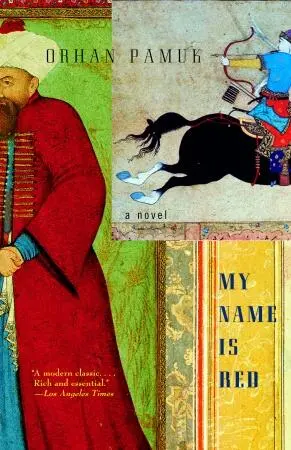
- Название:My Name is Red
- Автор:
- Жанр:
- Год:неизвестен
- ISBN:нет данных
- Рейтинг книги:5 / 5. Голосов: 1
-
Избранное:Добавить в избранное
- Отзывы:
-
Ваша оценка:
My Name is Red: краткое содержание, описание и аннотация
Предлагаем к чтению аннотацию, описание, краткое содержание или предисловие (зависит от того, что написал сам автор книги «My Name is Red»). Если вы не нашли необходимую информацию о книге — напишите в комментариях, мы постараемся отыскать её.
When the Sultan commissions a great book to celebrate his royal self and his extensive dominion, he directs Enishte Effendi to assemble a cadre of the most acclaimed artists in the land. Their task: to illuminate the work in the European style. But because figurative art can be deemed an affront to Islam, this commission is a dangerous proposition indeed, and no one in the elite circle can know the full scope or nature of the project.
Panic erupts when one of the chosen miniaturists disappears, and the Sultan demands answers within three days. The only clue to the mystery-or crime?-lies in the half-finished illuminations themselves. Has an avenging angel discovered the blasphemous work? Or is a jealous contender for the hand of Enishte’s ravishing daughter, the incomparable Shekure, somehow to blame?
Orhan Pamuk’s My Name Is Red is at once a fantasy and a philosophical puzzle, a kaleidoscopic journey to the intersection of art, religion, love, sex, and power.
"Pamuk is a novelist and a great one…My Name is Red is by far the grandest and most astonishing contest in his internal East-West war…It is chock-full of sublimity and sin…The story is told by each of a dozen characters, and now and then by a dog, a tree, a gold coin, several querulous corpses and the color crimson ('My Name is Red')…[Readers will] be lofted by the paradoxical lightness and gaiety of the writing, by the wonderfully winding talk perpetually about to turn a corner, and by the stubborn humanity in the characters' maneuvers to survive. It is a humanity whose lies and silences emerge as endearing and oddly bracing individual truths."- Richard Eder, New York Times Book Review
"A murder mystery set in sixteenth-century Istanbul [that] uses the art of miniature illumination, much as Mann's 'Doctor Faustus' did music, to explore a nation's soul… Erdag Goknar deserves praise for the cool, smooth English in which he has rendered Pamuk's finespun sentences, passionate art appreciations, sly pedantic debates, [and] eerie urban scenes."- John Updike, The New Yorker
"The interweaving of human and philosophical intrigue is very much as I remember it in The Name of the Rose, as is the slow, dense beginning and the relentless gathering of pace… But, in my view, his book is by far the better of the two. I would go so far as to say that Pamuk achieves the very thing his book implies is impossible… More than any other book I can think of, it captures not just Istanbul's past and present contradictions, but also its terrible, timeless beauty. It's almost perfect, in other words. All it needs is the Nobel Prize."-Maureen Freely, New Statesman (UK)
"A perfect example of Pamuk's method as a novelist, which is to combine literary trickery with page-turning readability… As a meditation on art, in particular, My Name is Red is exquisitely subtle, demanding and repaying the closest attention.. We in the West can only feel grateful that such a novelist as Pamuk exists, to act as a bridge between our culture and that of a heritage quite as rich as our own."-Tom Holland, Daily Telegraph (UK)
"Readers… will find themselves lured into a richly described and remarkable world… Reading the novel is like being in a magically exotic dream…Splendidly enjoyable and rewarding… A book in which you can thoroughly immerse yourself." -Allan Massie, The Scotsman (UK)
"A wonderful novel, dreamy, passionate and august, exotic in the most original and exciting way. Orhan Pamuk is indisputably a major novelist."-Philip Hensher, The Spectator (UK)
"[In this] magnificent new novel… Pamuk takes the reader into the strange and beautiful world of Islamic art,in which Western notions no longer make sense… In this world of forgeries, where some might be in danger of losing their faith in literature, Pamuk is the real thing, and this book might well be one of the few recent works of fiction that will be remembered at the end of this century."-Avkar Altinel, The Observer (UK)
My Name is Red — читать онлайн бесплатно полную книгу (весь текст) целиком
Ниже представлен текст книги, разбитый по страницам. Система сохранения места последней прочитанной страницы, позволяет с удобством читать онлайн бесплатно книгу «My Name is Red», без необходимости каждый раз заново искать на чём Вы остановились. Поставьте закладку, и сможете в любой момент перейти на страницу, на которой закончили чтение.
Интервал:
Закладка:
I pretended to satisfy my hunger at the table we’d set upstairs. From time to time, with the excuse of “checking on Grandfather,” I would step into the other room and burst into tears. Later because the children were scared and agitated, they snuggled up tightly next to me in bed. For a long while they were unable to sleep for fear of jinns, and as they tossed and turned they kept asking, “I heard a noise, did you hear it?” To lull them to sleep, I promised to tell them a love story. You know how words take wing in the darkness.
“Mother, you’re not going to get married are you?” said Shevket.
“Listen to me,” I said. “There was a prince who, from afar, fell in love with a strikingly beautiful maiden. How did this happen? I’ll tell you how. Before laying eyes on the pretty maiden, he’d seen her portrait, that’s how.”
As I would often do when I was upset and troubled, I recounted the tale not from memory, but improvising according to how I felt at that time. And since I colored it using a palette of my own memories and worries, what I recounted became a kind of melancholy illustration to accompany all that had happened to me.
After both children fell asleep, I left the warm bed and, together with Hayriye, cleaned up what that vile demon had scattered about. We picked up ruined chests, books, cloth, ceramic cups, earthenware pots, plates and inkpots that had been thrown about and shattered; we cleared away a demolished folding worktable, paint boxes and papers that had been torn up with furious hatred; and while doing so one of us, periodically, would stop and break down crying. It was as though we were more distraught over the wreckage of the rooms and their furnishings and the savage violation of our privacy, than we were over my father’s death. I can tell you from experience, unfortunates who’ve lost loved ones are comforted by the unchanged presence of objects in the house; they’re lulled by the sameness of the curtains, blankets and daylight, which, in turn, allows them occasionally to forget that Azrael has carried away their beloved or kin. The house that my father looked after with patience and love, whose nooks and doors he had meticulously embellished, had been mercilessly vandalized; thus, we were not only devoid of comfort and pleasant memories but, reminded of the pitilessness of the culprit’s damned soul, we were terrified as well.
When, for example, at my insistence we went downstairs, drew fresh water from the well, performed our ablutions and were reciting from the “Family of Imran” chapter-which my dearly departed father said he loved so much because it mentioned hope and death-out of his most cherished Herat-bound Koran, we were under sway of this terror and alarmed that the courtyard gate had begun to creak. It was nothing. But, after we checked that the latch was locked, and barricaded the gate by moving with our combined strength the planter of sweet basil that my father would water on spring mornings with freshly drawn well water, we reentered the house in the dead of night, and it suddenly seemed that the elongated shadows we were casting by the light of the oil lamp belonged to others. Most frightening of all was the horror that overcame us like a silent act of piety, as we solemnly washed his bloodied face and changed his clothes so that I might deceive myself into believing that my father had died at his appointed time; “Hand me his sleeve from underneath,” Hayriye had whispered to me.
As we removed his bloody clothes and undergarments, what aroused our amazement and awe was the vitality and whitish color of my father’s skin illuminated by candlelight. Because there were many more threatening things to frighten us, neither of us was shy about looking at my father’s sprawling naked body covered with moles and wounds. When Hayriye went back upstairs to fetch clean undergarments and his green silk shirt, unable to restrain myself, I looked down there and was immediately quite ashamed at what I’d done. After I’d dressed my father in fresh clothes and carefully cleaned the blood off his neck, face and hair, I embraced him with all my strength, and burying my nose in his beard, I inhaled his scent and cried at length.
For those of you who would accuse me of lacking feeling, or even of being guilty, let me hasten to tell of two further instances when I broke down crying: 1. When I was tidying the upstairs room so the children wouldn’t discover what had happened and I brought a seashell he’d used as a paper burnisher to my ear, as I’d done as a child, only to discover that the sound of the sea had diminished. 2. When I saw that the red velvet cushion my father sat upon often over the last twenty years-so much so it’d become part of his rear end-had been torn apart.
When everything in the house, excluding the damage that was beyond repair, was put back in order, I mercilessly denied Hayriye’s request to spread her roll-up mattress out in our room. “I don’t want the children to get suspicious in the morning,” I explained to her. But, to be honest, I was as eager to be alone with my children as I was to punish her. I entered my bed but was unable to sleep for a long while, not because I was preoccupied with the horror of what had happened, but because I was considering all that yet lay in store.
I AM RED
I appeared in Ghazni when Book of Kings poet Firdusi completed the final line of a quatrain with the most intricate of rhymes, besting the court poets of Shah Mahmud, who ridiculed him as being nothing but a peasant. I was there on the quiver of Book of Kings hero Rüstem when he traveled far and wide in pursuit of his missing steed; I became the blood that spewed forth when he cut the notorious ogre in half with his wondrous sword; and I was in the folds of the quilt upon which he made furious love with the beautiful daughter of the king who’d received him as a guest. Verily and truly, I’ve been everywhere and am everywhere. I emerged as Tur traitorously decapitated his brother Iraj; as legendary armies, spectacular as a dream, clashed on the steppes; and as Alexander’s lifeblood shimmered brightly from his handsome nose after he suffered sunstroke. Yes, Shah Behram Gür spent every night of the week with a different beauty beneath domes of varying color from distant lands, listening to the story she recounted, and I was upon the outfit of the striking maiden he visited on a Tuesday, whose picture he’d fallen in love with, just as I appeared from the crown to the caftan of Hüsrev, who’d fallen in love with Shirin’s picture. Verily, I was visible upon the military banners of armies besieging fortresses, upon the tablecloths covering tables set for feasts, upon the velvet caftans of ambassadors kissing the feet of sultans, and wherever the sword, whose legends children loved, was depicted. Yes, handsome almond-eyed apprentices applied me with elegant brushes to thick paper from Hindustan and Bukhara; I embellished Ushak carpets, wall ornamentation, the combs of fighting cocks, pomegranates, the fruits of fabled lands, the mouth of Satan, the subtle accent lines within picture borders, the curled embroidery on tents, flowers barely visible to the naked eye made for the artist’s own pleasure, blouses worn by stunning women with outstretched necks watching the street through open shutters, the sour-cherry eyes of bird statues made of sugar, the stockings of shepherds, the dawns described in legends and the corpses and wounds of thousands, nay, tens of thousands of lovers, warriors and shahs. I love engaging in scenes of war where blood blooms like poppies; appearing on the caftan of the most proficient of bards listening to music on a countryside outing as pretty boys and poets partake of wine; I love illuminating the wings of angels, the lips of maidens, the death wounds of corpses and severed heads bespeckled with blood.
Читать дальшеИнтервал:
Закладка:
Похожие книги на «My Name is Red»
Представляем Вашему вниманию похожие книги на «My Name is Red» списком для выбора. Мы отобрали схожую по названию и смыслу литературу в надежде предоставить читателям больше вариантов отыскать новые, интересные, ещё непрочитанные произведения.







Обсуждение, отзывы о книге «My Name is Red» и просто собственные мнения читателей. Оставьте ваши комментарии, напишите, что Вы думаете о произведении, его смысле или главных героях. Укажите что конкретно понравилось, а что нет, и почему Вы так считаете.