Orhan Pamuk - My Name is Red
Здесь есть возможность читать онлайн «Orhan Pamuk - My Name is Red» весь текст электронной книги совершенно бесплатно (целиком полную версию без сокращений). В некоторых случаях можно слушать аудио, скачать через торрент в формате fb2 и присутствует краткое содержание. Жанр: Современная проза, на английском языке. Описание произведения, (предисловие) а так же отзывы посетителей доступны на портале библиотеки ЛибКат.
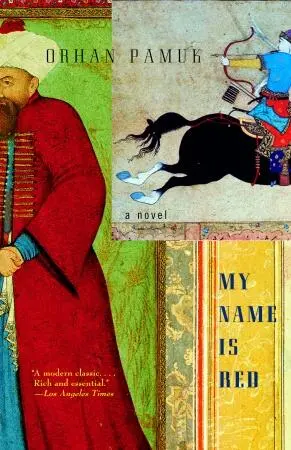
- Название:My Name is Red
- Автор:
- Жанр:
- Год:неизвестен
- ISBN:нет данных
- Рейтинг книги:5 / 5. Голосов: 1
-
Избранное:Добавить в избранное
- Отзывы:
-
Ваша оценка:
My Name is Red: краткое содержание, описание и аннотация
Предлагаем к чтению аннотацию, описание, краткое содержание или предисловие (зависит от того, что написал сам автор книги «My Name is Red»). Если вы не нашли необходимую информацию о книге — напишите в комментариях, мы постараемся отыскать её.
When the Sultan commissions a great book to celebrate his royal self and his extensive dominion, he directs Enishte Effendi to assemble a cadre of the most acclaimed artists in the land. Their task: to illuminate the work in the European style. But because figurative art can be deemed an affront to Islam, this commission is a dangerous proposition indeed, and no one in the elite circle can know the full scope or nature of the project.
Panic erupts when one of the chosen miniaturists disappears, and the Sultan demands answers within three days. The only clue to the mystery-or crime?-lies in the half-finished illuminations themselves. Has an avenging angel discovered the blasphemous work? Or is a jealous contender for the hand of Enishte’s ravishing daughter, the incomparable Shekure, somehow to blame?
Orhan Pamuk’s My Name Is Red is at once a fantasy and a philosophical puzzle, a kaleidoscopic journey to the intersection of art, religion, love, sex, and power.
"Pamuk is a novelist and a great one…My Name is Red is by far the grandest and most astonishing contest in his internal East-West war…It is chock-full of sublimity and sin…The story is told by each of a dozen characters, and now and then by a dog, a tree, a gold coin, several querulous corpses and the color crimson ('My Name is Red')…[Readers will] be lofted by the paradoxical lightness and gaiety of the writing, by the wonderfully winding talk perpetually about to turn a corner, and by the stubborn humanity in the characters' maneuvers to survive. It is a humanity whose lies and silences emerge as endearing and oddly bracing individual truths."- Richard Eder, New York Times Book Review
"A murder mystery set in sixteenth-century Istanbul [that] uses the art of miniature illumination, much as Mann's 'Doctor Faustus' did music, to explore a nation's soul… Erdag Goknar deserves praise for the cool, smooth English in which he has rendered Pamuk's finespun sentences, passionate art appreciations, sly pedantic debates, [and] eerie urban scenes."- John Updike, The New Yorker
"The interweaving of human and philosophical intrigue is very much as I remember it in The Name of the Rose, as is the slow, dense beginning and the relentless gathering of pace… But, in my view, his book is by far the better of the two. I would go so far as to say that Pamuk achieves the very thing his book implies is impossible… More than any other book I can think of, it captures not just Istanbul's past and present contradictions, but also its terrible, timeless beauty. It's almost perfect, in other words. All it needs is the Nobel Prize."-Maureen Freely, New Statesman (UK)
"A perfect example of Pamuk's method as a novelist, which is to combine literary trickery with page-turning readability… As a meditation on art, in particular, My Name is Red is exquisitely subtle, demanding and repaying the closest attention.. We in the West can only feel grateful that such a novelist as Pamuk exists, to act as a bridge between our culture and that of a heritage quite as rich as our own."-Tom Holland, Daily Telegraph (UK)
"Readers… will find themselves lured into a richly described and remarkable world… Reading the novel is like being in a magically exotic dream…Splendidly enjoyable and rewarding… A book in which you can thoroughly immerse yourself." -Allan Massie, The Scotsman (UK)
"A wonderful novel, dreamy, passionate and august, exotic in the most original and exciting way. Orhan Pamuk is indisputably a major novelist."-Philip Hensher, The Spectator (UK)
"[In this] magnificent new novel… Pamuk takes the reader into the strange and beautiful world of Islamic art,in which Western notions no longer make sense… In this world of forgeries, where some might be in danger of losing their faith in literature, Pamuk is the real thing, and this book might well be one of the few recent works of fiction that will be remembered at the end of this century."-Avkar Altinel, The Observer (UK)
My Name is Red — читать онлайн бесплатно полную книгу (весь текст) целиком
Ниже представлен текст книги, разбитый по страницам. Система сохранения места последней прочитанной страницы, позволяет с удобством читать онлайн бесплатно книгу «My Name is Red», без необходимости каждый раз заново искать на чём Вы остановились. Поставьте закладку, и сможете в любой момент перейти на страницу, на которой закончили чтение.
Интервал:
Закладка:
I rode four blocks toward the Golden Horn from the Yakutlar neighborhood to find the black-bearded, radiant-faced preacher of the mosque in Yasin Pasha, the adjacent neighborhood; broom in hand, he was shooing shameless dogs out of the muddy courtyard. I told him about my predicament. By the will of God, I explained, my Enishte’s time was upon him, and according to his last wish, I was to marry his daughter, who, by decision of the Üsküdar judge, had just been granted a divorce from a husband lost at war. The preacher objected that by the dictates of Islamic law a divorced woman must wait a month before remarrying, but I countered by explaining that Shekure’s former husband had been absent for four years; and so, there was no chance she was pregnant by him. I hastened to add that the Üsküdar judge granted a divorce this morning to allow Shekure to remarry, and I showed him the certifying document. “My exalted Imam Effendi, you may rest assured that there’s no obstacle to the marriage,” I said. True, she was a blood relation, but being maternal cousins is not an obstacle; her previous marriage had been nullified; there were no religious, social or monetary differences between us. And if he accepted the gold pieces I offered him up front, if he performed the ceremony at the wedding scheduled to take place before the entire neighborhood, he’d also be accomplishing a pious act before God for the fatherless children of a widowed woman. Did the Imam Effendi, I inquired, enjoy pilaf with almonds and dried apricots?
He did, but he was still preoccupied with the dogs at the gate. He took the gold coins. He said he’d don his wedding robes, straighten up his appearance, see to his turban and arrive in time to perform the nuptials. He asked the way to the house and I told him.
No matter how rushed a wedding might be-even one that the groom has dreamed about for twelve years-what could be more natural than his forgetting his worries and troubles and surrendering to the affectionate hands and gentle banter of a barber for a prenuptial shave and haircut? The barber’s, where my feet took me, was located near the market, on the street of the run-down house in Aksaray, which my late Enishte, my aunt and fair Shekure had quitted years after our childhood. This was the barber I’d faced five days ago, my first day back. When I entered he embraced me and as any good Istanbul barber would do, rather than asking where the last dozen years had gone, launched into the latest neighborhood gossip, concluding the conversation with an allusion to the place we would all go at the end of this meaningful journey called life.
The master barber had aged. The straight-edged razor he held in his freckled hand trembled as he made it dance across my cheek. He’d given himself over to drinking and had taken on a pink-complexioned, full-lipped, green-eyed boy-apprentice-who looked upon his master with awe. Compared with twelve years ago, the shop was cleaner and more orderly. After filling the hanging basin, which hung from the ceiling on a new chain, with boiling water, he carefully washed my hair and face with water from the brass faucet at the bottom of the basin. The old broad basins were newly tinned with no signs of rust, the heating braziers were clean, and the agate-handled razors were sharp. He wore an immaculate silk waistcoat, something he was loath to wear twelve years ago. I assumed that the elegant apprentice, tall for his age and of slender build, had helped bring some order to the shop and its owner, and surrendering myself to the soapy, rose-scented and steamy pleasures of a shave, I couldn’t help thinking how marriage not only brought new vitality and prosperity to a bachelor’s home, but to his work and his shop as well.
I’m not certain how much time had passed. I melted into the warmth of the brazier that gently heated the small shop and the barber’s adept fingers. With life having suddenly presented me the greatest of gifts today, as if for free, and after so much suffering, I felt a profound thanks toward exalted Allah. I felt an intense curiosity, wondering out of what mysterious balance this world of His had emerged, and I felt sadness and pity for Enishte, who lay dead in the house where, a while later, I would become master. I was readying myself to spring into action when there was a commotion at the always-open door of the barbershop: Shevket!
Flustered, but with his usual self-confidence, he held out a piece of paper. Unable to speak and expecting the worst, my insides were chilled as if by an icy draft as I read:
If there isn’t going to be a bride’s procession, I’m not getting married-Shekure.
Grabbing Shevket by the arm, I lifted him onto my lap. I would’ve liked to have responded to my dear Shekure by writing, “As you wish, my love!” but what would pen and ink be doing in the shop of an illiterate barber? So, with a calculated reserve, I whispered my response into the boy’s ear: “All right.” Still whispering, I asked him how his grandfather was doing.
“He’s sleeping.”
I now sense that Shevket, the barber and even you are suspicious about me and my Enishte’s death (Shevket, of course, suspects other things as well). What a pity! I forced a kiss upon him, and he quickly left, displeased. During the wedding, dressed in his holiday clothes, he glared at me with hostility from a distance.
Since Shekure wouldn’t be leaving her father’s house for mine, and I would be moving into the paternal home as bridegroom, the bridal procession was only fitting. Naturally, I was in no position to bedeck my wealthy friends and relatives and have them wait at Shekure’s front gate mounted on their horses as others might have done. Even so, I invited two of my childhood friends whom I’d run into during my six days back in Istanbul (one had become a clerk like myself and the other was running a bath house) as well as my dear barber, whose eyes had watered as he wished me happiness during my shave and haircut. Mounted upon my white horse, which I’d been riding that first day, I knocked at my beloved Shekure’s gate as if poised to take her to another house and another life.
To Hayriye, who opened the gate, I presented a generous tip. Shekure, dressed in a bright-red wedding gown with pink bridal streamers flowing from her hair to her feet, emerged amid cries, sobs, sighs (a woman scolded the children), outbursts, and shouts of “May God protect her,” and gracefully mounted a second white horse which we’d brought with us. As a hand-drummer and shrill zurna piper, kindly arranged by the barber for me at the last minute, began to play a slow bride’s melody, our poor, melancholy, yet proud procession set out on its way.
As our horses began to saunter, I understood that Shekure, with her usual cunning, had arranged this spectacle for the sake of safeguarding the nuptials. Our procession, having announced our wedding to the entire neighborhood, even if only at the last moment, had essentially secured everyone’s approval, thereby neutralizing any future objections to our marriage. Nevertheless, announcing that we were on the verge of marriage, and having a public wedding-as if to challenge our enemies, Shekure’s former husband and his family-further endangered the whole affair. Had it been left to me, I’d have held the ceremony in secret, without telling a soul, without a wedding celebration; I’d have preferred becoming her husband first and defending the marriage afterward.
I led the parade astride my fickle white fairy-tale horse, and as we moved through the neighborhood, I nervously watched for Hasan and his men, whom I expected to ambush us from an alleyway or a shadowy courtyard gate. I noticed how young men, the elders of the neighborhood and strangers stopped and waved from door fronts, without completely understanding all that was transpiring. In the small market area we’d unintentionally entered, I figured out that Shekure had masterfully activated her grapevine, and that her divorce and marriage to me was quickly winning acceptance in the neighborhood. This was evident from the excitement of the fruit-and-vegetable seller, who without leaving his colorful quinces, carrots and apples for too long, joined us for a few strides shouting “Praise be to God, may He protect you both,” and from the smile of the woeful shopkeeper and from the approving glances of the baker, who was having his apprentice scrape away the burnt residue in his pans. Still, I was anxious, maintaining my vigil against a sudden raid, or even a word of vulgar heckling. For this reason, I wasn’t at all disturbed by the commotion of the crowd of money-seeking children that had formed behind us as we left the bazaar. I understood from the smiles of women I glimpsed behind windows, bars and shutters that the enthusiasm of this noisy throng of children protected and supported us.
Читать дальшеИнтервал:
Закладка:
Похожие книги на «My Name is Red»
Представляем Вашему вниманию похожие книги на «My Name is Red» списком для выбора. Мы отобрали схожую по названию и смыслу литературу в надежде предоставить читателям больше вариантов отыскать новые, интересные, ещё непрочитанные произведения.










Обсуждение, отзывы о книге «My Name is Red» и просто собственные мнения читателей. Оставьте ваши комментарии, напишите, что Вы думаете о произведении, его смысле или главных героях. Укажите что конкретно понравилось, а что нет, и почему Вы так считаете.