Larry McMurtry - Lonesome Dove
Здесь есть возможность читать онлайн «Larry McMurtry - Lonesome Dove» весь текст электронной книги совершенно бесплатно (целиком полную версию без сокращений). В некоторых случаях можно слушать аудио, скачать через торрент в формате fb2 и присутствует краткое содержание. Жанр: Современная проза, на английском языке. Описание произведения, (предисловие) а так же отзывы посетителей доступны на портале библиотеки ЛибКат.
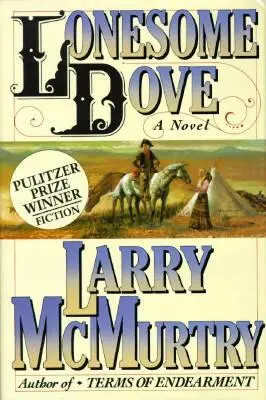
- Название:Lonesome Dove
- Автор:
- Жанр:
- Год:неизвестен
- ISBN:нет данных
- Рейтинг книги:5 / 5. Голосов: 1
-
Избранное:Добавить в избранное
- Отзывы:
-
Ваша оценка:
Lonesome Dove: краткое содержание, описание и аннотация
Предлагаем к чтению аннотацию, описание, краткое содержание или предисловие (зависит от того, что написал сам автор книги «Lonesome Dove»). Если вы не нашли необходимую информацию о книге — напишите в комментариях, мы постараемся отыскать её.
A love story, an adventure, an American epic, Lonesome Dove embraces all the West – legend and fact, heroes and outlaws, whoeres and ladies, Indians and settlers – in a novel that recreates the central American experience, the most enduring of our national myths.
Set in the late nineteenth century, Lonesome Dove is the story of a cattle drive from Texas to Montana – and much more. It is a drive that represents for everybody involved not only a daring, even a foolhardy, adventure, but a part of the American Dream – the attempt to carve out of the last remaining wilderness a new life.
Agustus McCrae and W.F. Call are former Texas Rangers, partners and friends who have shared hardship and danger together without ever quite understanding (or wanting to understand) each other's deepest emotions. Gus is the romantic, a reluctant rancher who has a way with women and the sense to leave well enough alone. Call is a driven, demanding man, a natural authority figure with no patience for weaknesses, and not many of his own. He is obsessed with the dream of creating his own empire, and with the need to conceal a secret sorrow of his own. The two men could hardly be more different, but both are tough, redoubtable fighters who have learned to count on each other, if nothing else.
Call's dream not only drags Gus along in its wake, but draws in a vast cast of characters:
– Lorena, the whore with the proverbial heart of gold, whom Gus (and almost everyone else) loves, and who survives one of the most terrifying experiences any woman could have…
– Elmira, the restless, reluctant wife of a small-time Arkansas sheriff, who runs away from the security of marriage to become part of the great Western adventure…
– Blue Duck, the sinister Indian renegade, one of the most frightening villains in American fiction, whose steely capacity for cruelty affects the lives of everyone in the book…
– Newt, the young cowboy for whom the long and dangerous journey from Texas to Montana is in fact a search for his own identity…
– Jake, the dashing, womanizing ex-Ranger, a comrade-in-arms of Gus and Call, whose weakness leads him to an unexpected fate…
– July Johnson, husband of Elmira, whose love for her draws him out of his secure life into the wilderness, and turns him into a kind of hero…
Lonesome Dove sweeps from the Rio Grande (where Gus and Call acquire the cattle for their long drive by raiding the Mexicans) to the Montana highlands (where they find themselves besieged by the last, defiant remnants of an older West).
It is an epic of love, heroism, loyalty, honor, and betrayal – faultlessly written, unfailingly dramatic. Lonesome Dove is the novel about the West that American literature – and the American reader – has long been waiting for.
Lonesome Dove — читать онлайн бесплатно полную книгу (весь текст) целиком
Ниже представлен текст книги, разбитый по страницам. Система сохранения места последней прочитанной страницы, позволяет с удобством читать онлайн бесплатно книгу «Lonesome Dove», без необходимости каждый раз заново искать на чём Вы остановились. Поставьте закладку, и сможете в любой момент перейти на страницу, на которой закончили чтение.
Интервал:
Закладка:
As they were going off, Newt saw that the tail of Lippy's old brown coat had gotten pinched in the wagon seat-which explained his not having jumped. The wagon tipped straight down, bounced once, and turned completely over just as it hit the water. The mules, still hitched to it, fell backwards on top of the mess. All four wagon wheels were spinning in the air when Newt and the Raineys jumped off their horses. The trouble was, they had no idea what to do next.
Fortunately Augustus had seen the commotion and in a minute was in the water, on old Malaria. He threw a loop over one of the spinning wheels and spurred the big horse vigorously, pulling the wagon to a tilt on one edge.
"Fish him out, boys, otherwise we'll have to go all the way to Montana without no pianer player," he said-though privately he doubted his efforts would do any good. The wagon had landed smack on top of Lippy. If he wasn't drowned he probably had a broken neck.
When the wagon tilted, Newt saw Lippy's legs. He and the Raineys waded in and tried to get him loose, but the coat was still pinched in the seat. All they could do was get his head above water, though his head was so covered with mud that it was difficult at first to know if he was dead or alive. Fortunately Pea soon rode up and cut the coat loose with his bowie knife.
"He's a mudhead, ain't he," Pea said, carefully wiping his knife on his pants leg. "Now I guess he'll be mad at me for ten years because I ruined his coat."
Lippy was limp as a rag and hadn't moved a muscle. Newt felt sick to his stomach. Once more, on a perfectly nice day with everything going well, death had struck and taken another of his friends. Lippy had been part of his life since he could remember. When he was a child, Lippy had occasionally taken him into the saloon and let him bang on the piano. Now they would have to bury him as they had buried Sean.
Strangely, neither Pea nor Mr. Gus was much concerned. The mules had regained their feet and stood in the shallow water, swishing their tails and looking sleepy. Call rode up about that time. He had been at the head of the herd, with Dish Boggett.
"Ain't nobody gonna unhitch them mules?" he asked. A big sack of flour had been thrown out of the wagon and lay in the river getting ruined. Newt had not noticed it until the Captain pointed at it.
"Well, I ain't," Augustus said. "The boys can, their feet are already wet."
It seemed to Newt everyone was being mighty callous about Lippy, who lay on the riverbank. Then, to his surprise, Lippy, whose head was still covered with mud, rolled over and began to belch water. He belched and vomited for several minutes, making a horrible sound, but Newt's relief that he was not dead was so great that he welcomed the sound and waded out to help the Raineys unhitch the mules.
It soon became clear that the wagon bed had been damaged beyond repair in the accident. When it was righted, all the goods that had been in it floated in the shallow water.
"What a place for a shipwreck," Augustus said.
"I never seen a wagon break in two before," Pea said.
The wagon bed, old and rotten, had burst upon impact. Several cowboys rode up and began to fish their bedrolls out of the muddy water.
"What became of Bol?" Pea asked. "Wasn't he driving the wagon?"
Lippy was sitting up, wiping mud off his head. He ran one finger under his loose lip as if he expected to find a tadpole or a small fish, but all he found was mud. About that time the Spettle boys rode up, and crossed the horse herd.
"Seen the cook?" Augustus asked.
"Why, he's walking along carrying his gun," Bill Spettle said. "Them pigs are with him."
Bolivar soon came in sight a couple of hundred yards away, the blue pigs walking along beside him.
"I heared a shot," Lippy said. "About that time them mules took to running. I guess a bandit shot at us."
"No competent bandit would waste a bullet on you or Bol either," Augustus said. "There ain't no reward for either of you."
"It sounded like a shotgun," Bill Spettle volunteered.
"Bol might have been taking target practice," Augustus said. "He might have fired at a cowpie."
"It don't matter what it was," Call said. "The damage is done."
Augustus was enjoying the little break the accident produced. Walking along all day beside a cow herd was already proving monotonous-any steady work had always struck him as monotonous. It was mainly accidents of one kind and another that kept life interesting, in his view, the days otherwise being mainly repetitious things, livened up mostly by the occasional card game.
It was made even more interesting a few minutes later when Bolivar walked up and handed in his resignation. He didn't even look at the smashed wagon.
"I don't want to go this way," he said, addressing himself to the Captain. "I am going back."
"Why, Bol, you won't stand a chance," Augustus said. "A renowned criminal like you. Some young sheriff out to make a reputation will hang you before you get halfway to the border."
"I don't care," Bol said. "I am going back."
In fact, he expected to be fired anyway. He had been dozing on the wagon seat, dreaming about his daughters, and had accidentally fired off the ten-gauge. The recoil had knocked him off the wagon, but even so it had been hard to get free of the dream. It turned into a dream in which his wife was angry, even as he awoke and saw the mules dashing away. The pigs were rooting in a rat's nest, under a big cactus. Bol was so enraged by the mules' behavior that he would have shot one of them, only they were already well out of range.
He had not seen the wagon go off the creek bank, but he was not surprised that it was broken. The mules were fast. He would probably not have been able to hit one of them even with a rifle, distracted as he was by the dream.
The fall convinced him he had lived long enough with Americans. They were not his compañeros . Most of his compañeros were dead, but his country wasn't dead, and in his village there were a few men who liked to talk about the old days when they had spent all their time stealing Texas cattle. In those years his wife had not been so angry. As he walked toward the busted wagon and the little group of men, he decided to go back. He was tired of seeing his family only in dreams. Perhaps this time when he walked in, his wife would be glad to see him.
At any rate, the Americanos were going too far north. He had not really believed Augustus when he said they would ride north for several months. Most of what Augustus said was merely wind. He supposed they would ride for a few days and then sell the cattle, or else start a ranch. He himself had never been more than two days' hard ride from the border in his life. Now a week had passed and the Americanos showed no sign of stopping. Already he was far from the river. He missed his family. Enough was enough.
Call was not especially surprised. "All right, Bol, do you want a horse?" he asked. The old man had cooked for them for ten years. He deserved a mount.
" Sí ," Bol said, remembering that it was a long walk back to the river, and then three days more to his village.
Call caught the old man a gentle gelding. "I've got no saddle to give you," he said, when he presented Bol with the horse.
Bol just shrugged. He had an extra serape and soon turned it into a saddle blanket. Apart from the gun, it was his only possession. In a moment he was ready to start home.
"Well, Bol, if you change your mind, you can find us in Montana," Augustus said. "It may be that your wife's too rusty for you now. You may want to come back and cook up a few more goats and snakes."
" Gracias, Capitán ," Bol said, when Call handed him the reins to the gelding. Then he rode off, without another word to anybody. It didn't surprise Augustus, since Bol had worked for them all those years without saying a word to anybody unless directly goaded into it-usually by Augustus.
Читать дальшеИнтервал:
Закладка:
Похожие книги на «Lonesome Dove»
Представляем Вашему вниманию похожие книги на «Lonesome Dove» списком для выбора. Мы отобрали схожую по названию и смыслу литературу в надежде предоставить читателям больше вариантов отыскать новые, интересные, ещё непрочитанные произведения.









Обсуждение, отзывы о книге «Lonesome Dove» и просто собственные мнения читателей. Оставьте ваши комментарии, напишите, что Вы думаете о произведении, его смысле или главных героях. Укажите что конкретно понравилось, а что нет, и почему Вы так считаете.