Larry McMurtry - Lonesome Dove
Здесь есть возможность читать онлайн «Larry McMurtry - Lonesome Dove» весь текст электронной книги совершенно бесплатно (целиком полную версию без сокращений). В некоторых случаях можно слушать аудио, скачать через торрент в формате fb2 и присутствует краткое содержание. Жанр: Современная проза, на английском языке. Описание произведения, (предисловие) а так же отзывы посетителей доступны на портале библиотеки ЛибКат.
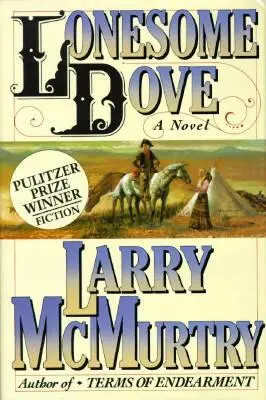
- Название:Lonesome Dove
- Автор:
- Жанр:
- Год:неизвестен
- ISBN:нет данных
- Рейтинг книги:5 / 5. Голосов: 1
-
Избранное:Добавить в избранное
- Отзывы:
-
Ваша оценка:
Lonesome Dove: краткое содержание, описание и аннотация
Предлагаем к чтению аннотацию, описание, краткое содержание или предисловие (зависит от того, что написал сам автор книги «Lonesome Dove»). Если вы не нашли необходимую информацию о книге — напишите в комментариях, мы постараемся отыскать её.
A love story, an adventure, an American epic, Lonesome Dove embraces all the West – legend and fact, heroes and outlaws, whoeres and ladies, Indians and settlers – in a novel that recreates the central American experience, the most enduring of our national myths.
Set in the late nineteenth century, Lonesome Dove is the story of a cattle drive from Texas to Montana – and much more. It is a drive that represents for everybody involved not only a daring, even a foolhardy, adventure, but a part of the American Dream – the attempt to carve out of the last remaining wilderness a new life.
Agustus McCrae and W.F. Call are former Texas Rangers, partners and friends who have shared hardship and danger together without ever quite understanding (or wanting to understand) each other's deepest emotions. Gus is the romantic, a reluctant rancher who has a way with women and the sense to leave well enough alone. Call is a driven, demanding man, a natural authority figure with no patience for weaknesses, and not many of his own. He is obsessed with the dream of creating his own empire, and with the need to conceal a secret sorrow of his own. The two men could hardly be more different, but both are tough, redoubtable fighters who have learned to count on each other, if nothing else.
Call's dream not only drags Gus along in its wake, but draws in a vast cast of characters:
– Lorena, the whore with the proverbial heart of gold, whom Gus (and almost everyone else) loves, and who survives one of the most terrifying experiences any woman could have…
– Elmira, the restless, reluctant wife of a small-time Arkansas sheriff, who runs away from the security of marriage to become part of the great Western adventure…
– Blue Duck, the sinister Indian renegade, one of the most frightening villains in American fiction, whose steely capacity for cruelty affects the lives of everyone in the book…
– Newt, the young cowboy for whom the long and dangerous journey from Texas to Montana is in fact a search for his own identity…
– Jake, the dashing, womanizing ex-Ranger, a comrade-in-arms of Gus and Call, whose weakness leads him to an unexpected fate…
– July Johnson, husband of Elmira, whose love for her draws him out of his secure life into the wilderness, and turns him into a kind of hero…
Lonesome Dove sweeps from the Rio Grande (where Gus and Call acquire the cattle for their long drive by raiding the Mexicans) to the Montana highlands (where they find themselves besieged by the last, defiant remnants of an older West).
It is an epic of love, heroism, loyalty, honor, and betrayal – faultlessly written, unfailingly dramatic. Lonesome Dove is the novel about the West that American literature – and the American reader – has long been waiting for.
Lonesome Dove — читать онлайн бесплатно полную книгу (весь текст) целиком
Ниже представлен текст книги, разбитый по страницам. Система сохранения места последней прочитанной страницы, позволяет с удобством читать онлайн бесплатно книгу «Lonesome Dove», без необходимости каждый раз заново искать на чём Вы остановились. Поставьте закладку, и сможете в любой момент перейти на страницу, на которой закончили чтение.
Интервал:
Закладка:
But his departure surprised and saddened Newt. It spoiled his relief that Lippy was alive-after all, he had lost another friend, Bol instead of Lippy. Newt didn't say so, but he would rather have lost Lippy. He didn't want Lippy to die, of course, but he wouldn't have minded if he had decided to return to Lonesome Dove.
But Bol rode away from them, his old gun resting across the horse's withers. For a moment Newt felt so sad that he almost embarrassed himself by crying. He felt his eyes fill up. How could Bol just go? He had always been the cook, and yet in five minutes he was as lost to them as if he had died. Newt turned and made a show of spreading out the bedrolls, but it was mainly to conceal the fact that he felt sad. If people kept leaving, they'd be down to nobody before they even got north of Texas.
Riding away, Bolivar too felt very sad. Now that he was going, he was not sure why he had decided to go. Perhaps it was because he didn't want to face embarrassment. After all, he had fired the shot that caused the mules to run. Also, he didn't want to get so far north that he couldn't find his way back to the river. As he rode away he decided he had made another stupid choice. So far, in his opinion, almost every decision of his life had been stupid. He didn't miss his wife that much-they had lost the habit of one another and might not be able to reacquire it. He felt a little bitter as he rode away. The Capitán should not have let him go. After all, he was the only man among them who could cook. He didn't really like the Americanos, but he was used to them. It was too bad they had suddenly decided to get so many cattle and go north. Life in Lonesome Dove had been easy. Goats were plentiful and easy to catch, and his wife was the right distance away. When he grew bored, he could beat the dinner bell with the broken crowbar. For some reason it gave him great satisfaction to beat the dinner bell. It had little to do with dinner, or anything. It was just something he liked to do. When he stopped he could hear the echoes of his work fading into Mexico.
He decided that, since he was in no hurry, he would stop in Lonesome Dove and beat the bell a few more times. He could say it was the Capitán 's orders. The thought was comforting. It made up for the fact that most of his decisions had been stupid. He rode south without looking back.
42.
"WELL, IF WE WASN'T DOOMED to begin with, we're doomed now," Augustus said, watching Bolivar ride away. He enjoyed every opportunity for pronouncing doom, and the loss of a cook was a good one.
"I expect we'll poison ourselves before we get much farther, with no regular cook," he said. "I just hope Jasper gets poisoned first."
"I never liked that old man's cooking anyway," Jasper said.
"You'll remember it fondly, once you're poisoned," Augustus said.
Call felt depressed by the morning's events. He did not particularly lament the loss of the wagon-an old wired-together wreck at best-but he did lament the loss of Bol. Once he formed a unit of men he didn't like to lose one of them, for any reason. Someone would have to assume extra work, which seldom sat well with whoever had to do it. Bolivar had been with them ten years and it was trying to lose him suddenly, although Call had not really expected him to come when he first announced the trip. Bolivar was a Mexican. If he didn't miss his family, he'd miss his country, as the Irishman did. Every night now, Allen O'Brien sang his homesick songs to the cattle. It soothed the cattle but not the men-the songs were too sorrowful.
Augustus noticed Call standing off to one side, looking blue. Once in a while Call would fall into blue spells-times when he seemed almost paralyzed by doubts he never voiced. The blue spells never came at a time of real crisis. Call thrived on crisis. They were brought on by little accidents, like the wagon breaking.
"Maybe Lippy can cook," Augustus suggested, to see if that would register with Call.
Lippy had found an old piece of sacking and was wiping the mud off his head. "No, I never learned to cook, I just learned to eat," Lippy said.
Call got on his horse, hoping to shake off the low feeling that had settled over him. After all, nobody was hurt, the herd was moving well, and Bol was no great loss. But the low feeling stayed. It was as if he had lead in his legs.
"You might try to load that gear on them mules," he said to Pea.
"Maybe we can make a two-wheel cart," Pea said. "There ain't much wrong with the front of the wagon. It's the back end that's busted up."
"Dern, Pea, you're a genius for figuring that out," Augustus said.
"I guess I'll go into San Antonio," Call said. "Maybe I can hire a cook and buy a new wagon."
"Fine, I'll join you," Augustus said.
"Why?" Call asked.
"To help judge the new chef," Augustus said. "You'd eat a fried stove lid if you was hungry. I'm interested in the finer points of cooking, myself. I'd like to give the man a tryout before we hire him."
"I don't see why. He won't have nothing much tenderer than a stove lid to cook around this outfit anyway," Jasper said. He had been very disappointed in the level of the grub.
"Just don't get nobody who cooks snakes," he warned. "If I have to eat any more snakes I'm apt to give notice."
"That's an idle threat, Jasper," Augustus said. "You wouldn't know where to go if you was to quit. For one thing, you'd be skeert to cross a river."
"You ought to let him be about that," Call said, when they had ridden out of earshot. Jasper's fear of water was nothing to joke about. Call had seen grown men get so scared of crossing rivers that it was practically necessary to knock them out at every crossing-and a shaky man was apt to panic and spook the herd. Under normal circumstances, Jasper Fant was a good hand, and there was nothing to be gained by riding him about his fear of water.
On the way to San Antonio they passed two settlements-nothing more than a church house and a few little stores, but settlements anyway, and not ten miles apart.
"Now look at that," Augustus said. "The dern people are making towns everywhere. It's our fault, you know."
"It ain't our fault and it ain't our business, either," Call said. "People can do what they want."
"Why, naturally, since we chased out the Indians and hung all the good bandits," Augustus said. "Does it ever occur to you that everything we done was probably a mistake? Just look at it from a nature standpoint. If you've got enough snakes around the place you won't be overrun with rats or varmints. The way I see it, the Indians and the bandits have the same job to do. Leave 'em be and you won't constantly be having to ride around these dern settlements."
"You don't have to ride around them," Call said. "What harm do they do?"
"If I'd have wanted civilization I'd have stayed in Tennessee and wrote poetry for a living," Augustus said. "Me and you done our work too well. We killed off most of the people that made this country interesting to begin with."
Call didn't answer. It was one of Gus's favorite themes, and if given a chance he would expound it for hours. Of course it was nonsense. Nobody in their right mind would want the Indians back, or the bandits either. Whether Gus had ever been in his right mind was an open question.
"Call, you ought to have married and had six or eight kids," Augustus remarked. If he couldn't get anywhere with one subject he liked to move on to another. Call's spirits hadn't improved much. When he was low it was hard to get him to talk.
"I can't imagine why you think so," Call said. "I wonder what's become of Jake?"
"Why, Jake's moseying along-starved for a card game, probably," Augustus said.
"He ought to leave that girl and throw in with us," Call said.
Читать дальшеИнтервал:
Закладка:
Похожие книги на «Lonesome Dove»
Представляем Вашему вниманию похожие книги на «Lonesome Dove» списком для выбора. Мы отобрали схожую по названию и смыслу литературу в надежде предоставить читателям больше вариантов отыскать новые, интересные, ещё непрочитанные произведения.









Обсуждение, отзывы о книге «Lonesome Dove» и просто собственные мнения читателей. Оставьте ваши комментарии, напишите, что Вы думаете о произведении, его смысле или главных героях. Укажите что конкретно понравилось, а что нет, и почему Вы так считаете.