Larry McMurtry - Lonesome Dove
Здесь есть возможность читать онлайн «Larry McMurtry - Lonesome Dove» весь текст электронной книги совершенно бесплатно (целиком полную версию без сокращений). В некоторых случаях можно слушать аудио, скачать через торрент в формате fb2 и присутствует краткое содержание. Жанр: Современная проза, на английском языке. Описание произведения, (предисловие) а так же отзывы посетителей доступны на портале библиотеки ЛибКат.
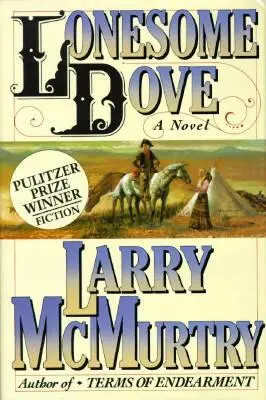
- Название:Lonesome Dove
- Автор:
- Жанр:
- Год:неизвестен
- ISBN:нет данных
- Рейтинг книги:5 / 5. Голосов: 1
-
Избранное:Добавить в избранное
- Отзывы:
-
Ваша оценка:
Lonesome Dove: краткое содержание, описание и аннотация
Предлагаем к чтению аннотацию, описание, краткое содержание или предисловие (зависит от того, что написал сам автор книги «Lonesome Dove»). Если вы не нашли необходимую информацию о книге — напишите в комментариях, мы постараемся отыскать её.
A love story, an adventure, an American epic, Lonesome Dove embraces all the West – legend and fact, heroes and outlaws, whoeres and ladies, Indians and settlers – in a novel that recreates the central American experience, the most enduring of our national myths.
Set in the late nineteenth century, Lonesome Dove is the story of a cattle drive from Texas to Montana – and much more. It is a drive that represents for everybody involved not only a daring, even a foolhardy, adventure, but a part of the American Dream – the attempt to carve out of the last remaining wilderness a new life.
Agustus McCrae and W.F. Call are former Texas Rangers, partners and friends who have shared hardship and danger together without ever quite understanding (or wanting to understand) each other's deepest emotions. Gus is the romantic, a reluctant rancher who has a way with women and the sense to leave well enough alone. Call is a driven, demanding man, a natural authority figure with no patience for weaknesses, and not many of his own. He is obsessed with the dream of creating his own empire, and with the need to conceal a secret sorrow of his own. The two men could hardly be more different, but both are tough, redoubtable fighters who have learned to count on each other, if nothing else.
Call's dream not only drags Gus along in its wake, but draws in a vast cast of characters:
– Lorena, the whore with the proverbial heart of gold, whom Gus (and almost everyone else) loves, and who survives one of the most terrifying experiences any woman could have…
– Elmira, the restless, reluctant wife of a small-time Arkansas sheriff, who runs away from the security of marriage to become part of the great Western adventure…
– Blue Duck, the sinister Indian renegade, one of the most frightening villains in American fiction, whose steely capacity for cruelty affects the lives of everyone in the book…
– Newt, the young cowboy for whom the long and dangerous journey from Texas to Montana is in fact a search for his own identity…
– Jake, the dashing, womanizing ex-Ranger, a comrade-in-arms of Gus and Call, whose weakness leads him to an unexpected fate…
– July Johnson, husband of Elmira, whose love for her draws him out of his secure life into the wilderness, and turns him into a kind of hero…
Lonesome Dove sweeps from the Rio Grande (where Gus and Call acquire the cattle for their long drive by raiding the Mexicans) to the Montana highlands (where they find themselves besieged by the last, defiant remnants of an older West).
It is an epic of love, heroism, loyalty, honor, and betrayal – faultlessly written, unfailingly dramatic. Lonesome Dove is the novel about the West that American literature – and the American reader – has long been waiting for.
Lonesome Dove — читать онлайн бесплатно полную книгу (весь текст) целиком
Ниже представлен текст книги, разбитый по страницам. Система сохранения места последней прочитанной страницы, позволяет с удобством читать онлайн бесплатно книгу «Lonesome Dove», без необходимости каждый раз заново искать на чём Вы остановились. Поставьте закладку, и сможете в любой момент перейти на страницу, на которой закончили чтение.
Интервал:
Закладка:
"Does Texas have mosquitoes too?" Joe asked.
July didn't answer. He knew the boy was starved for talk, and that he himself had been a sorry companion on the trip, but in fact he had no talk in him. He was so filled with worry that the only way he could contain it was just to keep silent and concentrate on the travel. He knew he was pushing both the boy and the horses harder than he ought to, but he couldn't keep from it. Only hard, constant travel allowed him to hold down the worry-which was all to do with Elmira.
Almost from the day they left, he felt something was wrong. He had had a feeling that something bad had happened, and no matter how hard he tried to concentrate on the job at hand, the worry wouldn't leave. It was all he could do to keep from turning the horses around and heading back for Font Smith.
At first Joe was cheerful and eager, but he was not a particularly strong boy, and he was not used to riding sixteen hours a day. He didn't complain, but he did grow tired, sleeping so deeply when they stopped that July could barely get him awake when it was time to move on. Often he rode in a doze for miles at a stretch. Once or twice July was tempted to leave him at one of the farms they passed. Joe was a willing worker and could earn his keep until he could come back and get him. But the only reason for doing that would be to travel even harder, and the horses couldn't stand it. Besides, if he left the boy, it would be a blow to his pride, and Joe didn't have too much pride as it was.
For several days they bore southwest, through the pine woods. It had been a rainy spring and their big problem was mosquitoes. The trees dripped and the puddles lay everywhere. July hardly noticed the mosquitoes himself, but Joe and the horses suffered, particularly at night.
"Pretty soon I'll be all bump," Joe said, grinning, as they slogged through a clearing. He looked up to see a broad, muddy river curving down from the north.
"I guess that's the Red," July said. "That means we're about to Texas."
When they rode up to the banks of the river they were greeted by an amazing sight. Though running freely, the river was shallow and evidently boggy. Evidence for the bogginess was visible in the form of a tall man over toward the far bank. He was standing in knee-high water, between a gaunt horse and a little brown pack mule, both of which had sunk past their hocks in the river mud.
"I've heard this river was half quicksand," July said.
From Roscoe, Joe had heard terrible stories about quicksand-in the stories, men and horses and even wagons were slowly swallowed up. He had suspected the stories were exaggerated, and the man and his animals proved it. All might be bogged, but none were sinking. The man wore a tall beaver hat and a long frock coat. Both animals had numerous parcels tied to them, and the man was amusing himself by untying the parcels and pitching them into the river. One by one they began to float away. To their astonishment he even threw away his bedroll.
"The man must be a lunatic," July said. "He must think that horse will float if he gets off some weight. That horse ain't gonna float."
The man noticed them and gave a friendly wave, then proceeded to unburden the mule of most of its pack. Some floated and some merely lay in the shallow water.
July rode upstream until he found a place where both deer and cattle had crossed. The water was seldom more than a foot deep. They crossed a reddish bar of earth, and it seemed for a moment they might bog, but July edged south and soon found firm footing. In a few minutes they were on the south bank, whereas the man in the beaver hat had made no progress at all. He was so cool about his predicament that it was hard to tell if he even wished to make progress.
"Let me have your rope," July said to Joe. He tied their two ropes together and managed to fling the man a line. After that it was no great trouble to drag the horse and the pack mule out. The man waded out with them.
"Thank you, men," he said. "I believe if my mule hadn't got out soon, he would have learned to live on fish. They're self-reliant creatures."
"I'm July Johnson and this is Joe," July said. "You didn't need to throw away your baggage."
"I've suffered no loss," the man said. "I'm glad I found a river to unload that stuff in. Maybe the fish and the tadpoles will make better use of it than I have."
"Well, I've never seen a fish that used a bedroll," July said.
Joe had never met a man so careless that he would throw his possessions in a river. But the man seemed as cheerful as if he'd just won a tub of money.
"My name's Sedgwick," he said. "I'm traveling through this country looking for bugs."
"I bet you found plenty," July said.
"What do you do with bugs?" Joe asked, feeling that the man was the strangest he had ever met.
"I study them," the man said.
Joe hardly knew what to say. What was there to study about a bug? Either it bit you or it didn't.
"I've left about a thousand bugs in Little Rock," the man said. "That's why I threw away my equipment. I'm out of the mood to study bugs and am thinking of going to Texas to preach the Gospel. I've heard that Texans can use some good straight Gospel."
"Why study a bug?" Joe asked again, his curiosity getting the better of him.
"There's more than a million species of insect and only one species of human being," the man said. "When we finish up with this planet the insects will take over. You may not think it, seeing all this fair land, but the days of the human race are numbered. The insects are waiting their turn."
July decided the man was mildly touched, but probably no danger to himself or anyone. "I'd watch these crossings, if I were you. Cross where the deer cross and you'll be all right," he said.
The man turned his blue eyes on July for a moment. "Why, son, I'm fine," he said. "You're the one in trouble. I can see you carry a weight on your heart. You're hurrying along to do something you may not want to do. I see by your badge that you're a lawman. But the crimes the law can understand are not the worst crimes. I have often sinned worse than the murderer, and yet I try to live in virtue."
July was so taken aback he hardly knew what to say. This Mr. Sedgwick was one of the queerest men he had ever met.
"This boy looks a little peaked," Mr. Sedgwick said. "You can leave him with me, if you like. I'll bring him along slow, fatten him up and teach him about the insect kingdom as we travel. I doubt he's had much chance to get an education."
July was half tempted. The stranger seemed kindly. On the other hand he wore a sidearm under his coat, so perhaps he wasn't as kindly as he looked.
"It may be we'll meet down the road," July said, ignoring the offer.
"Perhaps," Mr. Sedgwick said. "I see you're in a hurry to get someplace. It's a great mistake to hurry."
"Why?" Joe asked, puzzled by almost everything the traveler said.
"Because the grave's our destination," Mr. Sedgwick said. "Those who hurry usually get to it quicker than those who take their time. Now, me, I travel, and when I'll get anywhere is anybody's guess. If you two hadn't come along I'd have likely stood there in the river for another hour or two. The moving waters are ever a beautiful sight."
Mr. Sedgwick turned and walked down the riverbank without another word. From time to time he squatted to peer closely at the ground.
"I reckon he's spotted a bug," Joe said.
July didn't answer. Crazy or not, the tall traveler had been smart enough to figure out that the sheriff of Fort Smith was traveling with a heavy heart.
39.
THE DEATH OF the young Irishman cast a heavy gloom over the cow camp. Call could do nothing about it. For the next week it seemed no one talked of anything but the death.
Читать дальшеИнтервал:
Закладка:
Похожие книги на «Lonesome Dove»
Представляем Вашему вниманию похожие книги на «Lonesome Dove» списком для выбора. Мы отобрали схожую по названию и смыслу литературу в надежде предоставить читателям больше вариантов отыскать новые, интересные, ещё непрочитанные произведения.








Обсуждение, отзывы о книге «Lonesome Dove» и просто собственные мнения читателей. Оставьте ваши комментарии, напишите, что Вы думаете о произведении, его смысле или главных героях. Укажите что конкретно понравилось, а что нет, и почему Вы так считаете.