Larry McMurtry - Lonesome Dove
Здесь есть возможность читать онлайн «Larry McMurtry - Lonesome Dove» весь текст электронной книги совершенно бесплатно (целиком полную версию без сокращений). В некоторых случаях можно слушать аудио, скачать через торрент в формате fb2 и присутствует краткое содержание. Жанр: Современная проза, на английском языке. Описание произведения, (предисловие) а так же отзывы посетителей доступны на портале библиотеки ЛибКат.
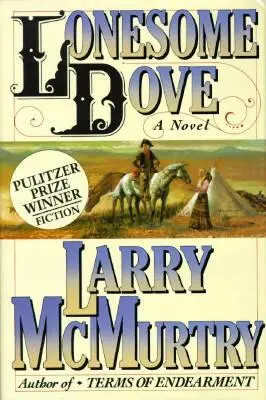
- Название:Lonesome Dove
- Автор:
- Жанр:
- Год:неизвестен
- ISBN:нет данных
- Рейтинг книги:5 / 5. Голосов: 1
-
Избранное:Добавить в избранное
- Отзывы:
-
Ваша оценка:
Lonesome Dove: краткое содержание, описание и аннотация
Предлагаем к чтению аннотацию, описание, краткое содержание или предисловие (зависит от того, что написал сам автор книги «Lonesome Dove»). Если вы не нашли необходимую информацию о книге — напишите в комментариях, мы постараемся отыскать её.
A love story, an adventure, an American epic, Lonesome Dove embraces all the West – legend and fact, heroes and outlaws, whoeres and ladies, Indians and settlers – in a novel that recreates the central American experience, the most enduring of our national myths.
Set in the late nineteenth century, Lonesome Dove is the story of a cattle drive from Texas to Montana – and much more. It is a drive that represents for everybody involved not only a daring, even a foolhardy, adventure, but a part of the American Dream – the attempt to carve out of the last remaining wilderness a new life.
Agustus McCrae and W.F. Call are former Texas Rangers, partners and friends who have shared hardship and danger together without ever quite understanding (or wanting to understand) each other's deepest emotions. Gus is the romantic, a reluctant rancher who has a way with women and the sense to leave well enough alone. Call is a driven, demanding man, a natural authority figure with no patience for weaknesses, and not many of his own. He is obsessed with the dream of creating his own empire, and with the need to conceal a secret sorrow of his own. The two men could hardly be more different, but both are tough, redoubtable fighters who have learned to count on each other, if nothing else.
Call's dream not only drags Gus along in its wake, but draws in a vast cast of characters:
– Lorena, the whore with the proverbial heart of gold, whom Gus (and almost everyone else) loves, and who survives one of the most terrifying experiences any woman could have…
– Elmira, the restless, reluctant wife of a small-time Arkansas sheriff, who runs away from the security of marriage to become part of the great Western adventure…
– Blue Duck, the sinister Indian renegade, one of the most frightening villains in American fiction, whose steely capacity for cruelty affects the lives of everyone in the book…
– Newt, the young cowboy for whom the long and dangerous journey from Texas to Montana is in fact a search for his own identity…
– Jake, the dashing, womanizing ex-Ranger, a comrade-in-arms of Gus and Call, whose weakness leads him to an unexpected fate…
– July Johnson, husband of Elmira, whose love for her draws him out of his secure life into the wilderness, and turns him into a kind of hero…
Lonesome Dove sweeps from the Rio Grande (where Gus and Call acquire the cattle for their long drive by raiding the Mexicans) to the Montana highlands (where they find themselves besieged by the last, defiant remnants of an older West).
It is an epic of love, heroism, loyalty, honor, and betrayal – faultlessly written, unfailingly dramatic. Lonesome Dove is the novel about the West that American literature – and the American reader – has long been waiting for.
Lonesome Dove — читать онлайн бесплатно полную книгу (весь текст) целиком
Ниже представлен текст книги, разбитый по страницам. Система сохранения места последней прочитанной страницы, позволяет с удобством читать онлайн бесплатно книгу «Lonesome Dove», без необходимости каждый раз заново искать на чём Вы остановились. Поставьте закладку, и сможете в любой момент перейти на страницу, на которой закончили чтение.
Интервал:
Закладка:
"I'd leave 'em out but they'd run off," she said. "They don't like farming as much as I do. I guess we'll have corn bread for supper. It's about all I eat."
"Why not bacon?" Roscoe asked. He was quite hungry and would have appreciated a good hunk of bacon or a chop of some kind. Several chickens were scratching around the cabin-any one of them would have made good eating but he didn't feel he ought to mention it, since he was the guest.
"I won't have no pigs around," Louisa said. "Too smart. I won't bother with animals I have to outwit. I'd rather just farm."
True to her word, Louisa served up a meal of corn bread, washed down with well water. The cabin was roomy and clean, but there was not much food in it. Roscoe was puzzled as to how Louisa could keep going with nothing but corn bread in her. It occurred to him that he had not seen a milk cow anywhere, so evidently she had even dispensed with such amenities as milk and butter.
She herself munched a plate of corn bread contentedly, now and then fanning herself. It was hot and still in the cabin.
"I doubt you'll catch that sheriff," she said, looking Roscoe over.
Roscoe doubted it too, but felt that he had to make a show of trying, at least. What was more likely was that if he rode around long enough July would eventually come and find him.
"Well, he went to Texas," he said. "Maybe I'll strike someone that's seen him."
"Yes, and maybe you'll ride right into a big mess of Comanche Indians," Louisa said. "You do that and you'll never enjoy another good plate of corn bread."
Roscoe let the remark pass. The less said about Indians the better, in his view. He munched corn bread for a while, preferring not to think about any of the various things that might happen to him in Texas.
"Was you ever married?" Louisa asked.
"No, ma'am," Roscoe said. "I was never even engaged."
"In other words you've went to waste," Louisa said.
"Well, I've been a deputy sheriff for a good spell," Roscoe said. "I keep the jail."
Louisa was watching him closely in a way that made him a little uncomfortable. The only light in the cabin came from a small coal-oil lamp on the table. A few small bugs buzzed around the lamp, their movements casting shadows on the table. The corn bread was so dry that Roscoe kept having to dip dippenfuls of water to wash it down.
"Roscoe, you're in the wrong trade," Louisa said. "If you could just learn to handle an ax you might make a good farmer."
Roscoe didn't know what to say to that. Nothing was less likely than that he would make a farmer.
"Why'd that sheriff's wife run off?" Louisa asked.
"She didn't say," Roscoe said. "Maybe she said to July but I doubt it, since he left before she did."
"Didn't like Arkansas, I guess," Louisa said. "He might just as well let her go, if that's the case. I like it myself, though it ain't no Alabama."
After that the conversation lagged. Roscoe kept wishing there was something to eat besides corn bread, but there wasn't. Louisa continued to watch him from the other side of the table.
"Roscoe, have you had any experience with women at all?" she asked, after a bit.
To Roscoe it seemed a bold question, and he took his time answering it. Once about twenty years earlier he had fancied a girl named Betsie and had been thinking about asking her to take a walk with him some night. But he was shy, and while he was getting around to asking, Betsie died of smallpox. He had always regretted that they never got to take their walk, but after that he hadn't tried to have much to do with women.
"Well, not much," he admitted, finally.
"I got the solution to both our problems," Louisa said. "You let that sheriff find his own wife and stay here and we'll get married."
She said it in the same confident, slightly loud voice that she always seemed to use-after a day of yelling at mules it was probably hard to speak in a quiet voice.
Despite the loudness, Roscoe assumed he had misunderstood her. A woman didn't just out and ask a man to marry. He pondered what she had said a minute, trying to figure out where he might have missed her meaning. It stumped him, though, so he chewed slowly on his last bite of corn bread.
"What was it you said?" he asked, finally.
"I said we oughta get married," Louisa said loudly. "What I like about you is you're quiet. Jim talked every second that he didn't have a whiskey bottle in his mouth. I got tired of listening. Also, you're skinny. If you don't last, you'll be easy to bury. I've buried enough husbands to take such things into account. What do you say?"
"I don't want to," Roscoe said. He was aware that it sounded impolite but was too startled to say otherwise.
"Well, you ain't had time to think about it," Louisa said. "Give it some thought while you're finishing the corn bread. Much as I hate burying husbands, I don't want to live alone. Jim wasn't much good but he was somebody in the bed, at least. I've had six boys in all but not a one of 'em stayed around. Had two girls but they both died. That's eight children. I always meant to have ten but I've got two to go and time's running out."
She munched her corn bread for a while. She seemed to be amused, though Roscoe couldn't figure out what might be amusing.
"How big was your family?" she asked.
"There was just four of us boys," Roscoe said. "Ma died young."
Louisa was watching him, which made him nervous. He remembered that he was supposed to be thinking about the prospect of marrying her while he finished the cornbread, but in fact his appetite was about gone anyway and he was having to choke it down. He began to feel more and more of a grievance against more and more people. The start of it all was Jake Spoon, who had no business coming to Fort Smith in the first place. It seemed to him that a chain of thoughtless actions, on the part of many people he knew, had resulted in his being stuck in a cabin in the wilderness with a difficult widow woman. Jake should have kept his pistol handier, and not resorted to a buffalo gun. Benny Johnson should have been paying attention to his dentistry and not walking around in the street in the middle of the day. July shouldn't have married Elmira if she was going to run off, and of course Elmira certainly had no business geting on the whiskey boat.
In all of it no one had given much consideration to him, least of all the townspeople of Fort Smith. Peach Johnson and Charlie Barnes, in particular, had done their best to see that he had to leave.
But if the townspeople of Fort Smith had not considered him, the same couldn't be said for Louisa Brooks, who was giving him a good deal more consideration than he was accustomed to.
"I was never a big meat eater," she said. "Living off corn bread keeps you feeling light on your feet."
Roscoe didn't feel light on his feet, though. Both his legs pained him from where the root had struck them. He choked down the last of the corn bread and took another swallow on two of the cool well water.
"You ain't a bad-looking feller," Louisa said. "Jim was prone to warts. Had 'em on his hands and on his neck both. So far as I can see you don't have a wart on you."
"No, don't believe so," Roscoe admitted.
"Well, that's all the supper," Louisa said. "What about my proposition?"
"I can't," Roscoe said, putting it as politely as he knew how. "If I don't keep on till I find July 1 might lose my job."
Louisa looked exasperated. "You're a fine guest," she said. "I tell you what, let's give it a tryout. You ain't had enough experience of women to know whether you like the married life or not. It might suit you to a T. If it did, you wouldn't have to do risky work like being a deputy."
It was true that being a deputy had become almost intolerably risky-Roscoe had to grant that. But judging from July's experience, marriage had its risks too.
Читать дальшеИнтервал:
Закладка:
Похожие книги на «Lonesome Dove»
Представляем Вашему вниманию похожие книги на «Lonesome Dove» списком для выбора. Мы отобрали схожую по названию и смыслу литературу в надежде предоставить читателям больше вариантов отыскать новые, интересные, ещё непрочитанные произведения.







Обсуждение, отзывы о книге «Lonesome Dove» и просто собственные мнения читателей. Оставьте ваши комментарии, напишите, что Вы думаете о произведении, его смысле или главных героях. Укажите что конкретно понравилось, а что нет, и почему Вы так считаете.