Larry McMurtry - Lonesome Dove
Здесь есть возможность читать онлайн «Larry McMurtry - Lonesome Dove» весь текст электронной книги совершенно бесплатно (целиком полную версию без сокращений). В некоторых случаях можно слушать аудио, скачать через торрент в формате fb2 и присутствует краткое содержание. Жанр: Современная проза, на английском языке. Описание произведения, (предисловие) а так же отзывы посетителей доступны на портале библиотеки ЛибКат.
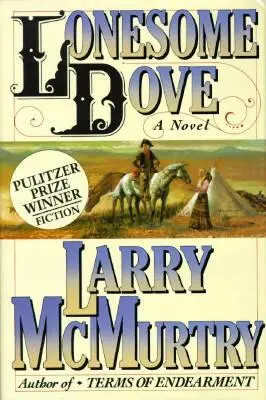
- Название:Lonesome Dove
- Автор:
- Жанр:
- Год:неизвестен
- ISBN:нет данных
- Рейтинг книги:5 / 5. Голосов: 1
-
Избранное:Добавить в избранное
- Отзывы:
-
Ваша оценка:
Lonesome Dove: краткое содержание, описание и аннотация
Предлагаем к чтению аннотацию, описание, краткое содержание или предисловие (зависит от того, что написал сам автор книги «Lonesome Dove»). Если вы не нашли необходимую информацию о книге — напишите в комментариях, мы постараемся отыскать её.
A love story, an adventure, an American epic, Lonesome Dove embraces all the West – legend and fact, heroes and outlaws, whoeres and ladies, Indians and settlers – in a novel that recreates the central American experience, the most enduring of our national myths.
Set in the late nineteenth century, Lonesome Dove is the story of a cattle drive from Texas to Montana – and much more. It is a drive that represents for everybody involved not only a daring, even a foolhardy, adventure, but a part of the American Dream – the attempt to carve out of the last remaining wilderness a new life.
Agustus McCrae and W.F. Call are former Texas Rangers, partners and friends who have shared hardship and danger together without ever quite understanding (or wanting to understand) each other's deepest emotions. Gus is the romantic, a reluctant rancher who has a way with women and the sense to leave well enough alone. Call is a driven, demanding man, a natural authority figure with no patience for weaknesses, and not many of his own. He is obsessed with the dream of creating his own empire, and with the need to conceal a secret sorrow of his own. The two men could hardly be more different, but both are tough, redoubtable fighters who have learned to count on each other, if nothing else.
Call's dream not only drags Gus along in its wake, but draws in a vast cast of characters:
– Lorena, the whore with the proverbial heart of gold, whom Gus (and almost everyone else) loves, and who survives one of the most terrifying experiences any woman could have…
– Elmira, the restless, reluctant wife of a small-time Arkansas sheriff, who runs away from the security of marriage to become part of the great Western adventure…
– Blue Duck, the sinister Indian renegade, one of the most frightening villains in American fiction, whose steely capacity for cruelty affects the lives of everyone in the book…
– Newt, the young cowboy for whom the long and dangerous journey from Texas to Montana is in fact a search for his own identity…
– Jake, the dashing, womanizing ex-Ranger, a comrade-in-arms of Gus and Call, whose weakness leads him to an unexpected fate…
– July Johnson, husband of Elmira, whose love for her draws him out of his secure life into the wilderness, and turns him into a kind of hero…
Lonesome Dove sweeps from the Rio Grande (where Gus and Call acquire the cattle for their long drive by raiding the Mexicans) to the Montana highlands (where they find themselves besieged by the last, defiant remnants of an older West).
It is an epic of love, heroism, loyalty, honor, and betrayal – faultlessly written, unfailingly dramatic. Lonesome Dove is the novel about the West that American literature – and the American reader – has long been waiting for.
Lonesome Dove — читать онлайн бесплатно полную книгу (весь текст) целиком
Ниже представлен текст книги, разбитый по страницам. Система сохранения места последней прочитанной страницы, позволяет с удобством читать онлайн бесплатно книгу «Lonesome Dove», без необходимости каждый раз заново искать на чём Вы остановились. Поставьте закладку, и сможете в любой момент перейти на страницу, на которой закончили чтение.
Интервал:
Закладка:
"Just quirt 'em if you see any," he added.
"I hope none don't crawl in this wagon," Lippy said, his lip quivering with apprehension.
The wagon floated better than expected-Bolivar barely got his feet wet. Jasper flinched once when he saw a stick he thought was a snake, but the moccasins had scattered and were not seen again.
Allen O'Brien dismounted and stood and cried over his brother. Jasper Fant cried, too, mostly from relief that he was still alive.
While they were having their cry, Deets and Pea got shovels from the wagon and dug a grave, back from the river a hundred yards, beside a live oak tree. Then they cut off part of one of the wagon sheets, wrapped the dead boy in it and carried him in the wagon to the grave. They laid him in it and Deets and Pea soon covered him, while most of the crew stood around, not knowing what to do or say.
"If you'd like to sing or something, do it," Call said. Allen stood a moment, started singing an Irish song in a quavering voice, then broke down crying and couldn't finish it.
"I don't have no pianer or I'd play one of the church hymns," Lippy said.
"Well, I'll say a word," Augustus said. "This was a good, brave boy, for we all saw that he conquered his fear of riding. He had a fine tenor voice, and we'll all miss that. But he wasn't used to this part of the world. There's accidents in life and he met with a bad one. We may all do the same if we ain't careful."
He turned and mounted old Malaria. "Dust to dust," he said. "Lets the rest of us go on to Montana."
He's right, Call thought. The best thing to do with a death was to move on from it. One by one the cowboys mounted and went off to the herd, many of them taking a quick last look at the muddy grave under the tree.
Augustus waited for Allen O'Brien, who was the last to mount. He was so weak from shock, it seemed he might not be able to, but he finally got on his horse and rode off, looking back until the grave was hidden by the tall gray grass. "It seems too quick," he said. "It seems very quick, just to ride off and leave the boy. He was the babe of our family," he added.
"If we was in town we'd have a fine funeral," Augustus said. "But as you can see, we ain't in town. There's nothing you can do but kick your horse."
"I wish I could have finished the song," Allen said.
36.
THE WHISKEY BOAT STANK, and the men on it stank, but Elmira was not sorry she had taken passage. She had a tiny little cubbyhole among the whiskey casks, with a few planks and some buffalo skins thrown over it to keep the rain out, but she spent most of her time sitting at the rear of the boat, watching the endless flow of brown water. Some days were so hot that the air above the water shimmered and the shore became indistinct; other days a chill rain blew and she wrapped herself in one of the buffalo robes and kept fairly dry. The rain was welcome, for it discouraged the fleas. They made her sleep uneasy, but it was a small price to pay for escaping from Fort Smith. She had lived where there were fleas before, and worse things than fleas.
As the boat inched its way up the Arkansas, the brown river gradually narrowed, and as it narrowed the boatmen and whiskey traders grew more restless. They drank so much whiskey themselves that Elmira felt they would be lucky to have any left to sell. Though she often felt them watching her as she sat at the end of the boat, they let her alone. Only Fowler, the chief trader, ever spoke more than a word or two to her. Fowler was a burly man with a dirty yellow beard and one eyelid that wouldn't behave. It twitched and jerked up and down erratically, so that looking at him was disconcerting: one minute he would be looking at you out of both eyes, and then the eyelid would droop and he would only be looking with an eye and a half.
Fowler drank continuously-all day and all night, so far as Elmira could tell. When she woke, from the fleas or the rocking of the boat, she would always hear his hoarse voice, talking to anyone who would listen. He kept a heavy rifle in the crook of his arm, and his eyes were always scanning the banks.
Mainly Fowler talked of Indians, for whom he had a pure hatred. He had been a buffalo hunter and had had many run-ins with them. When the buffalo ran out he began to traffic in whiskey. So far neither he nor any of his men had offered Elmira the slightest offense. It surprised her. They were a rough-looking bunch, and she had taken a big gamble in getting on the boat. No one in Fort Smith had seen her leave, as far as she knew, and the boatmen could have killed her and thrown her to the turtles without anyone's being the wiser. The first few nights in her cubbyhole she had been wakeful and a little frightened, expecting one of the men to stumble in and fall on her. She waited, thinking it would happen-if it did, she would only have her old life back, which had been part of the point of leaving. She would stop being July Johnson's wife, at least. It might be rough for a while, but eventually she would find Dee and life would improve.
But the men avoided her, day or night-all except Fowler, who wandered the boat constantly. Once, standing beside her, he knelt suddenly and cocked his rifle, but what he thought was an Indian turned out to be a bush. "The heat's got my eye jumping," he said, spitting a brown stream of tobacco into the water.
Elmira also watched the distant banks, which were green with the grass of spring. As the river gradually narrowed, she saw many animals: deer, coyote, cattle-but no Indians. She remembered stories heard over the years about women being carried off by Indians; in Kansas she had had such a woman pointed out to her, one who had been rescued and brought back to live with whites again. To her the woman seemed no different from other women, though it was true that she seemed cowed; but then, many women were cowed by events more ordinary. It was hard to see how the Indians could be much worse than the buffalo hunters, two of whom were on board. The sight of them brought back painful memories. They were big men with buffalo-skin coats and long shaggy hair-they looked like the animals they hunted. At night, in her cubbyhole, she would sometimes hear them relieving themselves over the side of the boat; they would stand just beyond the whiskey casks and pour their water into the Arkansas.
For some reason the sound reminded her of July, perhaps because she had never heard him make it. July was reticent about such things and would walk far into the woods when he had to go, to spare her any embarrassment. She found his reticence and shyness strangely irritating-it sometimes made her want to tell him what she had really done before they married. But she held back that truth, and every other truth she knew; she ceased talking to July Johnson at all.
In the long days and nights, with no one to talk to but Fowler, and him only occasionally, Elmira found herself thinking more and more about Dee. Joe she didn't think about, had never thought about much. He had never seemed hers, exactly, though she had certainly borne him. But from the first she had looked at him with detachment and only mild interest, and the twelve years since his birth had been a waiting period-waiting for the time for when she could send him away and belong only to herself again. It occurred to her that the one good thing about marrying July Johnson was that he would do to leave Joe with.
With Dee, she could belong to herself, for if ever a man belonged to himself, it was Dee. You never knew where Dee would be from one day to the next; when he was there he was always eager to share the fun, but then, before you could look around he had vanished, off to another town or another girl.
Soon the skies above the river got wider and wider as the river wound out of the trees and cut through the plains. The nights were cool, the mornings warming quickly, so that when Elmira woke the river behind her would be covered with a frosting of mist, and the boat would be lost in the mist completely, until the sun could break through. Several times ducks and geese, taking off in the mist, almost flew into her as she stood at the near of the boat wrapped in the buffalo robe. When the mist was heavy the splash of birds or the jumping of fish startled her; once she was frightened by the heavy beat of wings as one of the huge gray cranes flew low over the boat. As the mist thinned she would see the cranes standing solemnly in the shallows, ignoring the strings of ducks that swam nearby. Pockets of mist would linger on the water for an hour or more after the sun had risen and the sky turned a clean blue.
Читать дальшеИнтервал:
Закладка:
Похожие книги на «Lonesome Dove»
Представляем Вашему вниманию похожие книги на «Lonesome Dove» списком для выбора. Мы отобрали схожую по названию и смыслу литературу в надежде предоставить читателям больше вариантов отыскать новые, интересные, ещё непрочитанные произведения.









Обсуждение, отзывы о книге «Lonesome Dove» и просто собственные мнения читателей. Оставьте ваши комментарии, напишите, что Вы думаете о произведении, его смысле или главных героях. Укажите что конкретно понравилось, а что нет, и почему Вы так считаете.