Larry McMurtry - Lonesome Dove
Здесь есть возможность читать онлайн «Larry McMurtry - Lonesome Dove» весь текст электронной книги совершенно бесплатно (целиком полную версию без сокращений). В некоторых случаях можно слушать аудио, скачать через торрент в формате fb2 и присутствует краткое содержание. Жанр: Современная проза, на английском языке. Описание произведения, (предисловие) а так же отзывы посетителей доступны на портале библиотеки ЛибКат.
- Название:Lonesome Dove
- Автор:
- Жанр:
- Год:неизвестен
- ISBN:нет данных
- Рейтинг книги:5 / 5. Голосов: 1
-
Избранное:Добавить в избранное
- Отзывы:
-
Ваша оценка:
Lonesome Dove: краткое содержание, описание и аннотация
Предлагаем к чтению аннотацию, описание, краткое содержание или предисловие (зависит от того, что написал сам автор книги «Lonesome Dove»). Если вы не нашли необходимую информацию о книге — напишите в комментариях, мы постараемся отыскать её.
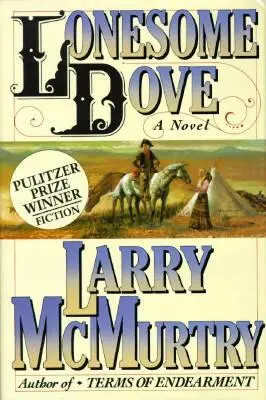
A love story, an adventure, an American epic, Lonesome Dove embraces all the West – legend and fact, heroes and outlaws, whoeres and ladies, Indians and settlers – in a novel that recreates the central American experience, the most enduring of our national myths.
Set in the late nineteenth century, Lonesome Dove is the story of a cattle drive from Texas to Montana – and much more. It is a drive that represents for everybody involved not only a daring, even a foolhardy, adventure, but a part of the American Dream – the attempt to carve out of the last remaining wilderness a new life.
Agustus McCrae and W.F. Call are former Texas Rangers, partners and friends who have shared hardship and danger together without ever quite understanding (or wanting to understand) each other's deepest emotions. Gus is the romantic, a reluctant rancher who has a way with women and the sense to leave well enough alone. Call is a driven, demanding man, a natural authority figure with no patience for weaknesses, and not many of his own. He is obsessed with the dream of creating his own empire, and with the need to conceal a secret sorrow of his own. The two men could hardly be more different, but both are tough, redoubtable fighters who have learned to count on each other, if nothing else.
Call's dream not only drags Gus along in its wake, but draws in a vast cast of characters:
– Lorena, the whore with the proverbial heart of gold, whom Gus (and almost everyone else) loves, and who survives one of the most terrifying experiences any woman could have…
– Elmira, the restless, reluctant wife of a small-time Arkansas sheriff, who runs away from the security of marriage to become part of the great Western adventure…
– Blue Duck, the sinister Indian renegade, one of the most frightening villains in American fiction, whose steely capacity for cruelty affects the lives of everyone in the book…
– Newt, the young cowboy for whom the long and dangerous journey from Texas to Montana is in fact a search for his own identity…
– Jake, the dashing, womanizing ex-Ranger, a comrade-in-arms of Gus and Call, whose weakness leads him to an unexpected fate…
– July Johnson, husband of Elmira, whose love for her draws him out of his secure life into the wilderness, and turns him into a kind of hero…
Lonesome Dove sweeps from the Rio Grande (where Gus and Call acquire the cattle for their long drive by raiding the Mexicans) to the Montana highlands (where they find themselves besieged by the last, defiant remnants of an older West).
It is an epic of love, heroism, loyalty, honor, and betrayal – faultlessly written, unfailingly dramatic. Lonesome Dove is the novel about the West that American literature – and the American reader – has long been waiting for.
Lonesome Dove — читать онлайн бесплатно полную книгу (весь текст) целиком
Ниже представлен текст книги, разбитый по страницам. Система сохранения места последней прочитанной страницы, позволяет с удобством читать онлайн бесплатно книгу «Lonesome Dove», без необходимости каждый раз заново искать на чём Вы остановились. Поставьте закладку, и сможете в любой момент перейти на страницу, на которой закончили чтение.
Интервал:
Закладка:
Indeed, the land was bleak, the surface sometimes streaked with salt. There were ocher-colored ridges here and there, completely free of grass.
"We can't start putting up with horse theft," Call said.
Deets was ranging ahead, and in the afternoon they saw him coming back. The simmering heat waves made him appear larger than he was.
"Camp's up ahead," he said. "They're in a draw, with a little water."
"How many?" Call asked.
"Didn't get no count," Deets said. "Not many. Couldn't be many and live out here."
"I say we wait for night and steal the nags back," Augustus said. "It's too hot to fight. Steal 'em back and let the red man chase the white for a while."
"If we wait for night we might lose half the horses," Call said. "They'll probably post a better guard than we had."
"I don't want to argue with you in this heat," Augustus said. "If you want to go now, okay. We'll just ride in and massacre them."
"Didn't see many men," Deets said. "Mostly women and children. They're real poor, Captain."
"What do you mean, real poor?"
"Means they're starving," Deets said. "They done cut up one horse."
"My God," Augustus said. "You mean they stole them horses for meat?"
That proved to be the case. They carefully approached the draw where the camp was and saw the whole little tribe gathered around the dead horse. There were only some twenty Indians, mostly women, children and old men. Call saw only two braves who looked to be of fighting age, and they were no more than boys. The Indians had pulled the dead horse's guts out and were hacking them into slices and eating them. Usually there were dogs around an Indian camp, but there were no dogs around this time.
"I guess these ain't the mighty plains Indians we've been hearing about," Augustus said. The whole little tribe was almost silent, each person concentrating on eating. They were all thin. Two old women were cutting meat off the haunch, meaning to dry it, and two young men, probably the ones who had stolen the horses, had caught another and were preparing to cut its throat. To prevent this, Call drew his pistol and fired into the air.
"Oh, let's go," Augustus said. "We don't want to be shooting these people, although it would probably be a mercy. I don't think they even have guns."
"I didn't shoot nobody," Call said. "But they're our horses."
At the shot the whole tribe looked up, stunned. One of the young men grabbed an old single-shot rifle but didn't fire. It seemed to be the only firearm the tribe possessed. Call fired in the air again, to scare them away from the horse, and succeeded better than he had expected to. Those who had been eating got to their feet, some with sections of gut still in their hands, and fled toward the four small ragged tepees that stood up the draw. The young man with the gun retreated too, helping one of the older women. She was bloody from the feast.
"They were just having a picnic," Augustus said. "We had a picnic the other day without nobody shooting at us."
"We can leave them two or three horses," Call said. "I just don't want to lose that sorrel they were about to kill."
In the tribe's flight a child had been forgotten-a little boy barely old enough to walk. He stood near the neck of the dead horse, crying, trying to find his mother. The tribe huddled in front of the tepees, silent. The only sound, for a moment, was the sound of the child's crying.
"He blind," Deets said.
Augustus saw that it was true. The child couldn't see where he was going, and a second later tripped over a pile of bloody horse guts, falling into them.
Deets, who was closest to the dead horse, walked over and picked the child up. The little blind boy kept wailing.
"Hush now," Deets said. "You a mess. You done rolled in all that blood."
At that moment there was a wild yell from the tepees and Deets looked up to see one of the young braves rushing toward him. He was the one who had picked up the rifle, but he had discarded the rifle and was charging with an old lance, crying his battle cry. Deets held out the baby and smiled-the young man, no older than Newt, didn't need to cry any battle cry. Deets kept holding the baby out toward the tribe and smiling, trusting that the young brave would realize he was friendly. The young man didn't need his lance-he could just take the squalling baby back to its mother.
Call and Augustus thought too that the young man would probably stop once he saw that Deets meant no harm. If not, Deets could whop him-Deets was a good hand-to-hand fighter.
It was only at the last second that they both realized that the Indian wasn't going to stop. His charge was desperate, and he didn't notice that Deets was friendly. He closed at a run.
"Shoot him, Deets!" Call yelled, raising his own gun.
Deets saw, too, at the last second, that the boy wasn't going to stop. The young warrior wasn't blind, but the look in his eyes was as unseeing as the baby's. He was still screaming a war cry-it was unnerving in the stillness-and his eyes were filled with hate. The old lance just looked silly. Deets held the baby out again, thinking the boy hadn't understood.
"Here, take him, I just helping him up," he said. Only then he saw it was too late-the young man couldn't stop coming and couldn't stop hating, either. His eyes were wild with hatred. Deets felt a deep regret that he should be hated so by this thin boy when he meant no harm. He tried to sidestep, hoping to gain a moment so he could set the baby down and wrestle with the Indian and maybe calm him.
But when Deets turned, the boy thrust the lance straight into his side and up into his chest.
Call and Augustus shot almost at the same time-the boy died with his hands still on the lance. They ran down to Deets, who still had the baby in his hands, although he had over a foot of lance inside him.
"Would you take him, Captain?" Deets asked, handing Call the child. "I don't want to sit him back in all that blood."
Then Deets dropped to his knees. He noticed with surprise that the young Indian was near him, already dead. For a moment he feared that somehow he had killed him, but then he saw that his own gun was still holstered. It must have been the Captain, or Mr. Gus. That was a sad thing, that the boy had had to die just because he couldn't understand that they were friendly. It was one more regret-probably the boy had just been so hungry he couldn't think straight.
Then he realized that he was on his knees and tried to get up, but Mr. Gus put a hand on his shoulder and asked him to wait.
"No, you don't have to get up yet, Deets," Augustus said. "Just rest a minute."
Deets noticed the handle of the lance protruding from his side. He knew the dead boy had put it there, but he felt nothing. The Captain stood in front of him, awkwardly holding the Indian baby. Deets looked at the Captain sadly. He hoped that now the Captain would see that he had been right.to feel worried about leaving Texas. It was a mistake, coming into other people's country. It only disturbed them and led to things like the dead boy. People wouldn't understand, wouldn't know that they were friendly.
It would have been so much better to stay where they had lived, by the old river. Deets felt a longing to be back, to sit in the corrals at night and wonder about the moon. Many a time he had dozed off, wondering about the moon, whether the Indians had managed to get on it. Sometimes he dreamed he was on it himself-a foolish dream. But the thought made him sleepy, and with one more look of regret at the dead boy who hadn't understood that he meant no harm, he carefully lay down on his side. Mr. Gus knelt beside him. For a moment Deets thought he was going to try to pull the lance out, but all he did was steady it so the handle wouldn't quiver.
"Where's little Newt?" Deets asked.
Читать дальшеИнтервал:
Закладка:
Похожие книги на «Lonesome Dove»
Представляем Вашему вниманию похожие книги на «Lonesome Dove» списком для выбора. Мы отобрали схожую по названию и смыслу литературу в надежде предоставить читателям больше вариантов отыскать новые, интересные, ещё непрочитанные произведения.









Обсуждение, отзывы о книге «Lonesome Dove» и просто собственные мнения читателей. Оставьте ваши комментарии, напишите, что Вы думаете о произведении, его смысле или главных героях. Укажите что конкретно понравилось, а что нет, и почему Вы так считаете.