Larry McMurtry - Lonesome Dove
Здесь есть возможность читать онлайн «Larry McMurtry - Lonesome Dove» весь текст электронной книги совершенно бесплатно (целиком полную версию без сокращений). В некоторых случаях можно слушать аудио, скачать через торрент в формате fb2 и присутствует краткое содержание. Жанр: Современная проза, на английском языке. Описание произведения, (предисловие) а так же отзывы посетителей доступны на портале библиотеки ЛибКат.
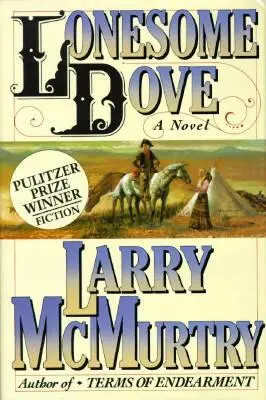
- Название:Lonesome Dove
- Автор:
- Жанр:
- Год:неизвестен
- ISBN:нет данных
- Рейтинг книги:5 / 5. Голосов: 1
-
Избранное:Добавить в избранное
- Отзывы:
-
Ваша оценка:
Lonesome Dove: краткое содержание, описание и аннотация
Предлагаем к чтению аннотацию, описание, краткое содержание или предисловие (зависит от того, что написал сам автор книги «Lonesome Dove»). Если вы не нашли необходимую информацию о книге — напишите в комментариях, мы постараемся отыскать её.
A love story, an adventure, an American epic, Lonesome Dove embraces all the West – legend and fact, heroes and outlaws, whoeres and ladies, Indians and settlers – in a novel that recreates the central American experience, the most enduring of our national myths.
Set in the late nineteenth century, Lonesome Dove is the story of a cattle drive from Texas to Montana – and much more. It is a drive that represents for everybody involved not only a daring, even a foolhardy, adventure, but a part of the American Dream – the attempt to carve out of the last remaining wilderness a new life.
Agustus McCrae and W.F. Call are former Texas Rangers, partners and friends who have shared hardship and danger together without ever quite understanding (or wanting to understand) each other's deepest emotions. Gus is the romantic, a reluctant rancher who has a way with women and the sense to leave well enough alone. Call is a driven, demanding man, a natural authority figure with no patience for weaknesses, and not many of his own. He is obsessed with the dream of creating his own empire, and with the need to conceal a secret sorrow of his own. The two men could hardly be more different, but both are tough, redoubtable fighters who have learned to count on each other, if nothing else.
Call's dream not only drags Gus along in its wake, but draws in a vast cast of characters:
– Lorena, the whore with the proverbial heart of gold, whom Gus (and almost everyone else) loves, and who survives one of the most terrifying experiences any woman could have…
– Elmira, the restless, reluctant wife of a small-time Arkansas sheriff, who runs away from the security of marriage to become part of the great Western adventure…
– Blue Duck, the sinister Indian renegade, one of the most frightening villains in American fiction, whose steely capacity for cruelty affects the lives of everyone in the book…
– Newt, the young cowboy for whom the long and dangerous journey from Texas to Montana is in fact a search for his own identity…
– Jake, the dashing, womanizing ex-Ranger, a comrade-in-arms of Gus and Call, whose weakness leads him to an unexpected fate…
– July Johnson, husband of Elmira, whose love for her draws him out of his secure life into the wilderness, and turns him into a kind of hero…
Lonesome Dove sweeps from the Rio Grande (where Gus and Call acquire the cattle for their long drive by raiding the Mexicans) to the Montana highlands (where they find themselves besieged by the last, defiant remnants of an older West).
It is an epic of love, heroism, loyalty, honor, and betrayal – faultlessly written, unfailingly dramatic. Lonesome Dove is the novel about the West that American literature – and the American reader – has long been waiting for.
Lonesome Dove — читать онлайн бесплатно полную книгу (весь текст) целиком
Ниже представлен текст книги, разбитый по страницам. Система сохранения места последней прочитанной страницы, позволяет с удобством читать онлайн бесплатно книгу «Lonesome Dove», без необходимости каждый раз заново искать на чём Вы остановились. Поставьте закладку, и сможете в любой момент перейти на страницу, на которой закончили чтение.
Интервал:
Закладка:
Call told them to keep as close to the cattle as possible and to keep the cattle moving. Any cattle that wandered far would probably starve to death.
Augustus thought the order foolish. "The only way to keep this herd together would be to string a rope around them-and we ain't got that much rope," he said.
Shortly after dark he was proven right. None of the animals wanted to go into the wind. It quickly became necessary for the cowboys to cover their horses' eyes with jackets or shirts; and despite the hands' precautions, little strings of cattle began to stray. Newt tried unsuccessfully to turn back two bunches, but the cattle paid him no mind, even when he bumped them with his horse. Finally he let them go, feeling guilty as he did it but not guilty enough to risk getting lost himself. He knew if he lost the herd he was probably done for; he knew it was a long way to water and he might not be able to find it, even though he was riding the good sorrel that Clara had given him.
Call felt sick with worry-the sandstorm was the worst possible luck, for it slowed down the herd and sapped the animals' strength just when they needed all they had just to reach the water. And yet there was nothing he could do about it. He tried to tie an old shirt around the Hell Bitch's eyes, but she shook him off so vigorously that he finally let it go.
At the height of the storm it seemed as if the herd might split into fragments. It was hard to see ten feet, and little bunches of cattle broke off unnoticed and slipped past the cowboys. Deets, more confident of his ability to find his way around than most, rode well west of the herd, turning back cattle whenever he found any. But it finally became pitch-dark, and even Deets could do nothing.
Augustus rode through the storm with a certain indifference, thinking of the two women he had just left. He took no interest in the straying cattle. That was Call's affair. He felt he himself deserved to be in the middle of a sandstorm on the Wyoming plain for being such a fool as to leave the women. Not a man to feel guilty, he was merely annoyed at himself for what he considered a misjudgment.
To Call's great relief, the storm blew itself out in three hours. The wind gradually died and the sand lay under their feet again instead of peppering them. The moon was soon visible, and the sky filled with bright stars. It would not be possible to judge how many cattle had strayed until the morning, but at least the main herd was still under their control.
But the storm and the long drive the day before had taken its toll in energy. By dawn, half the men were asleep in their saddles. They wanted to stop, but again Call pushed on; he knew they had lost ground, and was not going to stop just because the men were sleepy. All morning he rode through the herd, encouraging the men to push the cattle. He was not sure how far they had come, but he knew they still had a full day to go. Lack of water was beginning to tell on the horses, and the weaker cattle were barely stumbling along.
Deets alone brought back most of the strayed bunches, none of which had strayed very far. The plain was so vast and flat that the cattle were visible for miles, at least to Augustus and Deets, the eyesight champions.
"There's a bunch you missed," Augustus said, pointing to the northwest. Deets looked, nodded, and rode away. Jasper Fant looked and saw nothing but heat waves and blue sky. "I guess I need spectacles," he said. "I can't see nothing but nothing."
"Weak brains breed weak eyesight," Augustus said.
"We all got weak brains or we wouldn't be here," Soupy said sourly. He had grown noticeably more discontented in recent weeks-no one knew why.
Finally at noon Call stopped. The effort to move the drags was wearing out the horses. When the cowboys got to the wagon, most of them took a cup of water and dropped sound asleep on the ground, not bothering with bedrolls or even saddle blankets. Po Campo rationed the water carefully, giving each man only three swallows. Newt felt that he could have drunk a thousand swallows. He had never tasted anything so delicious. He had never supposed plain water could be so desirable. He remembered all the times he had carelessly drunk his fill. If he ever got another chance, he meant to enjoy it more.
Call let them rest three hours and then told them to get their best mounts. Some of the cattle were so weak the cowboys had to dismount, pull their tails and shout at them to get them up. Call knew that if they didn't make it on the next push, they would have to abandon the cattle in order to save the horses. Even after their rest, many of the cattle had their tongues hanging out. They were mulish, reluctant to move, but after much effort on the part of the exhausted men, the drive was started again.
Through the late afternoon and far into the night the cattle stumbled over the plain, the weaker cattle falling farther and farther behind. By daybreak the herd was strung out to a distance of more than five miles, most of the men plodding along as listlessly as the cattle. The day was as hot as any they remembered from south Texas-the distances that had spawned yesterday's wind refused to yield even a breeze, and it seemed to the men that the last moisture in their bodies was pouring out as sweat. They all yearned for evening and looked at the sun constantly, but the sun seemed as immobile as if suspended by a wire.
Toward midday many of the cattle began to turn back toward the water they had left two days before. Newt, struggling with a bunch, nearly got knocked off his horse by three steers that walked right into him. He noticed, to his shock, that the cattle didn't seem to see him-they were stumbling along, white-eyed. Appalled, he rode over to the Captain.
"Captain, they're going blind," he said.
Call looked grim. "It ain't real blindness," he said. "They get that way when they're real thirsty. They'll try to go back to the last water."
He told the men to forget the weaker cattle and try to keep the stronger one's moving.
"We ought to make the water by night," he said.
"If we make night," Augustus said.
"We can't just stop and die," Call said.
"I don't intend to," Augustus said. "But some of the men might. That Irishman is delirious. He ain't used to such dry country."
Indeed the terrible heat had driven Allen O'Brien out of his head. Now and then he would try to sing, though his tongue was swollen and his lips cracked.
"You don't need to sing," Call said.
Allen O'Brien looked at him angrily. "I need to cry, but I've got no tears," he said. "This goddamn country has burned up my tears."
Call had been awake for over three days, and he began to feel confused himself. He knew water couldn't be much farther, but, all the same, fatigue made him doubtful. Perhaps it had been a hundred miles rather than eighty. They would never make it, if so. He tried to remember, searching his mind for details that would suggest how far the river might be, but there were precious few landmarks on the dry plain, and the harder he concentrated the more his mind seemed to slip. He was riding the Hell Bitch, but for long moments he imagined he was riding old Ben again-a mule he had relied on frequently during his campaigning on the llano . Ben had had an infallible sense of direction and a fine nose for water. He wasn't fast but he was sure. At the time, some men had scoffed at him for riding a mule, but Call ignored them. The stakes were life or death, and Ben was the most reliable animal he had ever seen, if far from the prettiest.
The men had had the last of Po Campo's water that morning, barely enough to wet their tongues. Po Campo doled it out with severity, careful to see that no one got more than his share. Though the old man had walked the whole distance, using his ax-handle cane, he seemed not particularly tired.
Читать дальшеИнтервал:
Закладка:
Похожие книги на «Lonesome Dove»
Представляем Вашему вниманию похожие книги на «Lonesome Dove» списком для выбора. Мы отобрали схожую по названию и смыслу литературу в надежде предоставить читателям больше вариантов отыскать новые, интересные, ещё непрочитанные произведения.









Обсуждение, отзывы о книге «Lonesome Dove» и просто собственные мнения читателей. Оставьте ваши комментарии, напишите, что Вы думаете о произведении, его смысле или главных героях. Укажите что конкретно понравилось, а что нет, и почему Вы так считаете.