Larry McMurtry - Lonesome Dove
Здесь есть возможность читать онлайн «Larry McMurtry - Lonesome Dove» весь текст электронной книги совершенно бесплатно (целиком полную версию без сокращений). В некоторых случаях можно слушать аудио, скачать через торрент в формате fb2 и присутствует краткое содержание. Жанр: Современная проза, на английском языке. Описание произведения, (предисловие) а так же отзывы посетителей доступны на портале библиотеки ЛибКат.
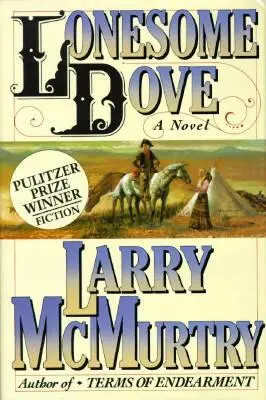
- Название:Lonesome Dove
- Автор:
- Жанр:
- Год:неизвестен
- ISBN:нет данных
- Рейтинг книги:5 / 5. Голосов: 1
-
Избранное:Добавить в избранное
- Отзывы:
-
Ваша оценка:
Lonesome Dove: краткое содержание, описание и аннотация
Предлагаем к чтению аннотацию, описание, краткое содержание или предисловие (зависит от того, что написал сам автор книги «Lonesome Dove»). Если вы не нашли необходимую информацию о книге — напишите в комментариях, мы постараемся отыскать её.
A love story, an adventure, an American epic, Lonesome Dove embraces all the West – legend and fact, heroes and outlaws, whoeres and ladies, Indians and settlers – in a novel that recreates the central American experience, the most enduring of our national myths.
Set in the late nineteenth century, Lonesome Dove is the story of a cattle drive from Texas to Montana – and much more. It is a drive that represents for everybody involved not only a daring, even a foolhardy, adventure, but a part of the American Dream – the attempt to carve out of the last remaining wilderness a new life.
Agustus McCrae and W.F. Call are former Texas Rangers, partners and friends who have shared hardship and danger together without ever quite understanding (or wanting to understand) each other's deepest emotions. Gus is the romantic, a reluctant rancher who has a way with women and the sense to leave well enough alone. Call is a driven, demanding man, a natural authority figure with no patience for weaknesses, and not many of his own. He is obsessed with the dream of creating his own empire, and with the need to conceal a secret sorrow of his own. The two men could hardly be more different, but both are tough, redoubtable fighters who have learned to count on each other, if nothing else.
Call's dream not only drags Gus along in its wake, but draws in a vast cast of characters:
– Lorena, the whore with the proverbial heart of gold, whom Gus (and almost everyone else) loves, and who survives one of the most terrifying experiences any woman could have…
– Elmira, the restless, reluctant wife of a small-time Arkansas sheriff, who runs away from the security of marriage to become part of the great Western adventure…
– Blue Duck, the sinister Indian renegade, one of the most frightening villains in American fiction, whose steely capacity for cruelty affects the lives of everyone in the book…
– Newt, the young cowboy for whom the long and dangerous journey from Texas to Montana is in fact a search for his own identity…
– Jake, the dashing, womanizing ex-Ranger, a comrade-in-arms of Gus and Call, whose weakness leads him to an unexpected fate…
– July Johnson, husband of Elmira, whose love for her draws him out of his secure life into the wilderness, and turns him into a kind of hero…
Lonesome Dove sweeps from the Rio Grande (where Gus and Call acquire the cattle for their long drive by raiding the Mexicans) to the Montana highlands (where they find themselves besieged by the last, defiant remnants of an older West).
It is an epic of love, heroism, loyalty, honor, and betrayal – faultlessly written, unfailingly dramatic. Lonesome Dove is the novel about the West that American literature – and the American reader – has long been waiting for.
Lonesome Dove — читать онлайн бесплатно полную книгу (весь текст) целиком
Ниже представлен текст книги, разбитый по страницам. Система сохранения места последней прочитанной страницы, позволяет с удобством читать онлайн бесплатно книгу «Lonesome Dove», без необходимости каждый раз заново искать на чём Вы остановились. Поставьте закладку, и сможете в любой момент перейти на страницу, на которой закончили чтение.
Интервал:
Закладка:
Augustus was oiling his rifle. "How far did you ride that horse?" he asked.
"To the next water and back," Call said. "Did you ever see a horse like her? She ain't even tired."
"How far is it to water?" Augustus asked.
"About eighty miles," Call said. "What do you think?"
"I ain't give it no thought at all, so far," Augustus said.
"We can't just sit here," Call said.
"Oh, we could," Augustus said. "We could have stopped pretty much anywhere along the way. It's only your stubbornness kept us going this long. I guess it'll be interesting to see if it can get us the next eighty miles."
Call got a plate and ate a big meal. He expected Po Campo to say something about their predicament, but the old cook merely dished out the food and said nothing. Deets was helping Pea Eye trim one of his horse's feet, a task Pea Eye had never been good at.
"Find the water, Captain?" Deets asked, smiling.
"I found it, 'bout eighty miles away," Call said.
"That's far," Pea Eye said.
They had stopped the cattle at the last stream that Deets had found, and now Call walked down it a way to think things over. He saw a gray wolf. It seemed to him to be the same wolf they had seen in Nebraska, after the picnic, but he told himself that was foolish speculation. A gray wolf wouldn't follow a cattle herd.
Deets finished trimming the horse's hooves and wiped the sweat off his face with his shirtsleeve. Pea Eye stood silently nearby. Though the two of them had soldiered together for most of their lives, they had never really had a conversation. It had seemed unnecessary. They exchanged information, and that was about it. Pea, indeed, had always been a little doubtful of the propriety of talking to Negroes, although he liked and respected Deets and was grateful to him now for trimming the horse's feet. He knew Deets was a great deal more competent than he was in many areas-tracking, for example. He knew that if it had not been for Deets's skill in finding water they might have all starved years before in campaigns on the llano . He knew, too, that Deets had risked his life a number of times to save his, and yet, standing there side by side, the only thing he could think of to talk about was the Captain's great love for the Hell Bitch.
"Well, he's mighty fond of that horse," he said. "And she might kill him yet."
"She ain't gonna kill the Captain," Deets said. He had the sad sense that things were not right. It seemed they were going to go north forever, and he couldn't think why. Life had been orderly and peaceful in Texas. He himself had particularly enjoyed his periodic trips to San Antonio to deposit money. Texas had always been their country, and it was a puzzle to him why they were going to a country that would probably be so wild there wouldn't even be banks to take money to.
"We way up here and it ain't our country," he said, looking at Pea. That was the heart of it-best to stay in your own country and not go wandering off where you didn't know the rivers or the water holes.
"Now up here, it's gonna be cold," he added, as if that were proof enough of the folly of their trip.
"Well, I hope we get there before the rivers start icing," Pea said. "I always worry about that thin ice."
With that he turned away, and the lengthy conversation was over.
By midafternoon Call came back from his walk and decided they would go ahead. It was go ahead or go back, and he didn't mean to go back. It wasn't rational to think of driving cattle over eighty waterless miles, but he had learned in his years of tracking Indians that things which seemed impossible often weren't. They only became so if one thought about them too much so that fear took over. The thing to do was go. Some of the cattle might not make it, but then, he had never expected to reach Montana with every head.
He told the cowboys to push the cattle and horses onto water and hold them there.
Without saying a word, Augustus walked over, took off his clothes, and had a long bath in the little stream. The cowboys holding the herd could see him sitting in the shallow water, now and then splashing some of his long white hair.
"Sometimes I think Gus is crazy," Soupy Jones said. "Why is he sitting in the water?"
"Maybe he's fishing," Dish Boggett said facetiously. He had no opinion of Soupy Jones and saw no reason why Gus shouldn't bathe if he wanted to.
Augustus came walking back to the wagon with his hair dripping.
"It looks like sandy times ahead," he said. "Call, you got too much of the prophet in you. You're always trying to lead us into the deserts."
"Well, there's water there," Call said. "I seen it. If we can get them close enough that they can smell it, they'll go. How far do you think a cow can smell water?"
"Not no eighty miles," Augustus said.
They started the herd two hours before sundown and drove all night through the barren country. The hands had made night drives before and were glad to be traveling in the cool. Most of them expected, though, that Call would stop for breakfast, but he didn't. He rode ahead of the herd and kept on going. Some of the hands were beginning to feel empty. They kept looking hopefully for a sign that Call might slacken and let Po Campo feed them-but Call didn't slacken. They kept the cattle moving until midday, by which time some of the weaker cattle were already lagging well behind. The leaders were tired and acting fractious.
Finally Call did stop. "We'll rest a little until it starts to get cool," he said. "Then we'll drive all night again. That ought to put us close."
He wasn't sure, though. For all their effort, they had covered only some thirty-five or forty miles. It would be touch and go.
Late that afternoon, while the cowboys were lying around resting, a wind sprang up from the west. From the first, it was as hot as if it were blowing over coals. By the time Call was ready to start the herd again, the wind had risen and they faced a full-fledged sandstorm. It blew so hard that the cattle were reluctant to face it.
Newt, with the Rainey boys, was holding the drags, as usual. The wind howled across the flat plain, and the sand seemed to sing as it skimmed the ground. Newt found that looking into the wind blinded him almost instantly. He mostly ducked his head and kept his eyes shut. The horses didn't like the sand either. They began to duck and jump around, irritated at being forced into such a wind.
"This is bad luck," Augustus said to Call. He adjusted his bandana over his nose and he pulled his hat down as far as it would go.
"We can't stop here," Call said. "We ain't but halfway to water."
"Yes, and some of them will still be halfway when this blows itself out," Augustus said.
Call helped Lippy and the cook tie down everything on the wagon. Lippy, who hated wind, looked frightened; Po Campo said nothing.
"You better ride tonight," Call said to Po Campo. "If you try to walk you might get lost."
"We all might get lost tonight," Po Campo said. He took an old ax handle that he sometimes used as a cane and walked, but at least he consented to walk right with the wagon.
None of the men-no strangers to sandstorms-could remember such a sunset. The sun was like a dying coal, ringed with black long before it neared the horizon. After it set, the rim of the earth was blood-red for a few minutes, then the red was streaked with black. The afterglow was quickly snuffed out by the sand. Jasper Fant wished for the thousandth time that he had stayed in Texas. Dish Boggett was troubled by the sensation that there was a kind of river of sand flowing above his head. When he looked up in the eerie twilight, he seemed to see it, as if somehow the world had turned over and the road that ought to be beneath his feet was now over his head. If the wind stopped, he felt, the sand river would fall and bury him.
Читать дальшеИнтервал:
Закладка:
Похожие книги на «Lonesome Dove»
Представляем Вашему вниманию похожие книги на «Lonesome Dove» списком для выбора. Мы отобрали схожую по названию и смыслу литературу в надежде предоставить читателям больше вариантов отыскать новые, интересные, ещё непрочитанные произведения.









Обсуждение, отзывы о книге «Lonesome Dove» и просто собственные мнения читателей. Оставьте ваши комментарии, напишите, что Вы думаете о произведении, его смысле или главных героях. Укажите что конкретно понравилось, а что нет, и почему Вы так считаете.