Larry McMurtry - Lonesome Dove
Здесь есть возможность читать онлайн «Larry McMurtry - Lonesome Dove» весь текст электронной книги совершенно бесплатно (целиком полную версию без сокращений). В некоторых случаях можно слушать аудио, скачать через торрент в формате fb2 и присутствует краткое содержание. Жанр: Современная проза, на английском языке. Описание произведения, (предисловие) а так же отзывы посетителей доступны на портале библиотеки ЛибКат.
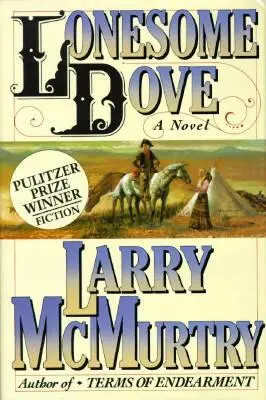
- Название:Lonesome Dove
- Автор:
- Жанр:
- Год:неизвестен
- ISBN:нет данных
- Рейтинг книги:5 / 5. Голосов: 1
-
Избранное:Добавить в избранное
- Отзывы:
-
Ваша оценка:
Lonesome Dove: краткое содержание, описание и аннотация
Предлагаем к чтению аннотацию, описание, краткое содержание или предисловие (зависит от того, что написал сам автор книги «Lonesome Dove»). Если вы не нашли необходимую информацию о книге — напишите в комментариях, мы постараемся отыскать её.
A love story, an adventure, an American epic, Lonesome Dove embraces all the West – legend and fact, heroes and outlaws, whoeres and ladies, Indians and settlers – in a novel that recreates the central American experience, the most enduring of our national myths.
Set in the late nineteenth century, Lonesome Dove is the story of a cattle drive from Texas to Montana – and much more. It is a drive that represents for everybody involved not only a daring, even a foolhardy, adventure, but a part of the American Dream – the attempt to carve out of the last remaining wilderness a new life.
Agustus McCrae and W.F. Call are former Texas Rangers, partners and friends who have shared hardship and danger together without ever quite understanding (or wanting to understand) each other's deepest emotions. Gus is the romantic, a reluctant rancher who has a way with women and the sense to leave well enough alone. Call is a driven, demanding man, a natural authority figure with no patience for weaknesses, and not many of his own. He is obsessed with the dream of creating his own empire, and with the need to conceal a secret sorrow of his own. The two men could hardly be more different, but both are tough, redoubtable fighters who have learned to count on each other, if nothing else.
Call's dream not only drags Gus along in its wake, but draws in a vast cast of characters:
– Lorena, the whore with the proverbial heart of gold, whom Gus (and almost everyone else) loves, and who survives one of the most terrifying experiences any woman could have…
– Elmira, the restless, reluctant wife of a small-time Arkansas sheriff, who runs away from the security of marriage to become part of the great Western adventure…
– Blue Duck, the sinister Indian renegade, one of the most frightening villains in American fiction, whose steely capacity for cruelty affects the lives of everyone in the book…
– Newt, the young cowboy for whom the long and dangerous journey from Texas to Montana is in fact a search for his own identity…
– Jake, the dashing, womanizing ex-Ranger, a comrade-in-arms of Gus and Call, whose weakness leads him to an unexpected fate…
– July Johnson, husband of Elmira, whose love for her draws him out of his secure life into the wilderness, and turns him into a kind of hero…
Lonesome Dove sweeps from the Rio Grande (where Gus and Call acquire the cattle for their long drive by raiding the Mexicans) to the Montana highlands (where they find themselves besieged by the last, defiant remnants of an older West).
It is an epic of love, heroism, loyalty, honor, and betrayal – faultlessly written, unfailingly dramatic. Lonesome Dove is the novel about the West that American literature – and the American reader – has long been waiting for.
Lonesome Dove — читать онлайн бесплатно полную книгу (весь текст) целиком
Ниже представлен текст книги, разбитый по страницам. Система сохранения места последней прочитанной страницы, позволяет с удобством читать онлайн бесплатно книгу «Lonesome Dove», без необходимости каждый раз заново искать на чём Вы остановились. Поставьте закладку, и сможете в любой момент перейти на страницу, на которой закончили чтение.
Интервал:
Закладка:
Now Bob lay in that bed all day, staring his empty stare. They had moved the bed near the window so that he would get the summer breezes and could look out if he liked and watch his horses grazing on the plain, or the hawks circling, or whatever little sights there might be. But Bob never turned his head, and no one knew if he felt the breezes. Clara had taken to sleeping on a little cot. The house had a small upper porch and she moved the cot out there in good weather. Often she lay awake, listening, half expecting Bob to come back to himself and call her. More often what happened was that he fouled himself; and instead of hearing him she would smell him. Even so, she was glad it happened at night so she could change him without the girls seeing.
It seemed to her, after a month of it, that she was carrying Bob away with those sheets; he had already lost much weight and every morning seemed a little thinner to her. The large body that had lain beside her so many nights, that had warmed her in the icy nights, that had covered her those many times through the years and given her five children, was dribbling away as offal, and there was nothing she could do about it. The doctors in Ogallala said Bob's skull was fractured; you couldn't put a splint on a skull; probably he'd die. And yet he wasn't dead. Often when she was cleaning him, bathing his soiled loins and thighs with warm water, the stem of life between his legs would raise itself, growing as if a fractured skull meant nothing to it. Clara cried at the sight-what it meant to her was that Bob still hoped for a boy. He couldn't talk or turn himself, and he would never beat another horse, most likely, but he still wanted a boy. The stem let her know it, night after night, when all she came in to do was clean the stains from a dying body. She would roll Bob on his side and hold him there for a while, for his back and legs were developing terrible bedsores. She was afraid to turn him on his belly for fear he might suffocate, but she would hold him on his side for an hour, sometimes napping as she held him. Then she would roll him back and cover him and go back to her cot, often to lie awake half the night, looking at the prairies, sad beyond tears at the ways of things. There Bob lay, barely alive, his ribs showing more every morning, still wanting a boy. I could do it, she thought-would it save him if I did? I could go through it one more time-the pregnancy, the fear, the sore nipples, the worry-and maybe it would be a boy. Though she had borne five children, she sometimes felt barren, lying on her cot at night. She felt she was ignoring her husband's last wish-that if she had any generosity she would do it for him. How could she lie night after night and ignore the strange, mute urgings of a dying man, one who had never been anything but kind to her, in his clumsy way. Bob, dying, still wanted her to make a little Bob. Sometimes in the long silent nights she felt she must be going crazy to think about such things, in such a way. And yet she came to dread having to go to him at night; it became as hard as anything she had had to do in her marriage. It was so hard that at times she wished Bob would go on and die, if he couldn't get well. The truth was, she didn't want another child, particularly not another boy. Somehow she felt confident she could keep her girls alive-but she lacked that confidence where boys were concerned. She remembered too well the days of icy terror and restless pain as she listened to Jim cough his way to death. She remembered her hatred of, and helplessness before, the fevers that had taken Jeff and Johnny. Not again, she thought-I won't live that again, even for you, Bob. The memory of the fear that had torn her as her children approached death was the most vivid of her life: she could remember the coughings, the painful breathing. She never wanted to listen helplessly to such again.
Besides, Bob wasn't really alive, even then-his eyes never flickered. It was only reflex that enabled him to swallow the soup she fed him. That his rod still seemed to live when she bathed him, that, too, was reflex, an obscene joke that life was playing on the two of them. It raised no feelings of tenderness in her, just a feeling of disgust at the cruelties of existence. It seemed to mock her, to make her feel that she was cheating Bob of something, though it was not easy to say what. She had married him, followed him, fed him, worked beside him, borne his children-and yet even as she changed his sheets she felt there was a selfishness in her that she had never mastered. Something had been held back-what it was, considering all that she had done, was hard to say. But she felt it anyway, fair judgment or not, and lay awake on her cot through half the night, tense with selfreproach.
In the mornings she lay wrapped in a quilt until the smell of Cholo's coffee waked her. She had fallen into the habit of letting Cholo make the coffee, mainly because he was better at it than she was. She would lie in her quilt, watching the mists float over the Platte, until one or both of the girls tiptoed out. They always tiptoed, as if they might wake their father, though his eyes were as wide open as ever.
"Ma, ain't you up?" Sally would say. "We been up awhile."
"Wanta gather the eggs?" Betsey asked. It was her favorite chore but she preferred to do it with her mother-some of the hens were irritable with Betsey and would peck her if she tried to slide an egg out from under them, whereas they would never peck Clara.
"I'd rather gather you two," Clara said, pulling both girls onto the cot with her. With the sunlight flooding the wide plain, and both her two girls in bed with her, it was hard to feel as bad about herself as she had felt alone in the night.
"Don't you wanta get up?" Sally asked. She had more of her father in her than Betsey had, and it bothered her a little to see her mother lazing in bed with the sun up. It seemed to her a little wrong-at least, her father had often complained about it.
"Oh, shush," Clara said. "The sun's just been up five minutes."
She reflected that perhaps that was what she had held back-she had never become proficient at early rising, despite all the practice she'd had. She had got up dutifully and made breakfast for Bob and whatever hands happened to be there, but she was not at her best, and the breakfasts seldom arrived on the table in the orderly fashion that Bob expected. It was a relief to her when he went away on horsetrading expeditions and she could sleep late, or just lie in bed thinking and reading the magazines she ordered from the East or from England.
The ladies' magazines had stories and parts of novels in them, in many of which were ladies who led lives so different from hers that she felt she might as well be on another planet. She liked Thackeray's ladies better than Dickens's, and George Eliot's best of all-but it was a frustration that the mail came so seldom. Sometimes she would have to wait for two or three months for her Blackwoods , wondering all the time what was happening to the people in the stories. Reading stories by all the women, not only George Eliot, but Mrs. Gore and Mrs. Gaskell and Charlotte Yonge, she sometimes had a longing to do what those women did-write stories. But those women lived in cities or towns and had many friends and relatives nearby. It discouraged her to look out the window at the empty plains and reflect that even if she had the eloquence to write, and the time, she had nothing to write about. With Maude Jones dead, she seldom saw another woman, and had no relatives near except her husband and her children. There was an aunt in Cincinnati, but they only exchanged letters once or twice a year. Her characters would have to be the horses and the hens, if she ever wrote, for the menfolk that came by weren't interesting enough to put in books, it seemed to her. None of them were capable of the kind of talk men managed in English novels.
Читать дальшеИнтервал:
Закладка:
Похожие книги на «Lonesome Dove»
Представляем Вашему вниманию похожие книги на «Lonesome Dove» списком для выбора. Мы отобрали схожую по названию и смыслу литературу в надежде предоставить читателям больше вариантов отыскать новые, интересные, ещё непрочитанные произведения.









Обсуждение, отзывы о книге «Lonesome Dove» и просто собственные мнения читателей. Оставьте ваши комментарии, напишите, что Вы думаете о произведении, его смысле или главных героях. Укажите что конкретно понравилось, а что нет, и почему Вы так считаете.