Larry McMurtry - Lonesome Dove
Здесь есть возможность читать онлайн «Larry McMurtry - Lonesome Dove» весь текст электронной книги совершенно бесплатно (целиком полную версию без сокращений). В некоторых случаях можно слушать аудио, скачать через торрент в формате fb2 и присутствует краткое содержание. Жанр: Современная проза, на английском языке. Описание произведения, (предисловие) а так же отзывы посетителей доступны на портале библиотеки ЛибКат.
- Название:Lonesome Dove
- Автор:
- Жанр:
- Год:неизвестен
- ISBN:нет данных
- Рейтинг книги:5 / 5. Голосов: 1
-
Избранное:Добавить в избранное
- Отзывы:
-
Ваша оценка:
Lonesome Dove: краткое содержание, описание и аннотация
Предлагаем к чтению аннотацию, описание, краткое содержание или предисловие (зависит от того, что написал сам автор книги «Lonesome Dove»). Если вы не нашли необходимую информацию о книге — напишите в комментариях, мы постараемся отыскать её.
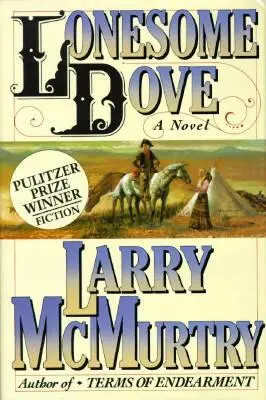
A love story, an adventure, an American epic, Lonesome Dove embraces all the West – legend and fact, heroes and outlaws, whoeres and ladies, Indians and settlers – in a novel that recreates the central American experience, the most enduring of our national myths.
Set in the late nineteenth century, Lonesome Dove is the story of a cattle drive from Texas to Montana – and much more. It is a drive that represents for everybody involved not only a daring, even a foolhardy, adventure, but a part of the American Dream – the attempt to carve out of the last remaining wilderness a new life.
Agustus McCrae and W.F. Call are former Texas Rangers, partners and friends who have shared hardship and danger together without ever quite understanding (or wanting to understand) each other's deepest emotions. Gus is the romantic, a reluctant rancher who has a way with women and the sense to leave well enough alone. Call is a driven, demanding man, a natural authority figure with no patience for weaknesses, and not many of his own. He is obsessed with the dream of creating his own empire, and with the need to conceal a secret sorrow of his own. The two men could hardly be more different, but both are tough, redoubtable fighters who have learned to count on each other, if nothing else.
Call's dream not only drags Gus along in its wake, but draws in a vast cast of characters:
– Lorena, the whore with the proverbial heart of gold, whom Gus (and almost everyone else) loves, and who survives one of the most terrifying experiences any woman could have…
– Elmira, the restless, reluctant wife of a small-time Arkansas sheriff, who runs away from the security of marriage to become part of the great Western adventure…
– Blue Duck, the sinister Indian renegade, one of the most frightening villains in American fiction, whose steely capacity for cruelty affects the lives of everyone in the book…
– Newt, the young cowboy for whom the long and dangerous journey from Texas to Montana is in fact a search for his own identity…
– Jake, the dashing, womanizing ex-Ranger, a comrade-in-arms of Gus and Call, whose weakness leads him to an unexpected fate…
– July Johnson, husband of Elmira, whose love for her draws him out of his secure life into the wilderness, and turns him into a kind of hero…
Lonesome Dove sweeps from the Rio Grande (where Gus and Call acquire the cattle for their long drive by raiding the Mexicans) to the Montana highlands (where they find themselves besieged by the last, defiant remnants of an older West).
It is an epic of love, heroism, loyalty, honor, and betrayal – faultlessly written, unfailingly dramatic. Lonesome Dove is the novel about the West that American literature – and the American reader – has long been waiting for.
Lonesome Dove — читать онлайн бесплатно полную книгу (весь текст) целиком
Ниже представлен текст книги, разбитый по страницам. Система сохранения места последней прочитанной страницы, позволяет с удобством читать онлайн бесплатно книгу «Lonesome Dove», без необходимости каждый раз заново искать на чём Вы остановились. Поставьте закладку, и сможете в любой момент перейти на страницу, на которой закончили чтение.
Интервал:
Закладка:
Part III
75.
CLARA WAS MILKING A MARE when Sally, her oldest girl, came racing down to the lots.
"Somebody's coming, Ma," Sally said, excitement in her face. Sally was ten years old and sociable-she loved visitors.
The young mare had dropped her foal early and the colt was too weak to stand up, which was why she was milking. The colt would suck milk off a rag, and Clara was determined to save it if she could. When Sally ran up, the mare flinched, causing Clara to squirt a stream of milk along her own arm.
"Haven't I told you to walk up to horses?" Clara said. She stood up and wiped the milk off her dripping arm.
"I'm sorry, Ma," Sally said, more excited than sorry. "See, there's a wagon coming."
Then Betsey, only seven, came flying out of the house, her brown hair streaming, and raced down to the corrals. Betsey liked company as much as her sister.
"Who's coming?" she asked.
The wagon was barely visible coming along the Platte from the west.
"I thought I told you girls to churn," Clara said. "Seems like all you do is hang out the window watching for travelers."
Of course, no one could blame them, for company was rare. They lived twenty miles from town, and a bad town at that-Ogallala. If they went in, it was usually for church, but they seldom made the trip. Their company mostly consisted of men who came to trade horses with Bob, her husband, and now that he was injured, few came. They had just as many horses-more, in fact-and Clara knew more about them than Bob had ever learned, but there were few men disposed to bargain with a woman, and Clara was not disposed to give their horses away. When she named a price she meant it, but usually men got their backs up and wouldn't buy.
"I expect they're just buffalo hunters," Clara said, watching the distant wagon creep over the brown plains. "You girls won't learn much from them, unless you're interested in learning how to spit tobacco."
"I ain't," Betsey said.
"You aren't, you mean," Sally said. "I thought all the buffalo were dead-how come they still hunt them?"
"Because people are slow learners, like your sister," Clara said, grinning at Betsey to mitigate the criticism.
"Are you gonna invite them for the night?" Sally asked. "Want me to kill a hen?"
"Not just yet, they may not be in the mood to stop," Clara said. "Besides, you and I don't agree about hens. You might kill one of the ones I like."
"Mother, they're just to eat," Sally said.
"Nope. I keep those hens to talk to me when I'm lonesome," Clara said. "I'll only eat the ones who can't make good conversation." Betsey wrinkled up her nose, amused by the comment. "Oh, Ma," she said, "hens don't talk."
"They talk," Clara said. "You just don't understand hen talk. I'm an old hen myself and it makes good sense to me."
"You ain't old, Ma," Sally said.
"That wagon won't be here for an hour," Clara said. "Go see about your pa. His fever comes up in the afternoon. Wet a rag and wipe his face."
Both girls stood looking at her silently. They hated to go into the sickroom. Both of them had bright-blue eyes, their legacy from Bob, but their hair was like hers and they were built like her, even to the knobby knees. Bob had been kicked in the head by a mustang he was determined to break, against Clara's advice. She had seen it happen-he had the mare snubbed to a post with a heavy rope and only turned his back on her for a second. But the mare struck with her front feet, quick as a snake. Bob had bent over to pick up another rope and the kick had caught him right back of the ear. The crack had sounded like a shot. The mare pawed him three or four times before Clara could reach him and drag him out of the way, but those blows had been minor. The kick behind the ear had almost killed him. They had been so sure he would die that they even dug the grave, up on the knoll east of the house where their three boys were buried: Jim and Jeff and Johnny, the three deaths Clara felt had turned her heart to stone: she hoped for stone, anyway, for stone wouldn't suffer from such losses.
Bob, though, hadn't died-neither had he recovered. His eyes were open, but he could neither speak nor move. He could swallow soup, if his head was tilted a certain way, and it was chicken broth that had kept him alive the three months since his accident. He simply lay staring up with his large blue eyes, feverish sometimes but mostly as still as if he were dead. He was a large man, over two hundred pounds, and it took all her strength to move him and clean him every day-he had no control over bowels or bladder. Day after day Clara removed the soiled bedclothes, stuffing them in a washtub she filled beforehand from the cistern. She never let the girls see or help her with the operation; she supposed Bob would die in time, and she didn't want his daughters to feel disgust for him, if she could prevent it. She only sent them in once a day to bathe his face, hoping that the sight of them would bring him out of his state.
"Is Daddy going to die?" Betsey often asked. She had been only one when Johnny, her last brother, had died, and had no memories of death, just a great curiosity about it.
"I don't know, Betsey," Clara said. "I don't know at all. I hope not."
"Well, but can't he ever talk again?" Sally asked. "His eyes are open, why can't he talk?"
"His head is hurt," Clara said. "It's hurt on the inside. Maybe it'll heal, if we take care of him, and then he can talk again."
"Do you think he can hear the piano when I play?" Betsey asked.
"Just go and bathe his face, please. I don't know what he can hear," she said. She felt as if a flood of tears might come at any moment, and she didn't want the girls to see them. The piano, over which she and Bob had argued for two years, had come the week before his accident-it had been her victory, but a sad one. She had ordered it all the way from St. Louis, and it had been woefully out of tune when it finally came, but there was a Frenchman who played the piano in a saloon in town who tuned it for her for five dollars. And although she assumed it was a whorehouse he played the piano in, she hired him at the big fee of two dollars a week to ride out and give her daughters lessons.
The Frenchman's name was Jules. He was really a French-Canadian who had been a trader on the Red River of the North and had gone broke when smallpox hit the tribes. He had wandered down through the Dakotas to Ogallala and turned to music for a living. He loved to come out and teach the girls-he said they reminded him of the cousins he had once played with in his grandmother's house in Montreal. He wore a black coat, when he came, and waxed his mustache. Both girls thought he was the most refined man they had ever seen, and he was.
Clara had bought the piano with money saved all those years from the sale of her parents' little business in Texas. She had never let Bob use the money-another bone of contention between them. She wanted it for her children, so when the time came they could be sent away to school and not have to spend their whole youth in such a raw, lonely place. The first of the money she spent was on the twostory frame house they had built three years before, after nearly fifteen years of life in the sod house Bob had dug for her on a slope above the Platte. Clara had always hated the sod house-hated the dirt that seeped down on her bedclothes, year after year. It was dust that caused her firstborn, Jim, to cough virtually from his birth until he died a year later. In the mornings Clara would walk down and wash her hair in the icy waters of the Platte, and yet by supper time, if she happened to scratch her head, her fingernails would fill with dirt that had seeped down during the day. For some reason, no matter where she moved her bed, the roof would trickle dirt right onto it. She tacked muslin, and finally canvas, on the ceiling over the bed but nothing stopped the dirt for long. It sifted through. It seemed to her that all her children had been conceived in dust clouds, dust rising from the bedclothes or sifting down from the ceiling. Centipedes and other bugs loved the roof; day after day they crawled down the walls, to end up in her stewpots or her skillets or the trunks where she stored her clothes.
Читать дальшеИнтервал:
Закладка:
Похожие книги на «Lonesome Dove»
Представляем Вашему вниманию похожие книги на «Lonesome Dove» списком для выбора. Мы отобрали схожую по названию и смыслу литературу в надежде предоставить читателям больше вариантов отыскать новые, интересные, ещё непрочитанные произведения.









Обсуждение, отзывы о книге «Lonesome Dove» и просто собственные мнения читателей. Оставьте ваши комментарии, напишите, что Вы думаете о произведении, его смысле или главных героях. Укажите что конкретно понравилось, а что нет, и почему Вы так считаете.