Larry McMurtry - Lonesome Dove
Здесь есть возможность читать онлайн «Larry McMurtry - Lonesome Dove» весь текст электронной книги совершенно бесплатно (целиком полную версию без сокращений). В некоторых случаях можно слушать аудио, скачать через торрент в формате fb2 и присутствует краткое содержание. Жанр: Современная проза, на английском языке. Описание произведения, (предисловие) а так же отзывы посетителей доступны на портале библиотеки ЛибКат.
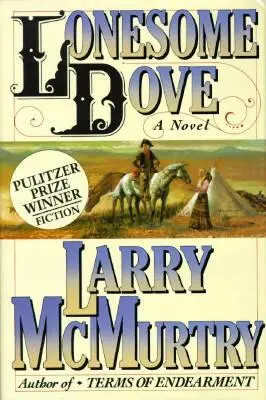
- Название:Lonesome Dove
- Автор:
- Жанр:
- Год:неизвестен
- ISBN:нет данных
- Рейтинг книги:5 / 5. Голосов: 1
-
Избранное:Добавить в избранное
- Отзывы:
-
Ваша оценка:
Lonesome Dove: краткое содержание, описание и аннотация
Предлагаем к чтению аннотацию, описание, краткое содержание или предисловие (зависит от того, что написал сам автор книги «Lonesome Dove»). Если вы не нашли необходимую информацию о книге — напишите в комментариях, мы постараемся отыскать её.
A love story, an adventure, an American epic, Lonesome Dove embraces all the West – legend and fact, heroes and outlaws, whoeres and ladies, Indians and settlers – in a novel that recreates the central American experience, the most enduring of our national myths.
Set in the late nineteenth century, Lonesome Dove is the story of a cattle drive from Texas to Montana – and much more. It is a drive that represents for everybody involved not only a daring, even a foolhardy, adventure, but a part of the American Dream – the attempt to carve out of the last remaining wilderness a new life.
Agustus McCrae and W.F. Call are former Texas Rangers, partners and friends who have shared hardship and danger together without ever quite understanding (or wanting to understand) each other's deepest emotions. Gus is the romantic, a reluctant rancher who has a way with women and the sense to leave well enough alone. Call is a driven, demanding man, a natural authority figure with no patience for weaknesses, and not many of his own. He is obsessed with the dream of creating his own empire, and with the need to conceal a secret sorrow of his own. The two men could hardly be more different, but both are tough, redoubtable fighters who have learned to count on each other, if nothing else.
Call's dream not only drags Gus along in its wake, but draws in a vast cast of characters:
– Lorena, the whore with the proverbial heart of gold, whom Gus (and almost everyone else) loves, and who survives one of the most terrifying experiences any woman could have…
– Elmira, the restless, reluctant wife of a small-time Arkansas sheriff, who runs away from the security of marriage to become part of the great Western adventure…
– Blue Duck, the sinister Indian renegade, one of the most frightening villains in American fiction, whose steely capacity for cruelty affects the lives of everyone in the book…
– Newt, the young cowboy for whom the long and dangerous journey from Texas to Montana is in fact a search for his own identity…
– Jake, the dashing, womanizing ex-Ranger, a comrade-in-arms of Gus and Call, whose weakness leads him to an unexpected fate…
– July Johnson, husband of Elmira, whose love for her draws him out of his secure life into the wilderness, and turns him into a kind of hero…
Lonesome Dove sweeps from the Rio Grande (where Gus and Call acquire the cattle for their long drive by raiding the Mexicans) to the Montana highlands (where they find themselves besieged by the last, defiant remnants of an older West).
It is an epic of love, heroism, loyalty, honor, and betrayal – faultlessly written, unfailingly dramatic. Lonesome Dove is the novel about the West that American literature – and the American reader – has long been waiting for.
Lonesome Dove — читать онлайн бесплатно полную книгу (весь текст) целиком
Ниже представлен текст книги, разбитый по страницам. Система сохранения места последней прочитанной страницы, позволяет с удобством читать онлайн бесплатно книгу «Lonesome Dove», без необходимости каждый раз заново искать на чём Вы остановились. Поставьте закладку, и сможете в любой момент перейти на страницу, на которой закончили чтение.
Интервал:
Закладка:
"I'd rather live in a tepee, like an Indian," she told Bob many times. "I'd be cleaner. When it got dirty we could burn it."
The idea had shocked Bob, a conventional man if there ever was one. He could not believe he had married a woman who wanted to live like an Indian. He worked hard to give her a respectable life, and yet she said things like that-and meant them. And she stubbornly kept her own money, year after year-for the children's education, she said, although one by one the three boys died long before they were old enough to be sent anywhere. The last two lived long enough for Clara to teach them to read. She had read them Walter Scott's Ivanhoe when Jeff and Johnny were six and seven, respectively. Then the next winter both boys had died of pneumonia within a month of one another. It was a terrible winter, the ground frozen so deep there was no way to dig a grave. They had had to put the boys in the little kindling shed, wrapped tightly in wagon sheets, until winter let up enough that they could be buried. Many days Bob would come home from delivering horses to the Army-his main customer-to find Clara sitting in the icy shed by the two small bodies, tears frozen on her cheeks so hard that he would have to heat water and bathe the ice from her face. He tried to point out to her that she mustn't do it-the weather was below zero, and the wind swept endlessly along the Platte. She could freeze to death, sitting in the kindling shed. If only I would, Clara thought-I'd be with my boys.
But she didn't freeze, and Jeff and Johnny had been buried beside Jim, and despite her resolve never to lay herself open to such heartbreak again, she had the girls, neither of whom had ever had more than a cold. Bob couldn't believe his own bad luck; he longed for a strong boy or two to help him with the stock.
And yet he loved the girls in his unspeaking way. His love mostly came out in awkwardness, for their delicacy frightened him. He was continually warning them about their health and trying to keep them wrapped up. Their recklessness almost stopped his heart at times-they were the kind of girls who would run out in the snow barefoot if they chose. He feared for them, and also feared the effect on his wife if one of them should die. Impervious to weather himself, he came to dread the winters for fear winter would take the rest of his family. Yet the girls proved as strong as their mother, whereas the boys had all been weak. It made no sense to Bob, and he was hoping if they could only have another boy, he would turn into the helper he needed.
The only hand they had was an old Mexican cowboy named Cholo. The old man was wiry and strong, despite his age, and stayed mainly because of his devotion to Clara. It was Cholo, and not her husband, who taught her to love horses and to understand them. Cholo had pointed out to her at once that her husband would never break the mustang mare; he had urged her to persuade Bob to sell the mare un broken, or else let her go. Though Bob had been a horse trader all his adult life, he had no real skill with horses. If they disobeyed him, he beat them-Clara had often turned her back in disgust from the sight of her husband beating a horse, for she knew it was his incompetence, not the horse's, that was to blame for whatever incident had provoked the beating. Bob could not contain his violence when angered by a horse.
With her, it was different. He had never raised a hand to her, though she provoked him often, and deeply. Perhaps it was because he had never quite believed that she would marry him, or never quite understood why she had. The shadow of Augustus McCrae had hung over their courtship; Bob had never known why she chose him over the famous Ranger, or over any of the other men she could have had. In her day she had been the most sought-after girl in Texas, and yet she had married him, and followed him to the Nebraska plains, and stayed and worked beside him. It was hard country for women, Bob knew that. Women died, went crazy or left. The wife of their nearest neighbor, Maude Jones, had killed herself with a shotgun one morning, leaving a note which merely said, "Can't stand listening to this wind no more." Maude had had a husband and four children, but had killed herself anyway. For a time, Clara had taken in the children, until their grandparents in Missouri came for them. Len Jones, Maude's husband, soon drank himself into poverty. He fell out of his wagon drunk one night and froze to death not two hundred yards from a saloon.
Clara had lived, and stayed, though she had a look in her gray eyes that frightened Bob every time he saw it. He didn't really know what the look meant, but to him it meant she might leave if he didn't watch out. When they first came to Nebraska, he had had the drinking habit. Ogallala was hardly even a town then; there were few neighbors, and almost no socials. The Indians were a dire threat, though Clara didn't seem to fear them. If they had company, it was usually soldiers-the soldiers drank, and so did he. Clara didn't like it. One night he got pretty drunk, and when he got up in the morning she had that look in her eye. She made him breakfast, but then she looked at him coldly and lay down a threat. "I want you to stop drinking," she said. "You've been drunk three times this week. I won't live here and get dirt in my hair for the love of a drunkard."
It was the only threat she ever had to make. Bob spent the day worrying, looking at the bleak plains and wondering what he would do in such a place without her. He never touched whiskey again. The jug he had been working on sat in the cupboard for years, until Clara finally mixed it with sorghum molasses and used it for cough medicine.
They had few quarrels, most of them about money. Clara was a good wife and worked hard; she never did anything untoward or unrespectable, and yet the fact that she had that Texas money made Bob uneasy. She wouldn't give it up or let him use it, no matter how poor they were. Not that she spent it on herself-Clara spent nothing on herself, except for the books she ordered or the magazines she took. She kept the money for her children, she said-but Bob could never be sure she wasn't keeping it so she could leave if she took a notion. He knew it was foolish-Clara would leave, money or no money, if she decided to go-but he couldn't get the idea out of his mind. She wouldn't even use the money on the house, although she had wanted the house, and they had had to haul the timber two hundred miles. Of course, he had prospered in the horse business, mainly because of the Army trade; he could afford to build her a house. But he still resented her money. She told him it was only for the girls' education-and yet she did things with it that he didn't expect. The winter before she had bought Cholo a buffalo coat, an action which shocked Bob. He had never heard of a married woman buying a Mexican cowboy an expensive coat. Then there was the piano. She had ordered that too, although it cost two hundred dollars and another forty to transport. And yet he had to admit he loved to see his girls sitting at the piano, trying to learn their fingering. And the buffalo coat had saved Cholo's life when he was trapped in an April blizzard up on the Dismal River. Clara got her way, and her way often turned out to make sense-and yet Bob more and more felt that her way skipped him, somehow. She didn't neglect him in any way that he could put his finger on, and the girls loved him, but there were many times when he felt left out of the life of his own family. He would never have said that to Clara-he was not good with words, and seldom spoke unless he was spoken to, unless it was about business. Watching his wife, he often felt lonely. Clara seemed to sense it and would usually come and try to be especially nice to him, or to get him laughing at something the girls had done-and yet he still felt lonely, even in their bed.
Читать дальшеИнтервал:
Закладка:
Похожие книги на «Lonesome Dove»
Представляем Вашему вниманию похожие книги на «Lonesome Dove» списком для выбора. Мы отобрали схожую по названию и смыслу литературу в надежде предоставить читателям больше вариантов отыскать новые, интересные, ещё непрочитанные произведения.








Обсуждение, отзывы о книге «Lonesome Dove» и просто собственные мнения читателей. Оставьте ваши комментарии, напишите, что Вы думаете о произведении, его смысле или главных героях. Укажите что конкретно понравилось, а что нет, и почему Вы так считаете.