Ha Jin - War Trash
Здесь есть возможность читать онлайн «Ha Jin - War Trash» весь текст электронной книги совершенно бесплатно (целиком полную версию без сокращений). В некоторых случаях можно слушать аудио, скачать через торрент в формате fb2 и присутствует краткое содержание. Жанр: Современная проза, на английском языке. Описание произведения, (предисловие) а так же отзывы посетителей доступны на портале библиотеки ЛибКат.
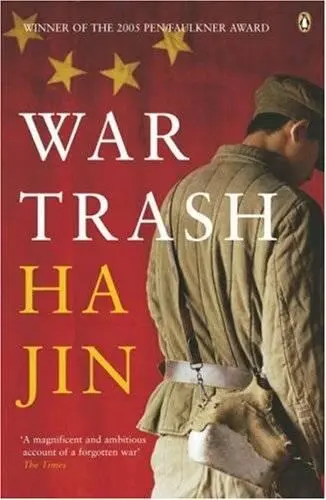
- Название:War Trash
- Автор:
- Жанр:
- Год:неизвестен
- ISBN:нет данных
- Рейтинг книги:5 / 5. Голосов: 1
-
Избранное:Добавить в избранное
- Отзывы:
-
Ваша оценка:
War Trash: краткое содержание, описание и аннотация
Предлагаем к чтению аннотацию, описание, краткое содержание или предисловие (зависит от того, что написал сам автор книги «War Trash»). Если вы не нашли необходимую информацию о книге — напишите в комментариях, мы постараемся отыскать её.
Jin (Waiting; The Crazed; etc.) applies his steady gaze and stripped-bare storytelling to the violence and horrifying political uncertainty of the Korean War in this brave, complex and politically timely work, the story of a reluctant soldier trying to survive a POW camp and reunite with his family. Armed with reams of research, the National Book Award winner aims to give readers a tale that is as much historical record as examination of personal struggle. After his division is decimated by superior American forces, Chinese "volunteer" Yu Yuan, an English-speaking clerical officer with a largely pragmatic loyalty to the Communists, rejects revolutionary martyrdom and submits to capture. In the POW camp, his ability to communicate with the Americans thrusts him to the center of a disturbingly bloody power struggle between two factions of Chinese prisoners: the pro-Nationalists, led in part by the sadistic Liu Tai-an, who publicly guts and dissects one of his enemies; and the pro-Communists, commanded by the coldly manipulative Pei Shan, who wants to use Yu to save his own political skin. An unofficial fighter in a foreign war, shameful in the eyes of his own government for his failure to die, Yu can only stand and watch as his dreams of seeing his mother and fiancée again are eviscerated in what increasingly looks like a meaningless conflict. The parallels with America 's current war on terrorism are obvious, but Jin, himself an ex-soldier, is not trying to make a political statement. His gaze is unfiltered, camera-like, and the images he records are all the more powerful for their simple honesty. It is one of the enduring frustrations of Jin's work that powerful passages of description are interspersed with somewhat wooden dialogue, but the force of this story, painted with starkly melancholy longing, pulls the reader inexorably along.
From The New Yorker
Ha Jin's new novel is the fictional memoir of a Chinese People's Volunteer, dispatched by his government to fight for the Communist cause in the Korean War. Yu Yuan describes his ordeal after capture, when P.O.W.s in the prison camp have to make a wrenching choice: return to the mainland as disgraced captives, or leave their families and begin new lives in Taiwan. The subject is fascinating, but in execution the novel often seems burdened by voluminous research, and it strains dutifully to illustrate political truisms. In a prologue, Yuan claims to be telling his story in English because it is "the only gift a poor man like me can bequeath his American grandchildren." Ha Jin accurately reproduces the voice of a non-native speaker, but the labored prose is disappointing from an author whose previous work – "Waiting" and " Ocean of Words " – is notable for its vividness and its emotional precision.
War Trash — читать онлайн бесплатно полную книгу (весь текст) целиком
Ниже представлен текст книги, разбитый по страницам. Система сохранения места последней прочитанной страницы, позволяет с удобством читать онлайн бесплатно книгу «War Trash», без необходимости каждый раз заново искать на чём Вы остановились. Поставьте закладку, и сможете в любой момент перейти на страницу, на которой закончили чтение.
Интервал:
Закладка:
From somewhere near the ceiling, in the southern upper corner of the wall, came a rasping sound. We stood up and moved over to look. Slowly a lumpy thing emerged in the corner. None of us could reach it, so Mushu squatted down and let me step on his shoulders while Little Hou held my leg to keep me steady. I stretched out and pulled the thing in through a rift between the ceiling and the wall. It was a parcel wrapped in a piece of waterproof cloth. Hurriedly we opened it – inside were a block of cooked rice and six baked squids, each about four inches long. On top of the food was a slip of paper bearing Commissar Pei 's handwriting in pencil: "Keep fighting, take care of your health, stay alert, and we'll be in touch soon." We wolfed down the war criminal's food, which was much tastier than ours. We were very touched by the message, which was passed among us several times. We were so excited that for hours we went on talking about what we could do. For most of us, Commissar Pei seemed like a lighthouse that could guide our foundering ship home.
Then Little Hou said, "Why don't we use the time here to create a special code, to open a channel of communication between Commissar Pei and the camp?"
"That'll be great if we can," said Mushu.
"But I don't know anything about the code stuff," I put in. "Can we do it only with the three of us?"
"Probably he can." Mushu pointed at Little Hou, who hiccuped, chewing something vigorously. Mushu continued, "Keep in mind, it was this fellow who made most of the general code used among the battalions."
Little Hou said to me about Mushu, "He was a signalman in Compound 10, he can help me."
We three looked at one another, then hugged tightly. I told them that I would obey any orders they gave, despite my leadership. They laughed. I still couldn't imagine how they could possibly open such a channel of communication, though I knew I ought to encourage them. After we broke the work into separate parts, we ran into difficulties we hadn't expected. To begin with, we needed paper and a pencil. How on earth could we get those things in this hellhole? Little Hou regretted not having brought along his pencil stub. I told him, "Forget it, even if you had taken it with you, you might've lost it to the guards."
Mushu nudged me in the ribs and said, "Look at that." He pointed at the windowsill, on which was a whitish wad. I rushed over and grabbed the thing – ah, a roll of toilet tissue! "The Americans are so considerate!" Mushu laughed. "I never used such fancy toilet paper back in our country. Comrades, I bet none of you did either."
"Uh-uh, not me." Little Hou shook his chin with a straight face.
We cracked up, though subduedly. So we had solved the paper problem. But what should we do about the pencil? This beat us, and we agreed to ask for help the next morning.
I slept well for the rest of the night, whereas neither of them could sleep a wink. When I woke up six hours later, they told me that I had snored like a pig. Before daybreak, as the stars were fading and a fine mist was rising from the ocean, we knocked on the wall. Instantly the other side responded. I got on Mushu's shoulders and talked to Ming through the hole. "This is Yuan," I whispered.
"Ah, I was so happy to see you yesterday." His voice was brisk but half suppressed.
"How's Commissar Pei, and yourself?"
"We're fine."
"Listen, we're planning to create a code for you to use to communicate with the camp. But first we want to get permission from Commissar Pei. Can you ask him for us?" We ought to inform the top leader beforehand in case a similar project was already afoot.
"Certainly," Ming said.
Both of us got down to give our bearers a breather. Two minutes later I stood on Mushu's shoulders again. Ming told me, " Commissar Pei is delighted. He appreciates your initiative in this matter. He says he'll wait for the news of your success. Can we do something to help?"
"We need a pencil. Do you happen to have one?"
"We do have a short piece here. Wait a second, I'll hand it over."
Seeing that a wet patch had emerged on Mushu's back, I asked him if I should step down for a moment.
"No, I'm all right." He patted my leg. Little Hou squatted down beside him and asked me to put my right foot on his shoulder, but Mushu pushed him away. They were both excited because a pencil was available.
A moment later another package was pushed over through the hole. This time it contained some rice together with a pencil. Little Hou grabbed the three-inch stub, kissed it, and pressed it against his chest.
Without delay we began to work. There were two parts to the project: first, the code, and second, the method of transmission, that is, a special way of sending and receiving encoded messages. According to Little Hou, the code wasn't very hard to make, and he had already started on it. Neither Mushu nor I had any clue how it was formed exactly, so we focused on the method of transmission, which was the difficult part, having to be invented entirely by ourselves. Alas, I couldn't be of any help. If messages could not be transmitted properly, the code would be of no use however ingeniously it was devised, but all the methods Mushu could imagine were unsuitable. For example, the semaphore of gestures employed among the compounds couldn't be distinguished from a distance of over three hundred yards. How about light? That wasn't feasible either. In the first place, we had no flashlights. Even if we'd had them, they would have been too dangerous to use, since the enemy could see the light and might fire at the signalman.
What should we do? Mushu began pacing the cell again while we were both thinking hard for a solution. Although I was a layman, I could tell we wouldn't find an adequate method very soon, so I suggested we focus on the code first, giving thought to the transmission part whenever we could. During the day I stood at the window most of the time keeping watch on the guards and the maintenance men. We had divided the safety measures among ourselves. If a GI or a custodian came in, I would go up to him and block his way by speaking to him, and Mushu would drop his pants and crouch over the toilet pail so as to prevent the intruder from searching the cell while Little Hou would put the piece of toilet paper he was writing on into his mouth. Little Hou always kept the penciled sheets underneath his shirt. With great caution we went on working at the code.
Day after day we racked our brains, but still couldn't find an adequate transmission method. Little Hou was truly a smart fellow and engrossed in the code work most of the time. When he was eating or taking a break, he would mention to us one possibility and another, but none of them would work. Then one morning he hit on a brilliant idea, namely to simplify the Morse code as much as possible, to the degree of letting one dot or one dash stand for a numeral. This would not only speed up the transmission but also reduce confusion. Based on this conception, he and Mushu created the Walking Telegraphic Method: the sender of the message would stand behind the window of the war criminals cell. If he walked to the left side, it meant a dot; if he moved to the right, it denoted a dash; if he hunkered down below the window, that indicated the beginning of a new group of numerals. One dot meant 1, one dot plus one dash – 2, two dots plus one dash – 3, two dots – 4, three dots – 5, three dashes – 6, two dashes plus one dot – 7, one dash plus one dot – 8, two dashes – 9, and one dash – o. As a rule, every four numerals represented a word. After the receiver jotted down the numerals, he passed it on to the code man, who could decipher them with the aid of the codebook Little Hou was making. In the reverse order to our cell, the war criminal's room had a window facing Compound 6, so they could send and receive messages from within the room. This method would definitely resolve the problem of transmission. How excited we were! We wanted to shout for joy, but we didn't dare. We only lifted Little Hou on our shoulders and walked a few rounds in the cell. Then he returned to working at the code.
Читать дальшеИнтервал:
Закладка:
Похожие книги на «War Trash»
Представляем Вашему вниманию похожие книги на «War Trash» списком для выбора. Мы отобрали схожую по названию и смыслу литературу в надежде предоставить читателям больше вариантов отыскать новые, интересные, ещё непрочитанные произведения.




Обсуждение, отзывы о книге «War Trash» и просто собственные мнения читателей. Оставьте ваши комментарии, напишите, что Вы думаете о произведении, его смысле или главных героях. Укажите что конкретно понравилось, а что нет, и почему Вы так считаете.