Tracy Chevalier - Remarkable Creatures
Здесь есть возможность читать онлайн «Tracy Chevalier - Remarkable Creatures» — ознакомительный отрывок электронной книги совершенно бесплатно, а после прочтения отрывка купить полную версию. В некоторых случаях можно слушать аудио, скачать через торрент в формате fb2 и присутствует краткое содержание. Жанр: Современная проза, на английском языке. Описание произведения, (предисловие) а так же отзывы посетителей доступны на портале библиотеки ЛибКат.
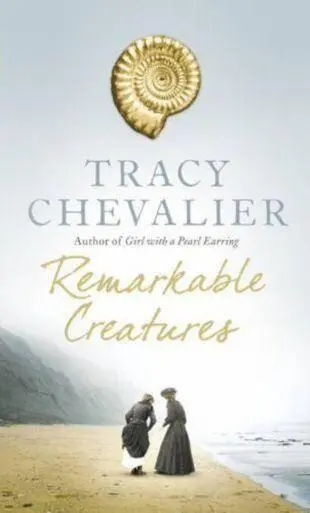
- Название:Remarkable Creatures
- Автор:
- Жанр:
- Год:неизвестен
- ISBN:нет данных
- Рейтинг книги:4 / 5. Голосов: 1
-
Избранное:Добавить в избранное
- Отзывы:
-
Ваша оценка:
Remarkable Creatures: краткое содержание, описание и аннотация
Предлагаем к чтению аннотацию, описание, краткое содержание или предисловие (зависит от того, что написал сам автор книги «Remarkable Creatures»). Если вы не нашли необходимую информацию о книге — напишите в комментариях, мы постараемся отыскать её.
Remarkable Creatures — читать онлайн ознакомительный отрывок
Ниже представлен текст книги, разбитый по страницам. Система сохранения места последней прочитанной страницы, позволяет с удобством читать онлайн бесплатно книгу «Remarkable Creatures», без необходимости каждый раз заново искать на чём Вы остановились. Поставьте закладку, и сможете в любой момент перейти на страницу, на которой закончили чтение.
Интервал:
Закладка:
I opened my purse and poured into my palm a few bits of fossils that had found their way there. Most of my pockets and purses held fossil pieces. Reverend Jones’ mouth twisted in disgust as he glanced at the contents: ammonites, belemnite shafts, a chunk of fossilised wood, a length of crinoid stem. He reacted as if I had trailed horse dung into the church on my shoes. “Why on earth are you carrying those about?”
Ignoring his question, I held out an ammonite. “I should like to know where the live versions of these are, Reverend Jones, for I have never seen one.” As we gazed at the fossil, I felt for a moment that I was being sucked into its spiral, farther and farther back in time until the past was lost in the centre.
Reverend Jones’ response to the ammonite was more prosaic. “Perhaps you haven’t seen them because they live out at sea, and their bodies only wash up after they die.” He turned away and, pulling the door shut, locked it with the deft turn of a key, a gesture he seemed to enjoy.
I stepped in front of him so that he could not hurry off to his dinner. Indeed, he could not move at all, but was pinned in the corner. Not being able to get away from me and my awkward questions seemed to disturb Reverend Jones even more than my bringing out the ammonite had. He whipped his head from side to side. “Fanny, have you done yet?” he called. There was no response, however. She must have gone outside to dump the sweepings.
“Have you heard about the crocodile head the Annings have found in the cliffs and are showing at the Assembly Rooms?” I asked.
Reverend Jones forced himself to look straight at me. He had narrow eyes that seemed to be seeking out a horizon even when they were set on mine. “I know of it, yes.”
“Have you seen it?”
“I have no desire to see it.”
I was not surprised. Reverend Jones showed no curiosity about anything other than what would soon be on his plate. “The specimen does not look like any creature that lives now,” I said.
“Miss Philpot-”
“Someone-a member of this congregation, in fact-has suggested that it is an animal that God rejected in favour of a better design.”
Reverend Jones looked aghast. “Who said that?”
“It is not important who said it. I just wondered if there was any truth in the theory.”
Reverend Jones brushed down the sleeves of his coat and pursed his lips.“Miss Philpot, I am surprised. I thought you and your sisters were well versed in the Bible.”
“We are-”
“Let me make it clear: you need only look to Scripture for answers to your questions. Come.” He led the way back to the pulpit, where the Bible he had read from lay.
As he began flipping through the pages, the girl approached. “Reverend Jones, sir, I done the sweeping.”
“Thank you, Fanny.” Reverend Jones regarded her for a moment, then said, “There is something else I would like you to do for me, child. Come over to the Bible. I want you to read something out to Miss Philpot. There’s another penny in it for you.” He turned to me. “Fanny Miller and her family joined St Michael’s a few years ago from the Congregationalists, for they were deeply disturbed by the Annings’ fossil hunting. The Church of England is clearer in its biblical interpretation than some of the Dissenters’ churches. You have found much comfort here, haven’t you, Fanny?”
Fanny nodded. She had wide, crystal blue eyes topped with smooth, dark eyebrows that contrasted with her fair hair. She would never lead with her eyes, though they were her best feature, but with her brow, which was wrinkled with apprehension as she gazed at the Bible.
“Don’t be frightened, Fanny,” Reverend Jones said to soothe her. “You are a very good reader. I have heard you at Sunday school. Start here.” He laid a finger on a passage.
She read in a halting whisper:
“And God said, ‘Let the waters bring forth abundantly the moving creature that hath life, and fowl that may fly above the earth in the open firmament of heaven.’ And God created great whales, and every living creature that moveth, which the waters brought forth abundantly, after their kind, and every winged fowl after his kind; and God saw that it was good. And God blessed them, saying, ‘Be fruitful, and multiply, and fill the waters in the seas, and let fowl multiply in the earth.’ And the evening and the morning were the fifth day.
“Excellent, Fanny, you may stop there.”
I thought he had finished patronising me by having an ignorant girl read out from Genesis, but Reverend Jones himself continued, “And God said, ‘Let the earth bring forth the living creature after his kind, cattle, and creeping thing, and beast of the earth after his kind,’ and it was so.”
I stopped listening after a few lines. I knew them anyway, and couldn’t bear his oboe voice, which lacked the depth one expected of a man in his position. I actually preferred Fanny’s unschooled recitation. While he read I let my eye rest on the page. To the left of the Biblical words were annotations in red of Bishop Ussher’s chronological calculations of the Bible. According to him, God created Heaven and Earth on the night preceding the 23rd October 4004 BC. I had always wondered at his precision.
“…And the evening and the morning were the sixth day.”
When Reverend Jones finished we were silent.
“You see, Miss Philpot, it really is very simple,” Reverend Jones said. He seemed much more confident now that he had the Bible with him. “All that you see about you is as God set it out in the beginning. He did not create beasts and then get rid of them. That would suggest He had made a mistake, and of course God is all-knowing and incapable of error, is He not?”
“I suppose not,” I conceded.
Reverend Jones’ mouth writhed. “You suppose not?”
“Of course not,” I said quickly. “I’m sorry; it’s just that I am confused. You are saying that everything we see around us is exactly as God created it, are you not? The mountains and seas and rocks and hills-the landscape is as it was at the beginning?”
“Of course.” Reverend Jones looked around at his church, tidy and quiet. “We are done here, aren’t we, Fanny?”
“Yes, Reverend Jones.”
But I was not done. “So every rock we see is as God created it at the beginning,” I persisted. “And the rocks came first, as it says in Genesis, before the animals.”
“Yes, yes.” Reverend Jones was becoming impatient, his mouth chewing an imaginary straw.
“If that is the case, then how did the skeletons of animals get inside rocks and become fossils? If the rocks were already created by God before the animals, how is it that there are bodies in the rocks?”
Reverend Jones stared at me, his mouth at last stilled into a tight straight line. Fanny Miller’s forehead was a field of furrows. One of the pews creaked in the stillness.
“God placed the fossils there when He created the rocks, to test our faith,” he responded at last. “As He is clearly testing yours, Miss Philpot.”
It is my faith in you that is being tested, I thought.
“Now, I really am very late for my dinner,” Reverend Jones continued. He picked up the Bible, a gesture that seemed to suggest he thought I might steal it. “Do not ask me difficult questions,” he might as well have said.
I never again mentioned fossils to Reverend Jones.
Lord Henley had to wait almost the agreed two years for the crocodile body to emerge. At first when I saw him at church or the Assembly Rooms or on the street, he would shout each time, “Where’s the body? Have you dug it out yet?” I would have to explain that the landslip was still blocking it and could not easily be shifted. He seemed not to understand until Mary and Joseph Anning and I took him one day to see the landslip for himself. He was startled, and also angry. “No one told me there was this much rock blocking it,” he claimed, stomping at a bubble of clay. “You’ve misled me, Miss Philpot, you and the Annings.”
Читать дальшеИнтервал:
Закладка:
Похожие книги на «Remarkable Creatures»
Представляем Вашему вниманию похожие книги на «Remarkable Creatures» списком для выбора. Мы отобрали схожую по названию и смыслу литературу в надежде предоставить читателям больше вариантов отыскать новые, интересные, ещё непрочитанные произведения.





Обсуждение, отзывы о книге «Remarkable Creatures» и просто собственные мнения читателей. Оставьте ваши комментарии, напишите, что Вы думаете о произведении, его смысле или главных героях. Укажите что конкретно понравилось, а что нет, и почему Вы так считаете.