Tracy Chevalier - Remarkable Creatures
Здесь есть возможность читать онлайн «Tracy Chevalier - Remarkable Creatures» — ознакомительный отрывок электронной книги совершенно бесплатно, а после прочтения отрывка купить полную версию. В некоторых случаях можно слушать аудио, скачать через торрент в формате fb2 и присутствует краткое содержание. Жанр: Современная проза, на английском языке. Описание произведения, (предисловие) а так же отзывы посетителей доступны на портале библиотеки ЛибКат.
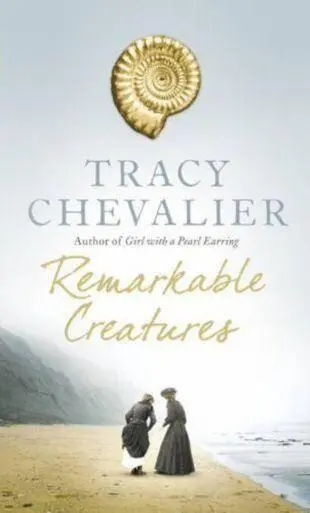
- Название:Remarkable Creatures
- Автор:
- Жанр:
- Год:неизвестен
- ISBN:нет данных
- Рейтинг книги:4 / 5. Голосов: 1
-
Избранное:Добавить в избранное
- Отзывы:
-
Ваша оценка:
Remarkable Creatures: краткое содержание, описание и аннотация
Предлагаем к чтению аннотацию, описание, краткое содержание или предисловие (зависит от того, что написал сам автор книги «Remarkable Creatures»). Если вы не нашли необходимую информацию о книге — напишите в комментариях, мы постараемся отыскать её.
Remarkable Creatures — читать онлайн ознакомительный отрывок
Ниже представлен текст книги, разбитый по страницам. Система сохранения места последней прочитанной страницы, позволяет с удобством читать онлайн бесплатно книгу «Remarkable Creatures», без необходимости каждый раз заново искать на чём Вы остановились. Поставьте закладку, и сможете в любой момент перейти на страницу, на которой закончили чтение.
Интервал:
Закладка:
I glanced at Mary. “A month at least,” I guessed. “Perhaps longer. No one has dealt with such a large creature before.”
Lord Henley grunted. He was eyeing the skull as if it were a haunch of venison dressed in port sauce. It was clear he wanted to take it back to Colway Manor immediately-he was the sort of man who made a decision and did not like to wait for the results. However, even he could see that the specimen needed attention-partly to present it in its best light, but also to preserve it. The skull had been pressed between layers of rock in the cliff, protecting it from exposure to air and keeping it damp. Now that it was free it would soon dry out and begin to crack as it shrank, unless Mary sealed it with the varnish her father had used on his cabinets. “All right, then,” he said. “A month to clean it, then bring it to me.”
“We ain’t giving up the skull till the body turns up,” Mary declared.
I frowned and shook my head at her. I was trying to lead Lord Henley gently to the notion of paying for the skull and body together, and Mary was blundering into my delicate negotiations. She ignored me, however, and added, “We’re keeping the head at Cockmoile Square.”
Lord Henley gazed at me. “Miss Philpot, why should this child have any say over what happens to the specimen?”
I coughed into my handkerchief. “Well, sir, she did find it-she and her brother-so I suppose her family has some claim on it.”
“Where is the father, then? I should be talking to him, not to a-” Lord Henley paused, as if saying “woman” or “girl” were too undignified for him.
“He died a few months ago.”
“The mother, then. Bring the mother here.” Lord Henley spoke as if commanding a groom to bring his horse.
It was hard to picture Molly Anning bargaining with Lord Henley. The day before she had agreed that I would try to convince Lord Henley to wait for a complete specimen. We had not discussed her doing the business dealings herself. I sighed. “Run and fetch your mother, Mary.”
We waited in awkward silence for them to come back, taking refuge in studying the skull. “Its eyes are rather large for a crocodile, do you not think, Lord Henley?” I ventured.
Lord Henley scuffed his boots on the floor. “It’s simple, Miss Philpot. This is one of God’s early models, and He decided to give the subsequent ones smaller eyes.”
I raised my eyebrows. “Do you mean God rejected it?”
“I mean God wanted a better version-the crocodile we know now-and replaced it.”
I had never heard of such a thing. I wanted to ask Lord Henley more about this idea, but he always stated things so baldly that there was no room for questions. He made me feel an idiot, even when I knew he was a bigger one than I.
It was just as well that we were interrupted by Molly Anning. Mercifully she did not bring the crying baby, but arrived trailing Mary and the smell of cabbage. “I’m Molly Anning, sir,” she said, wiping her hands on her apron and looking around her, for she would never have been inside the Assembly Rooms. “I run our fossil shop. What was it you wanted?” She was the same height as Lord Henley, and her level gaze seemed to subdue him a little. She surprised me too. I had never heard of the workshop being called a shop, or of her having anything to do with it. But then, without a husband, she had to take on new tasks. Running a business appeared to be one of them.
“I want to take this specimen, Mrs Anning. If your daughter will allow it,” Lord Henley added with a touch of sarcasm. “But then, your daughter answers to you, does she not?”
“Course.” Molly Anning barely glanced at the skull. “How much you want to pay, then?”
“Three pounds.”
“That-” I began.
“I expect there be plenty of gentlemen prepared to pay more,” Molly Anning talked over me. “But we’ll take your money, if you like, as a deposit for the whole creature once Mary finds it.”
“And if she doesn’t?”
“Oh, she’ll find it all right. My Mary always finds things. She’s special like that-always has been, since she was struck by lightning. That were in your field, weren’t it, Lord Henley, where she was struck?”
Several things astonished me: that Molly Anning was talking so confidently to a member of the gentry; that she had rather cleverly allowed him to name his price, throwing him off balance and getting an idea of the worth of an object whose value she didn’t know; that she had the cunning to make the lightning strike seem to be his responsibility. Most surprising, though, she had actually complimented her daughter just when Mary needed it. I’d heard people say that Molly Anning was an original; now I understood what they meant.
Lord Henley hardly knew how to respond. I stepped in to help him out. “Of course, the Annings will give you the head for three pounds if the body isn’t found within, shall we say, two years?”
Lord Henley glanced from Molly Anning to me. “All right,” he replied at length, placing his hand again on his prize.
After encountering the skull, I found it difficult to sleep, dreaming of the eyes of animals I had looked into: horses, cats, seagulls, dogs. There was a flatness in them, the lack of a God-given spark, that frightened me into wakefulness.
On Sunday I remained behind after the service at St Michael’s, waving on Bessy and my sisters. “I will catch you up,” I said, and stood at the back of the church, waiting for the vicar to finish his goodbyes to the other parishioners. Reverend Jones was a plain man, with a boxy head and close-cropped hair, whose thin lips twisted and turned even when every other part of him was still. I had not spoken with him except to mouth pleasantries, for he was uninspiring during services, his voice reedy, his sermons lacklustre. However, he was a man of God, and I hoped he might be able to give me guidance.
At last only a girl remained behind, sweeping the floor. Reverend Jones was going up and down the pews, picking up hymn sheets and checking for gloves or prayer books left behind. He did not see me. Indeed, it felt as if he did not want to see me. His pastoral duties over for the day, he was doubtless thinking about the dinner he would soon sit down to and the sleep by the fire afterwards. When I cleared my throat and he looked up, he could not stop his mouth tightening into a brief grimace. “Miss Philpot, is this handkerchief yours?” He held out a ball of white cloth, probably hopeful that I could be easily dismissed.
“I’m afraid not, Reverend Jones.”
“Ah. You are looking for something else, perhaps? A purse? A button? A hair pin?”
“No, I wished to discuss a matter with you.”
“I see.” Reverend Jones pushed out his lips. “My dinner will be ready soon and I need to finish up here. You don’t mind…?” He continued along the pews, straightening cushions as I trailed behind. All the while I could hear the scratch of the girl’s broom on the floor.
“I wanted to ask you what you thought of fossils.” In trying to hold his attention, my voice came out louder than I had intended in the empty church. The sweeping stopped, but Reverend Jones continued up the aisle to the oak pulpit, where he picked up his own handkerchief and put it in his pocket.
“What do I think of fossils, Miss Philpot? I do not think of them.”
“But do you know what they are?”
“They are skeletons that have been compressed by rock over time to become stone themselves. Most educated people know that.”
“But the skeletons-are they of creatures that still exist today?”
Reverend Jones hurried to the altar and gathered up a set of candlesticks and the altar cloth. I felt like an idiot following him about.
“Of course they exist,” he said. “All of the creatures God made exist.” He opened a door in the aisle to the left of the altar, which led to a small back room where church bits and pieces were stored. Over his shoulder I spied a jug labelled “Holy Water” sitting on a table. I remained in the doorway while Reverend Jones shut the candlesticks and cloth in a cupboard. “I’m afraid I don’t understand your question, Miss Philpot,” he called over his shoulder.
Читать дальшеИнтервал:
Закладка:
Похожие книги на «Remarkable Creatures»
Представляем Вашему вниманию похожие книги на «Remarkable Creatures» списком для выбора. Мы отобрали схожую по названию и смыслу литературу в надежде предоставить читателям больше вариантов отыскать новые, интересные, ещё непрочитанные произведения.


Обсуждение, отзывы о книге «Remarkable Creatures» и просто собственные мнения читателей. Оставьте ваши комментарии, напишите, что Вы думаете о произведении, его смысле или главных героях. Укажите что конкретно понравилось, а что нет, и почему Вы так считаете.