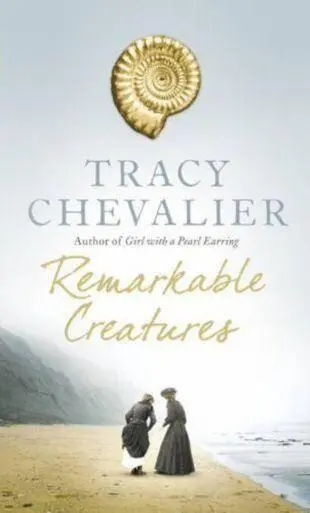
Tracy Chevalier - Remarkable Creatures
Здесь есть возможность читать онлайн «Tracy Chevalier - Remarkable Creatures» — ознакомительный отрывок электронной книги совершенно бесплатно, а после прочтения отрывка купить полную версию. В некоторых случаях можно слушать аудио, скачать через торрент в формате fb2 и присутствует краткое содержание. Жанр: Современная проза, на английском языке. Описание произведения, (предисловие) а так же отзывы посетителей доступны на портале библиотеки ЛибКат.
- Название:Remarkable Creatures
- Автор:
- Жанр:
- Год:неизвестен
- ISBN:нет данных
- Рейтинг книги:4 / 5. Голосов: 1
-
Избранное:Добавить в избранное
- Отзывы:
-
Ваша оценка:
Remarkable Creatures: краткое содержание, описание и аннотация
Предлагаем к чтению аннотацию, описание, краткое содержание или предисловие (зависит от того, что написал сам автор книги «Remarkable Creatures»). Если вы не нашли необходимую информацию о книге — напишите в комментариях, мы постараемся отыскать её.
Remarkable Creatures — читать онлайн ознакомительный отрывок
Ниже представлен текст книги, разбитый по страницам. Система сохранения места последней прочитанной страницы, позволяет с удобством читать онлайн бесплатно книгу «Remarkable Creatures», без необходимости каждый раз заново искать на чём Вы остановились. Поставьте закладку, и сможете в любой момент перейти на страницу, на которой закончили чтение.
Интервал:
Закладка:
Margaret was crying again. I could not bear it, for she would make me cry as well, and I do not cry. I left her to take refuge in the dining room with my fossils. Let Louise comfort her when she returned.
Later that day I used Lord Henley’s visit as an excuse to go down to Cockmoile Square. I wanted to discuss with the Annings his interest in the skull, and also to hear about what Mary had found back on the beach, for she’d told me she was going to look for the crocodile’s body. When I arrived, I went first to the kitchen to speak to Mary’s mother. Molly Anning was a tall, gaunt woman wearing a mop cap and a grubby white apron. She stood at the range, stirring what smelled like oxtail broth, while a baby squalled without conviction in a drawer in the corner.
I set down a bundle. “Bessy made too many rock cakes and thought you might like some, Mrs Anning. There’s a round of cheese in there too, and part of a pork pie.” The kitchen was cold, with the fire in the range feeble. I should have brought coal as well. I did not tell her that Bessy had made the rock cakes only because I ordered her to. Whatever their hardships, Bessy did not like the Annings, feeling-like other good families in Lyme, I expect-that our association with them demeaned us.
Molly Anning murmured thanks but did not look up. I knew she did not think much of me, for I was the embodiment of what she did not want Mary to become: unmarried and obsessed with fossils. I understood her fears. My mother would not have wished my life on me either-nor would I, a few years back. Now I was living it, though, it was not so bad. In some ways I had more freedom than ladies who married.
The baby continued to wail. Of the ten children Molly Anning had borne, only three survived, and this one did not sound as if he would last his infancy. I looked around for a nurse or maid, but of course there was none. Forcing myself to go over to him, I gave the swaddled body a pat, which only made him cry harder. I have never known what to do with babies.
“Leave him, ma’am,” Molly Anning called. “Attention will only make him worse. He’ll settle in a bit.”
I stepped away from the drawer and looked about, trying not to reveal my dismay at the shabbiness of the room. Kitchens are normally the most welcoming part of a house, but the Annings’ lacked the basic warmth and well-stocked feeling that encourages lingering. There was a battered table with three chairs pulled up to it and a shelf holding a few chipped plates. No bread or pies or jugs of milk sat out as they did in our kitchen, and I felt a sudden fondness for Bessy. However much she grumbled, she kept the kitchen full of food, and that abundance was a comfort that spread through Morley Cottage. The security she created was what saw us Philpot sisters through the day. Not to have it must gnaw at the gut as much as real hunger did.
Poor Mary, I thought. To be on the cold beach all day and come back to this. “I’m here to see Mary and Joseph, Mrs Anning,” I said aloud. “Are they about?”
“Joe’s got work at the mill today. Mary’s downstairs.”
“Did you see the skull they brought back from the beach yesterday?” I couldn’t help asking. “It is quite exceptional.”
“Haven’t had the time.” Molly picked up a head of cabbage from a basket and began to chop at it savagely. She led with her hands, though not as Margaret did with frivolous gestures. Molly’s were always busy with work: stirring, wiping, clearing.
“It is just downstairs, though,” I persisted, “and well worth a look. It would only take a moment. You could do it now-I’ll look after the soup and the baby while you go.”
Molly Anning grunted. “You look after the baby, eh? I’d like to see that.” Her chuckle made me turn red.
“They’ll get a good price for the crocodile once they’ve cleaned it up.” I spoke of the skull in the one way I knew would interest her.
Indeed, Molly Anning looked up, but didn’t have a chance to reply before Mary came clattering up the stairs. “You here to see the croc, Miss Philpot?”
“And you as well, Mary.”
“Come down, then, ma’am.”
I had been in the Annings’ workshop a handful of times during the years we’d lived in Lyme, to order cabinets from Richard Anning, or to pick up or drop off specimens for Mary to clean, though most often she came to me. While Richard Anning worked as a cabinet maker, the room had been a battleground between the elements representing two parts of his life: the wood he made a living from and the stone that fed his interest in the natural world. Still stacked against the wall on one side of the room were sheets of wood planed fine, as well as smaller strips of veneer. Buckets of old varnish and tools littered the floor, which was strewn with wood shavings. Little had been touched on this side of the room in the months since Richard Anning’s death, though I suspected the Annings had sold some of the wood in order to eat, and would soon sell off the rest, as well as the tools.
On the other side of the room were long shelves crammed with chunks of rock containing specimens as yet unlocked by Mary’s hammer. Also on the shelves and on the floor, in no order that I could discern in the dim light, were crates of various sizes containing a jumble of broken bits of belemnites and ammonites, slivers of fossilised wood, stones carrying traces of fish scales, and many other examples of half-realised, incomplete, or inferior fossils that could never be sold.
Over all of the room, uniting wood and stone, there lay the finest coat of dust. Crumbled limestone and shale creates sticky clay and, when dry, a ubiquitous dust that is almost as soft and fine as talcum powder, gritty underfoot and drying to one’s skin. I knew this dust well, as did Bessy, who complained bitterly about having to clean up after me when I brought back specimens from the cliffs.
I shivered, partly from the cold of the cellar, where there was no fire, but also because the room’s disorder upset me. When out collecting I had learned to discipline myself and not pick up every bit of fossil I found, but look instead for whole specimens. Both Bessy and my sisters would rebel against the insistent creep of partial fossils over all available space. Morley Cottage was meant to be our refuge from the harsh outdoor world. If allowed indoors at all, fossils had to be tamed-cleaned, catalogued, labelled and placed in cabinets, where they could be looked at safely without threat to the order of our daily lives.
The chaos in the Annings’ workshop signalled to me something worse than poor housekeeping. Here was muddled thinking and moral disorder. I knew Richard Anning had been politically rebellious, with admiring stories still circulating years later about a riot he had led protesting over the price of bread. The family were Dissenters-not unusual in Lyme, perhaps, which because of its isolation seemed to be a haven for independent Christians. I had no ill feelings towards Dissenters. I wondered, though, if now her father was gone, Mary might benefit from a little more order in her life-physical if not spiritual.
However, I would put up with a great deal of dirt and confusion in order to see what had been laid out on a table in the middle of the room and surrounded by candles, like a pagan offering. There were not enough candles to light it properly, though. I vowed to have Bessy drop off some the next time she came down the hill.
On the beach with so many others about, I’d not had much chance to study the skull. Now, seen in full rather than in silhouette, it looked like a craggy, knobbly model of a mountainous landscape, with two hillocks bulging out like Bronze Age tumuli. The crocodile’s grin, now that I could see all of it, seemed otherworldly, especially in the flickering candlelight. It made me feel I was peering through a window into a deep past where such alien creatures lurked.
Читать дальшеИнтервал:
Закладка:
Похожие книги на «Remarkable Creatures»
Представляем Вашему вниманию похожие книги на «Remarkable Creatures» списком для выбора. Мы отобрали схожую по названию и смыслу литературу в надежде предоставить читателям больше вариантов отыскать новые, интересные, ещё непрочитанные произведения.



Обсуждение, отзывы о книге «Remarkable Creatures» и просто собственные мнения читателей. Оставьте ваши комментарии, напишите, что Вы думаете о произведении, его смысле или главных героях. Укажите что конкретно понравилось, а что нет, и почему Вы так считаете.