William Gibson - Spook Country
Здесь есть возможность читать онлайн «William Gibson - Spook Country» весь текст электронной книги совершенно бесплатно (целиком полную версию без сокращений). В некоторых случаях можно слушать аудио, скачать через торрент в формате fb2 и присутствует краткое содержание. Город: NEW YORK, Год выпуска: 2007, Издательство: G. P. PUTNAM’S SONS, Жанр: Современная проза, на английском языке. Описание произведения, (предисловие) а так же отзывы посетителей доступны на портале библиотеки ЛибКат.
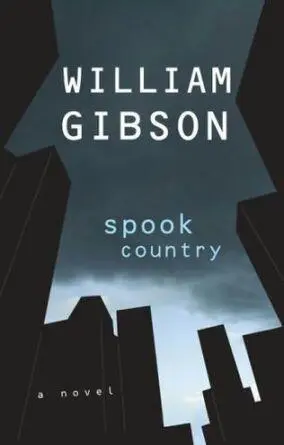
- Название:Spook Country
- Автор:
- Издательство:G. P. PUTNAM’S SONS
- Жанр:
- Год:2007
- Город:NEW YORK
- ISBN:нет данных
- Рейтинг книги:4 / 5. Голосов: 1
-
Избранное:Добавить в избранное
- Отзывы:
-
Ваша оценка:
Spook Country: краткое содержание, описание и аннотация
Предлагаем к чтению аннотацию, описание, краткое содержание или предисловие (зависит от того, что написал сам автор книги «Spook Country»). Если вы не нашли необходимую информацию о книге — напишите в комментариях, мы постараемся отыскать её.
, the challenge of writing about the present-day world drove him to create perhaps his best novel yet, and in
he remains at the top of his game. It's a stripped-down thriller that reads like the best DeLillo (or the best Gibson), with the lives of a half-dozen evocative characters connected by a tightly converging plot and by the general senses of unease and wonder in our networked, post-9/11 time.
Spook Country — читать онлайн бесплатно полную книгу (весь текст) целиком
Ниже представлен текст книги, разбитый по страницам. Система сохранения места последней прочитанной страницы, позволяет с удобством читать онлайн бесплатно книгу «Spook Country», без необходимости каждый раз заново искать на чём Вы остановились. Поставьте закладку, и сможете в любой момент перейти на страницу, на которой закончили чтение.
Интервал:
Закладка:
“Yes,” said Milgrim, feeling an irrational but very powerful urge to put the cable-tie back on, as though that would magically reverse the flow of events, taking him back to the uneventful park of a few moments before, seeming now a very paradise of security and light.
“We happened to be nearby,” said the one beside him, “and drove to Lafayette, where we found you. Since then, as a favor to Mr. Birdwell, we have been observing your movements, Mr. Milgrim, awaiting an opportunity to speak with you in private.”
The hands on his shoulders grew abruptly heavier. “Where is that cop-looking motherfucker you always with, Mr. Milgrim? Drove you over here.”
“He’s not a cop,” Milgrim said.
“He didn’t ask you that,” said the one beside him.
“Whoa,” exclaimed the one behind, “old white man just deck that boy out the cuts!”
“Thief!” shouted a man, from the direction of the Greenmarket. “Thieves!” Milgrim saw movement there.
“This place supposed to be gentrified,” said the man beside Milgrim, as if offended by the disturbance. “Two million a unit, here.”
“Shit,” said the one behind, letting go of Milgrim’s shoulders, “it’s a bust.”
“He’s DEA!” shrieked Milgrim, lunging forward, his worn leather soles slipping nightmarishly, like feet in some ancient animation, one in which the gate of the projector is jumping. Or a very, very bad dream. And part of that dream, as he ran, was that he was still holding, before him, as if some tiny sword, his painfully honed Houdini key.
42. GOING AWAY
S ystema avoids pursuit whenever possible, the uncles taught. Systema prefers not to flee; rather, it goes away. The distinction was difficult to express, but easily demonstrated through something as simple as the attempted grappling of wrists across a table. The wrist trained in systema went away.
But Tito, having been directed to a particular place, the mysteriously named W, could no longer fully practice going away, the art of which is dependent on a genuine lack of direction. To be pursued, as Oshosi assured him he now was, was to accept a certain disadvantage. But there was systema for this as well, and he chose to demonstrate it now, taking the back of a bench at speed, dropping, rolling, coming up with his momentum intact but headed in the direction opposite. A simple enough business, spending momentum in the roll, but he heard a child cheer to see it.
The nearest of his three pursuers was just rounding the bench as Tito vaulted back over it, past him, and hit the path, running east now. He looked back. The other two, untrained slaves to their own momentum, were carried past the first and very nearly ran into the bench. These were the ones he’d seen Marcos trip. One of them had a bloodied mouth.
With Oshosi at his shoulder, Tito ran toward Union Square East and Sixteenth Street. The orisha wanted him out of the park and its calculable geometries of pursuit. A cab slid in front of him as he reached the traffic on Union Square East; he went over its hood, meeting the eyes of its driver as he slid past the windshield, friction burning his thigh through his jeans. The driver slammed his horn and held it, and other horns woke reflexively, a sudden uneven blaring that mounted to crescendo as his three pursuers reached the stream of traffic. Tito looked back and saw the one with the bloody mouth maneuvering between crowded bumpers, holding something aloft like a token. A badge, Tito guessed.
Tito ran north, bent low, deliberately slowing, weaving through the crowd, some of whom were pausing to see what the horns were about. Faces peered from the windows of a restaurant. He looked back and saw the bloody-mouthed man spill a woman out of his way as he ran after Tito.
Tito sped up, Oshosi noting that his pursuer was still gaining. He ran across Seventeenth without slowing. Saw the entrance to the resturant, a revolving door. He ran on, to the hotel’s entrance, an airy lip of glass protruding to shelter it. Under the startled doorman’s black-shirted arm, past a woman just emerging. He saw Brotherman descending two broad marble steps, divided by a central railing. Brotherman wore a Federal Express uniform and cradled a flat red-white-and-blue carton upright in his arms. He’d never seen Brotherman in shorts before. As Tito threw right, his new shoes grabbing the white marble, he heard the bloody-mouthed man slam through the doors behind him.
He glimpsed a sinuous overhang of stairway, deeper in the lobby, and registered the distinctive sound of Brotherman, releasing, on his exit, thirty pounds of twelve-millimeter steel ball bearings, through the trick bottom of his FedEx carton and onto the white marble.
Tito sprinted south, Oshosi indicating that his pursuer, who must have missed the bearings, was only a few steps behind.
Into the restaurant, darting past the row of tables by the south-facing windows; past the unbelieving faces of diners, who an instant before had been lingering over desserts and coffees.
The man with the bloody mouth caught his left shoulder and he careened into a table, food and glassware flying, a woman screaming. In the instant of contact, Eleggua, mounting Tito with nauseating speed, had reached back with Tito’s right hand, slipped something from the man’s belt, and now simultaneously drew and fired the Bulgarian’s pneumatic gun with his left, from under Tito’s right armpit.
An inhuman shriek unmounted the orisha as Tito saw the illuminated exit sign and slammed through the door beneath it, past the laden carts of busboys. Kitchen staff in white flung themselves out of his way. He slipped in something wet, nearly went down, ran on. Exit sign. Slamming out, into sudden sunlight, as an alarm triggered behind him.
A large green van, neatly lettered in silver, one of its twin rear doors open. Prada man, no longer wearing his painter’s overalls, reaching down his hand.
Tito handed him the leather-cased badge Eleggua had taken from the pursuer’s belt.
He flipped it open. “Ice,” he said, and pocketed it. He boosted Tito into the truck. A dark, hollow, diesel-smelling space, with odd dim lights. “You’ve already met.” He jumped out of the truck and slammed and locked the door.
“Be seated,” said the old man, from a bench fastened lengthwise across the space with canvas strapping. “We wouldn’t want you injured, in case of a sudden stop.”
Tito climbed over the back of the padded bench. Discovering the two ends of a simple seat belt, he fastened them as the driver put the truck in gear, heading west, then swung north onto Park.
“I trust they took it from you?” the old man asked, in Russian.
“Yes, they did,” Tito replied, in English.
“Very good,” said the old man, in Russian. “Very good.”
43. PONG
T he lobby bar was full again.
She found him seated at the long alabaster table, snacking, from a rectangular plate, on what looked like sushi wrapped in raw meat. “Who took the picture?” she asked, when she was close enough to ask quietly and be heard.
“Pamela. She’s an excellent photographer.”
“Was she following me?”
“No. She was watching Chombo. Watching him pack up and move out.”
“Are you sure he moved himself out? He wasn’t arrested by the Department of Homeland Security?”
“I doubt the DHS would let him smoke cigarettes and get in the way, while they packed up the evidence.”
“I wouldn’t want a chance to find out, myself. Would you?”
“Of course not. Would you like a drink?”
“Not now, thanks. I’d like you to explain, if what you’ve told me so far is true, why you don’t seem worried about that. I would be. In fact, I’ve discovered that I am. If you’ve been sniffing around covert American programs designed to intercept smuggled weapons, I’d imagine you’re running some chance of getting yourself in trouble. If not, and what you’ve told me is true, why not?” Which was putting it more forcefully than she’d intended, but it felt right.
Читать дальшеИнтервал:
Закладка:
Похожие книги на «Spook Country»
Представляем Вашему вниманию похожие книги на «Spook Country» списком для выбора. Мы отобрали схожую по названию и смыслу литературу в надежде предоставить читателям больше вариантов отыскать новые, интересные, ещё непрочитанные произведения.

Обсуждение, отзывы о книге «Spook Country» и просто собственные мнения читателей. Оставьте ваши комментарии, напишите, что Вы думаете о произведении, его смысле или главных героях. Укажите что конкретно понравилось, а что нет, и почему Вы так считаете.