William Gibson - Spook Country
Здесь есть возможность читать онлайн «William Gibson - Spook Country» весь текст электронной книги совершенно бесплатно (целиком полную версию без сокращений). В некоторых случаях можно слушать аудио, скачать через торрент в формате fb2 и присутствует краткое содержание. Город: NEW YORK, Год выпуска: 2007, Издательство: G. P. PUTNAM’S SONS, Жанр: Современная проза, на английском языке. Описание произведения, (предисловие) а так же отзывы посетителей доступны на портале библиотеки ЛибКат.
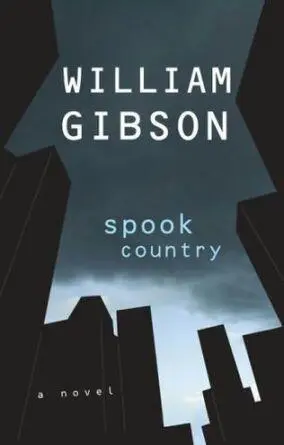
- Название:Spook Country
- Автор:
- Издательство:G. P. PUTNAM’S SONS
- Жанр:
- Год:2007
- Город:NEW YORK
- ISBN:нет данных
- Рейтинг книги:4 / 5. Голосов: 1
-
Избранное:Добавить в избранное
- Отзывы:
-
Ваша оценка:
Spook Country: краткое содержание, описание и аннотация
Предлагаем к чтению аннотацию, описание, краткое содержание или предисловие (зависит от того, что написал сам автор книги «Spook Country»). Если вы не нашли необходимую информацию о книге — напишите в комментариях, мы постараемся отыскать её.
, the challenge of writing about the present-day world drove him to create perhaps his best novel yet, and in
he remains at the top of his game. It's a stripped-down thriller that reads like the best DeLillo (or the best Gibson), with the lives of a half-dozen evocative characters connected by a tightly converging plot and by the general senses of unease and wonder in our networked, post-9/11 time.
Spook Country — читать онлайн бесплатно полную книгу (весь текст) целиком
Ниже представлен текст книги, разбитый по страницам. Система сохранения места последней прочитанной страницы, позволяет с удобством читать онлайн бесплатно книгу «Spook Country», без необходимости каждый раз заново искать на чём Вы остановились. Поставьте закладку, и сможете в любой момент перейти на страницу, на которой закончили чтение.
Интервал:
Закладка:
“No,” Milgrim agreed, carefully neutral, “you said you were going to need them.”
“You don’t know what to say if a cop or a traffic warden shows up and asks what you’re doing here.” Brown snapped the cuffs back into their little formfitting plastic holster on his belt.
Help me, I’ve been kidnapped, Milgrim thought. Or, better: The trunk of this car is full of plastic explosives.
“You’re going to sit on a bench, enjoy the sun,” Brown said.
“Right,” said Milgrim.
Brown unlocked the doors and they both got out. “Keep your hands on the roof of the car,” Brown said. Milgrim did, while Brown opened the rear door on his side and bent in, to secure the second Transit Authority tag on the inside of the rear window. Milgrim stood with his palms flat on the clean, warm roof of the Corolla. Brown straightened up, closing the door. He clicked his key, locking the car. “This way,” Brown said, then something else, something Milgrim didn’t catch, probably in his role as Red Team One.
Brown’s laptop, Milgrim thought. The bag.
Rounding the corner and finding the park spread before them, Milgrim squinted, unready for space, light, trees on the verge of leafage, the cheery canvas huddle of the Greenmarket.
Sticking close, he followed Brown across Union Square West and into the Greenmarket, passing young mothers with ATV-wheeled strollers and plastic bags of organic goodies. Then down past that WPA-era building he remembered, now apparently a restaurant, but closed. They came to the path that crossed the park at Sixteenth, with Lincoln atop his plinth at its center. Milgrim remembered trying to figure out what it was that Lincoln held at his side, in his left hand. A folded newspaper?
“Right here,” said Brown, indicating the bench nearest Union Square West, on the south side of the path. “Not in the center. Here.” He pointed to a spot directly beside the circular armrest, designed to be deliberately inhospitable to the back of any weary head. Milgrim sat, gripping the armrest to do so, as Brown pulled a skinny strip of shiny black plastic out of the waistband of his trousers, whipped it adroitly around the armrest and Milgrim’s wrist, and fastened it, tightening it with a sharp, zipping sound. This left about a foot of excess plastic protruding from the cuff Brown had formed. He twisted this out of the way, making it less evident, and straightened up. “We’ll collect you later. Keep your mouth shut.”
“Okay,” said Milgrim, craning his neck to watch Brown walk quickly south, his back to the Greenmarket. Milgrim blinked, processing, seeing the Corolla’s curbside rear window shatter. That delicious instant, just before it fell into countless fragments. If you were careful, the alarm might not even sound. You could lean in, over the ragged edge of glass, and snag the strap on Brown’s bag, wherein, Milgrim was certain, would be found the brown paper bag of Rize. And walk away.
Milgrim looked down at the narrow black band of unbreakable plastic around his wrist. He adjusted the cuff of the Paul Stuart coat, to make his situation less obvious to passersby. If Brown were using ordinary hardware-department cable-ties, which this looked to be, Milgrim knew how to release it. The milky, translucent flexicuffs the NYPD used, he knew from experience, were not as easily unfastened. Had Brown not wanted to carry anything that wasn’t black or titanium, he wondered.
Milgrim had briefly shared an apartment in the East Village with a woman who’d kept an emergency supply of Valium in an aluminum fishing-tackle box. The box’s latch had a hole through which a small padlock could have been inserted, but she’d preferred to seal it with a plastic cable-tie, a slightly smaller version of the tie that now tethered Milgrim to this bench. When it was necessary to access the supply, Milgrim had determined, she’d snip the tie with pliers or nail-clippers, replacing it with a fresh one when she needed to reseal the box. This procedure made little sense, Milgrim had observed, but people did tend to be eccentric about their drugs. He’d supposed that the ties, like an embossed wax seal on a letter, provided proof that she was the last to have opened the box. Milgrim had looked for her supply of ties, the simplest way to bypass this, but hadn’t been able to find it.
He had, however, determined that cable-ties are actually closed with a tiny molded internal ratchet. Once he’d learned to insert the flat tip of a jeweler’s screwdriver, he’d been able to open and close her ties at will, even if she’d snipped them off short, as she tended to do.
The fact of his pilfering had quickly put that particular relationship behind him, but now he leaned forward, over his knees, to peer down at the unswept pavement between his feet. He’d already conducted a mental inventory of his pockets, and knew that he had nothing at all like a jeweler’s screwdriver.
Uncomfortably aware that he could be taken for a tweaker looking for hallucinatory fragments of crack, he conducted a focused survey of the ground. He noticed, and as quickly rejected, an inch-long shard of brown bottle glass. Sawing through the tie was at least a theoretical possibility, but he had no idea how long it might take, or really if it would work at all, and he was also afraid of cutting himself. A paper clip, after what Brown might have called field-expedient modification, might do, but in his experience you didn’t find paper clips or wire coat hangers when you needed them. But here, a few feet beyond the tip of his left shoe, was something slender, rectangular, apparently metallic. Glinting faintly. Getting a grip on the armrest with his captive hand, he swiveled awkwardly off the bench, extending his left leg as far as possible and scraping repeatedly over the object with his left heel as he attempted to bring it closer. The fifth or sixth scrape did it, and he was able to snatch up his gratifying rigid and narrow prize with his free hand, returning quickly to the bench and a more orthodox posture.
He held it between thumb and forefinger, like a seamstress her needle, and studied it carefully. It was the broken clip from a pen or pencil, stamped tin or brass, and rust flecked its cheap plated finish.
Very nearly perfect. He checked its tip against the small opening through which he intended to dislodge the invisible ratchet. Too wide, but not by much. He found a particularly rough section of cast iron on the side of the armrest and went to work.
It felt good to have something to do with his hands, or, anyway, hand, on a summer day. “Man the toolmaker,” said Milgrim, filing away at his fairy Houdini shiv.
40. DANCING
T ito knelt and tightened the laces of his Adidas GSG9s, respectfully reminding the Guerreros that it was time. He stood, flexed his toes, crossed Fourteenth Street, and started up through the park, his hand on the iPod in its plastic bag in his jacket pocket.
Juana, once, in Havana, had taken him to a building of great and utterly decayed grandeur, though in those days he had had no idea that a structure of such age and intricacy might be found in any other condition. In the foyer, continents and oceans of distempered plaster were mapped on walls and ceiling. The elevator had shaken and screeched, carrying them to the top floor, and as Juana had heaved the cagelike metal door open, Tito had abruptly become aware of the drums he must have been hearing for some time, perhaps since they had first entered this street in Dragones. As they waited at the tall doors of the floor’s single apartment, Tito had read and reread the handwritten message in Spanish on a grease-flecked slip of brown paper, fastened to the door with four thickly rusted carpet tacks: “Enter in the spirit of God and Jesus Christ, or do not enter.” Tito had looked up at Juana, raising his eyebrows in some question he wasn’t quite able to form. “It might as well say Marx and Lenin,” Juana had told him. The door had been opened by a tall woman in a scarlet headscarf, a lit cigar in her hand, who smiled broadly to see them, and reached out to touch Tito’s head.
Читать дальшеИнтервал:
Закладка:
Похожие книги на «Spook Country»
Представляем Вашему вниманию похожие книги на «Spook Country» списком для выбора. Мы отобрали схожую по названию и смыслу литературу в надежде предоставить читателям больше вариантов отыскать новые, интересные, ещё непрочитанные произведения.

Обсуждение, отзывы о книге «Spook Country» и просто собственные мнения читателей. Оставьте ваши комментарии, напишите, что Вы думаете о произведении, его смысле или главных героях. Укажите что конкретно понравилось, а что нет, и почему Вы так считаете.