Malcolm Bradbury - Doctor Criminale
Здесь есть возможность читать онлайн «Malcolm Bradbury - Doctor Criminale» весь текст электронной книги совершенно бесплатно (целиком полную версию без сокращений). В некоторых случаях можно слушать аудио, скачать через торрент в формате fb2 и присутствует краткое содержание. Город: London, Год выпуска: 2000, ISBN: 2000, Издательство: Picador, Жанр: Современная проза, на английском языке. Описание произведения, (предисловие) а так же отзывы посетителей доступны на портале библиотеки ЛибКат.
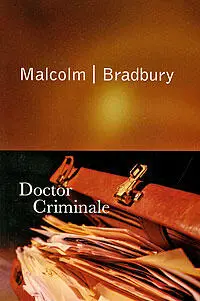
- Название:Doctor Criminale
- Автор:
- Издательство:Picador
- Жанр:
- Год:2000
- Город:London
- ISBN:978-0330390347
- Рейтинг книги:5 / 5. Голосов: 1
-
Избранное:Добавить в избранное
- Отзывы:
-
Ваша оценка:
Doctor Criminale: краткое содержание, описание и аннотация
Предлагаем к чтению аннотацию, описание, краткое содержание или предисловие (зависит от того, что написал сам автор книги «Doctor Criminale»). Если вы не нашли необходимую информацию о книге — напишите в комментариях, мы постараемся отыскать её.
Doctor Criminale — читать онлайн бесплатно полную книгу (весь текст) целиком
Ниже представлен текст книги, разбитый по страницам. Система сохранения места последней прочитанной страницы, позволяет с удобством читать онлайн бесплатно книгу «Doctor Criminale», без необходимости каждый раз заново искать на чём Вы остановились. Поставьте закладку, и сможете в любой момент перейти на страницу, на которой закончили чтение.
Интервал:
Закладка:
But I realized none of this when, encouraged by Ildiko Hazy, and supported, rather doubtfully, by Lavinia, still engaged on her obscure recce in Vienna, I sent off a cable asking permission for myself and companion to cover the event on behalf of a British newspaper and on behalf of the Great British Public, whose concern about the cutting edge of modern literature was, I said, well known. Much to my surprise, a cable from Barolo flew back almost immediately, signed by none other than Professor Monza himself. It declared his extreme delight that the British press should want to do literature, and indeed himself, the honour of covering the occasion. It also issued a joint invitation to myself and my companion, and told me that joining instructions and briefings for the congress would follow almost immediately.
And so they did; and from that moment onward the whole flavour of my life changed, and the whole nature of my quest for Bazlo Criminale was transformed. An hour later I was called down from my room at the Budapest Ramada – Ildiko happened to be with me, helping me check the contents of the mini-bar – and there in the lobby was one of those leather-coated motorbikers whose appearance of violence and aggression is intended to reassure us that these days trade and data always pass everywhere at the very fastest speed. He handed me an express package that had just landed hot from the sky at Budapest airport. On it was the great logo of the Magno Foundation; it was clear that our joining and briefing instructions had come. Ildiko and I took them back upstairs to my room, where it was definitely more comfortable, and we began to examine them. It was probably then we should have sensed the grandeur and munificence of the occasion, but I fear we did not.
Certainly we realized at once that this was no ordinary conference, held in a cafeteria with a cooking smell in the background. The Barolo instructions impressed from the start. They explained we should arrive on a certain day (it was the next one), at a certain time (14.30), at a certain place (Milan Central railway station), where a formal reception committee would receive all congress members. One hundred people, the documents warned, would be attending. The Villa Barolo was far too remote, its deliberations far too demanding, its security far too intense, to allow for other joining arrangements, and those who did not follow the instructions precisely would not be admitted. The villa was isolated, indeed islanded, and could not be reached by car; the nearest parking space was probably ten miles away. There were also no landing facilities for personal planes, helicopters, or private yachts, other than those belonging to the members of the Magno Foundation itself.
This didn’t greatly concern us, but we did realize that, once we had reached Barolo, a good deal would be done to ensure our intellectual strenuousness, our convenience and comfort. The working languages of the congress were English, Italian, French and German; full interpretation facilities would be provided. Fax machines and photocopying facilities would be made available. ‘Fruit in our rooms,’ said Ildiko, seeing that Apricots and Apples would also be on offer; I explained this was computing equipment. All papers would be photocopied and made available in advance (‘That is silly,’ said Ildiko, ‘Why go?’) and the full proceedings would later be published by a distinguished university press in the USA. In the intervals of our deliberations, a heated pool was available for informal discussions (‘Oh, that is why go,’ said Ildiko). So would tennis, riding, boating on the lake. Guests were advised to bring appropriate clothing for cold and wet days (the weather, unlike almost everything else, could unfortunately not be guaranteed) and stout shoes for walking the extensive private grounds. Dinner jackets were not obligatory, but formal clothes were needed for the evening, when orders, decorations and Nobel medals could be worn.
There were also some special instructions for the press. Media attention was not encouraged, but since this was a historic and international event some coverage was permitted. To avoid inhibiting discussion, members of the press were expected to be discreet, and observe the congressional ‘off the record’ convention, which meant all statements were unattributable. Stories should be checked with the Secretariat before being filed. Press packs would be issued on arrival; special press badges would be worn. Accommodation for organizers and main speakers would be provided in the Villa Barolo itself; other participants, including the members of the press, would watchtowers and belvederes that lay within the confines of the extensive and beautiful grounds.
‘But I thought nobody in your West took writing seriously,’ said Ildiko, as we checked through all the documents in my room, ‘I thought all your writers starved, except of course for Jeffrey Archer. I thought that was why your writers envied ours so much, when we were always putting them in prison.’ ‘Nobody in the West does take writing seriously,’ I said, ‘What they take seriously are conferences. That’s what hotels are for. Shall I send back a cable to say we accept?’ ‘Of course, it’s wonderful, and Criminale will be there,’ said Ildiko, ‘Do you like me to go for some train tickets? Now may I have your dollar?’ She held out her hand; I gave her some. ‘This is not very much,’ said Ildiko, ‘I also have to live when I get there.’ ‘It looks as though the Magno Foundation will take care of that,’ I said.
‘Really, I hope you are not going to be mean, or this will not be such a good trip,’ said Ildiko, ‘You do like to take care of me in the West? Remember I have never been there.’ ‘Never?’ I asked. ‘No, of course,’ said Ildiko, ‘Before the change I was not allowed to travel. To travel you must be very reliable. I was not so reliable. That is how it was in those days.’ ‘I understand,’ I said. ‘But you do please to go with me, I hope?’ ‘Of course, Ildiko,’ I said. ‘I found you the way to Criminale, no?’ ‘You did,’ I said. ‘And I think you do like me a bit, yes?’ ‘Of course,’ I said. ‘Then you let me have that hundred-dollar note, all right?’ ‘All right,’ I said.
And so, very early the next morning, Ildiko and I were to be found, on one of the railway stations at Budapest, with our light load of luggage. Alas, it was not Gustave Eiffel’s splendid creation, but the plastic-tiled cavern at which I had arrived a couple of days earlier. Soon we were aboard the international train that was going to take us south and west toward the great Barolo Congress. We went through places with names like Szekesfehervar and Balatonszentgyorgy, past great long lakes and mountains that shone with snow and ice. We crossed Hungary into Yugoslavia, passed through the mountains, came to Zagreb, quiet as a mouse then, though terrible times came since. Waiters flitted in dining car, bottles of wine rattled against the windows. Meanwhile Ildiko and I stood in the second-class corridor of the crowded train, and ate crusty ham baguettes grabbed through the train window from platform vendors. It was, as things turned out, the last modest meal we were to consume for quite a few more days.
And then, suddenly, our train emerged from the shadow of the Alps, and we found we had crossed not just one but several frontiers. We had moved from north to south, from east to west, from shadow into a world of brighter light and Mediterranean noise. At Villa Opicina we crossed the Italian frontier, where immigration checked our papers and the armed financial police examined our currency; after all, we were now entering the great new world of European Monetary Union. We stopped again in Trieste, where James Joyce and Italo Svevo wrote (and God bless both of them). Then slowly, as if uncertain of its destination, our train dragged across the plains of the Udine, of Friuli, of Lombardy, passing through or around ancient cities, capitals of old independent states, and crossed through ricefields, oilfields, battlefields. At one point we changed, and came, a little ahead of time, into the great central railway station in Milan, where we were hoping that someone or other was waiting to meet us.
Читать дальшеИнтервал:
Закладка:
Похожие книги на «Doctor Criminale»
Представляем Вашему вниманию похожие книги на «Doctor Criminale» списком для выбора. Мы отобрали схожую по названию и смыслу литературу в надежде предоставить читателям больше вариантов отыскать новые, интересные, ещё непрочитанные произведения.








Обсуждение, отзывы о книге «Doctor Criminale» и просто собственные мнения читателей. Оставьте ваши комментарии, напишите, что Вы думаете о произведении, его смысле или главных героях. Укажите что конкретно понравилось, а что нет, и почему Вы так считаете.