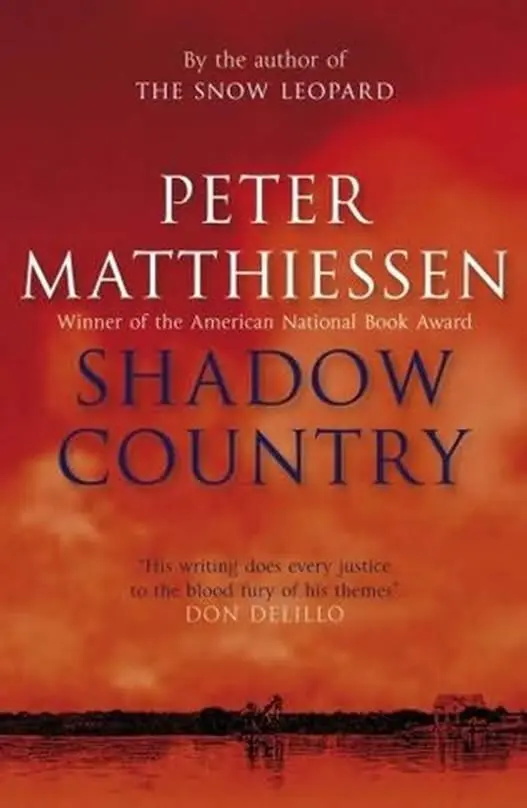
Peter Matthiessen - Shadow Country
Здесь есть возможность читать онлайн «Peter Matthiessen - Shadow Country» весь текст электронной книги совершенно бесплатно (целиком полную версию без сокращений). В некоторых случаях можно слушать аудио, скачать через торрент в формате fb2 и присутствует краткое содержание. Жанр: Современная проза, на английском языке. Описание произведения, (предисловие) а так же отзывы посетителей доступны на портале библиотеки ЛибКат.
- Название:Shadow Country
- Автор:
- Жанр:
- Год:неизвестен
- ISBN:нет данных
- Рейтинг книги:3 / 5. Голосов: 1
-
Избранное:Добавить в избранное
- Отзывы:
-
Ваша оценка:
Shadow Country: краткое содержание, описание и аннотация
Предлагаем к чтению аннотацию, описание, краткое содержание или предисловие (зависит от того, что написал сам автор книги «Shadow Country»). Если вы не нашли необходимую информацию о книге — напишите в комментариях, мы постараемся отыскать её.
Peter Matthiessen's great American epic-Killing Mister Watson, Lost Man's River, and Bone by Bone-was conceived as one vast mysterious novel, but because of its length it was originally broken up into three books. In this bold new rendering, Matthiessen has cut nearly a third of the overall text and collapsed the time frame while deepening the insights and motivations of his characters with brilliant rewriting throughout. In Shadow Country, he has marvelously distilled a monumental work, realizing his original vision.
Inspired by a near-mythic event of the wild Florida frontier at the turn of the twentieth century, Shadow Country reimagines the legend of the inspired Everglades sugar planter and notorious outlaw E. J. Watson, who drives himself relentlessly toward his own violent end at the hands of neighbors who mostly admired him, in a killing that obsessed his favorite son.
Shadow Country traverses strange landscapes and frontier hinterlands inhabited by Americans of every provenance and color, including the black and Indian inheritors of the archaic racism that, as Watson's wife observed, "still casts its shadow over the nation."
Peter Matthiessen's lyrical and illuminating work in the Watson narrative has been praised highly by such contemporaries as Saul Bellow, William Styron, and W. S. Merwin. Joseph Heller said "I read it in great gulps, up each night later than I wanted to be, in my hungry impatience to find out more and more."
Shadow Country — читать онлайн бесплатно полную книгу (весь текст) целиком
Ниже представлен текст книги, разбитый по страницам. Система сохранения места последней прочитанной страницы, позволяет с удобством читать онлайн бесплатно книгу «Shadow Country», без необходимости каждый раз заново искать на чём Вы остановились. Поставьте закладку, и сможете в любой момент перейти на страницу, на которой закончили чтение.
Интервал:
Закладка:
Josie was small and flirty as a bird, switching her tail and tossing her black curls. Said she only come to Chatham to make sure the boys-her brother Tant and me and Rob-was treated decent by that old repperbait, but as Rob said, what she was there for was to look after Old Repperbait under the covers. At supper she just danced away when he reached out for her, but them two didn’t waste no time getting together after dark, and next day us boys was told to sleep down in the shed. “This place ain’t built for secrets!” Josie said.
Josie had a baby while she lived there called Pearl Watson. What with Rob and Tant and Baby Pearl, along with Netta and Minnie at Caxambas, Mister Watson and me had us a real family like before.
Tant was only a young feller then, not much older than me. His mother was my grandmother Mary Ann Daniels. There was Danielses all along this coast and big litters of their kin. The men was mostly straight black-haired and black-eyed, breed Injun in their appearance, and they moved around from one island to another. By the time they got finished-and they ain’t done yet-everybody in the Islands had some kind of a Daniels in the family.
Tant was more Irish in his looks. Black hair but curly, had a little mustache and Josie’s small sharp nose. He was tall and scrawny. Never farmed nor fished if he could help it, had no truck with common labor. Times Mister Watson went away, he fooled around making moonshine from the cane or went out hunting, you never knew where Tant would be from one day to the next. Never married, never lived a day under his own roof, but he was a sprightly kind of feller who made people feel good and was always welcome. Played hell with the plume birds while they lasted, brought wildfowl, venison, and shine from one hearth to another all his life. “I’m livin off the land,” Tant liked to say, “and drinking off it, too.” He were mostly drunk even when working, nearly passed out into his dinner plate. One time he leaned over and mumbled into the Boss’s ear so all could hear him, “Planter Watson? Ain’t none of my damn business, Planter Watson, it sure ain’t, but it sure looks like some worthless rascal been drinking up all your profits.” How the Boss could grin at that I just don’t know.
We hardly seen hide nor hair of Tant, come time for cutting cane. Tant hated stooping all day long amongst the bugs and snakes, muscles burning and brain half-cooked and the earth whirling. Nobody who ain’t done it knows how frazzled a man gets with weariness and thirst, whacking away in the wet heat at that sharp cane with them hard leaf tips that could poke your eye out. On top of half-killing you, the work was risky; them big damn cane knives, sharp as razors, could glance off any whichy-way when a man was tired. One swing from the man next to you could hack your arm or take your ear off, or your own blade might glance off stalks and slash an artery. So what he done, he persuaded the Boss how he’d save him money supplying fresh wild victuals for the harvest workers, venison and ducks and gator tail or gophers, whatever was wanted. A hunter as good as Stephen S. Jenkins would be plumb wasted in the cane field, is what he said. “That’s right, boy,” Mister Watson would agree, “because you are bone lazy to start with and too weakened by cane spirits for a good day’s work.” And Tant would moan real doleful, saying, “Oh, sweet Jesus, if that ain’t the God’s truth!” Mister Watson would curse and threaten him, but in the end, he always laughed and let him go.
• • •
Mister Watson scraped his help at Port Tampa and Key West, lodged ’em in a bunkhouse in the back end of the boat shed. Told ’em the roof and cornshuck mattresses was free of charge but a half day’s pay would be deducted for their grub. Them field hands worked all that hot cane in bad old broken shoes, no boots, no gloves, nor leggins, not unless they rented ’em from Mister Watson.
Like I say, most of our cutters was drinkers or drifters, wanted men, runaway niggers, maybe all them things at once. Anyplace else that sorry kind of help was here today and gone tomorrow but on Chatham Bend there weren’t nowhere to go to, nothin but mangrove tangle and deep-water rivers swarmin with sharks and gators. Them men was prisoners, couldn’t get away, and the Boss’s talk of Injuns and cottonmouths and giant crocodiles kept ’em too scared to try. Knowing how hard it was to train new help, Mister Watson made sure them men was always owin. He never let ’em off his plantation except they was dead sick or too loony to work or just beggin to give up all their back pay for a boat ride to most anywhere, county jail included.
Aunt Jane was hearin rumors in Fort Myers, the Boss told me. Laughed about it but I seen that he was bothered. She said, “Do unto others, Edgar Watson, as you would have them do unto you.” And he asked her, “You think them scum wouldn’t do the same unto Ed Watson the first chance they got? That’s human nature.” “You’ve grown hard-hearted,” she would say, shaking her head. And he said, “No, Mandy, I am not hard-hearted but I am hard-headed, as a man must be who aims to run a business in this country and support his family.” He’d talk about that big hotel we seen at Punta Gorda and the Yankee railroad men who was investing in frontier Florida on both coasts. Them capitalists and tycoons and such used up whole gangs of niggers and immigrants, treated ’em any way they wanted and no interference from the law, having paid off all the bureaucrats and politicians-he’d go off on a regular tirade.
As time went on, something changed there at the Bend. Mister Watson grew heavy and stayed dirty. The crew took to drinking up Tant’s moonshine, having got the idea they were free to let things go. When he shouted, they would all jump up, rattle things around, go right back to their drinking. Finally he went on a rampage, cleared that whole bunch out. Told ’em they had drunk up all their pay along with all his profits. He picked a day when Tant were gone, not wanting to fire Tant, who drank more than the rest of ’em put together.
That day I come in from Key West, I hardly had the boat tied up when Josie and them others come quacking down the path like a line of ducks, with Mister Watson right behind kicking their bundles. Ought to be kicking their fat bee -hinds, he roared. Hollered at me to haul them whores and riffraff off his river before he blowed their brains out, them’s that had any. Take ’em out into the Gulf and feed ’em to the sharks. His own little thin Pearl looked scared to death.
Nosir, they weren’t sassing him that afternoon! They had played with fire and they knowed it. Only after they was safe downriver did they start in bitchin and moanin about unpaid wages.
CARRIE

Frank Tippins thinks he loves the girl who married his friend Walter Langford!
Mr. Tippins, who might run for sheriff, is in his early thirties, tall and lanky, black handlebar mustache. His black and bag-kneed Sunday suit, white shirt, string tie and waistcoat, cowboy hat and boots, remind the ladies of Wyatt Earp of the Wild West, a book much admired by our reading circle.
Like his colleague, Mr. Earp, Frank Tippins seems calm, courteous, softspoken, though much more at ease with horses than with me. He confided that his broad Western hat, which provided shelter from the sun and rain in his cow hunter days, had also served as a water vessel for his bathing. (He might still bathe in it, for all I know.)
From Mr. Jim Cole’s point of view, says Walter, Frank Tippins would make a mighty fine sheriff mainly because, as a onetime cow hunter for the Hendrys, he was bound to sympathize with the cattlemen in regard to disorderly conduct by the cowhands and undue enforcement of cattleroaming ordinances. Those men also like Frank Tippins because he is so amiable with Yankee visitors, making a virtue of the flies and cow dung and dirt streets that decent citizens perceive as the greatest of our fair city’s afflictions. (Walter says that honor falls to the disgraceful lack of a river bridge and a road north, far less a railroad, that might permit our isolated town to enter the Twentieth Century.)
Читать дальшеИнтервал:
Закладка:
Похожие книги на «Shadow Country»
Представляем Вашему вниманию похожие книги на «Shadow Country» списком для выбора. Мы отобрали схожую по названию и смыслу литературу в надежде предоставить читателям больше вариантов отыскать новые, интересные, ещё непрочитанные произведения.










Обсуждение, отзывы о книге «Shadow Country» и просто собственные мнения читателей. Оставьте ваши комментарии, напишите, что Вы думаете о произведении, его смысле или главных героях. Укажите что конкретно понравилось, а что нет, и почему Вы так считаете.