Чимаманда Адичи - Purple hibiscus
Здесь есть возможность читать онлайн «Чимаманда Адичи - Purple hibiscus» — ознакомительный отрывок электронной книги совершенно бесплатно, а после прочтения отрывка купить полную версию. В некоторых случаях можно слушать аудио, скачать через торрент в формате fb2 и присутствует краткое содержание. Год выпуска: 2003, ISBN: 2003, Издательство: Algonquin Books of Chapel Hill, Жанр: Современная проза, на английском языке. Описание произведения, (предисловие) а так же отзывы посетителей доступны на портале библиотеки ЛибКат.
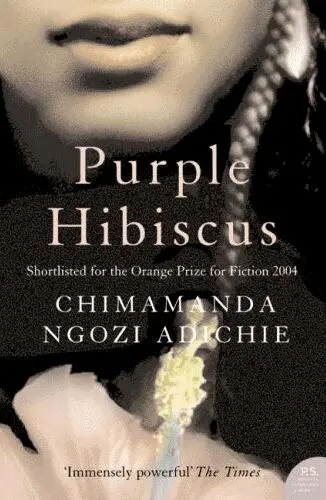
- Название:Purple hibiscus
- Автор:
- Издательство:Algonquin Books of Chapel Hill
- Жанр:
- Год:2003
- ISBN:1-56512-387-5
- Рейтинг книги:5 / 5. Голосов: 1
-
Избранное:Добавить в избранное
- Отзывы:
-
Ваша оценка:
Purple hibiscus: краткое содержание, описание и аннотация
Предлагаем к чтению аннотацию, описание, краткое содержание или предисловие (зависит от того, что написал сам автор книги «Purple hibiscus»). Если вы не нашли необходимую информацию о книге — напишите в комментариях, мы постараемся отыскать её.
Purple hibiscus — читать онлайн ознакомительный отрывок
Ниже представлен текст книги, разбитый по страницам. Система сохранения места последней прочитанной страницы, позволяет с удобством читать онлайн бесплатно книгу «Purple hibiscus», без необходимости каждый раз заново искать на чём Вы остановились. Поставьте закладку, и сможете в любой момент перейти на страницу, на которой закончили чтение.
Интервал:
Закладка:
"Why are they accusing you of encouraging the riot, Aunty?" Jaja asked.
"It's all rubbish. They want to scare me. Since when have students needed somebody to tell them when to riot?"
"I don't believe they just forced their way into our house and turned it upside down," Amaka said. "I don't believe it."
"Thank God Chima is asleep," Aunty Ifeoma said.
"We should leave," Obiora said. "Mom, we should leave. Have you talked to Aunty Phillipa since the last time?"
Aunty Ifeoma shook her head. She was putting back the books and table mats from the sideboard drawers. Jaja went over to help her.
"What do you mean, leave? Why do we have to run away from our own country? Why can't we fix it?" Amaka asked.
"Fix what?" Obiora had a deliberate sneer on his face.
"So we have to run away? That's the answer, running away?" Amaka asked, her voice shrill.
"It's not running away, it's being realistic. By the time we get into university, the good professors will be fed up with all this nonsense and they will go abroad."
"Shut up, both of you, and come and clean up this place!" Aunty Ifeoma snapped. It was the first time she did not look on proudly and enjoy my cousins' arguments.
An earthworm was slithering in the bathtub, near the drain, when I went in to take a bath in the morning. The purplish-brown body contrasted with the whiteness of the tub. The pipes were old, Amaka had said, and every rainy season, earthworms made their way into the bathtub. Aunty Ifeoma had written the works department about the pipes, but, of course, it would take ages before anybody did anything about them. Obiora said he liked to study the worms; he'd discovered that they died only when you poured salt on them. If you cut them in two, each part simply grew back to form a whole earthworm. Before I climbed into the tub, I picked the rope like body out with a twig broken off a broom and threw it in the toilet. I could not flush because there was nothing to flush, it would be a waste of water. The boys would have to pee looking at a floating earthworm in the toilet bowl.
When I finished my bath, Aunty Ifeoma had poured me a glass of milk. She had sliced my okpa, too, and red chunks of pepper gaped from the yellow slices. "How do you feel, nne?" she asked.
"I'm fine, Aunty." I did not even remember that I had once hoped never to open my eyes again, that fire had once dwelt in my body. I picked up my glass, stared at the curiously beige and grainy milk.
"Homemade soybean milk," Aunty Ifeoma said. "Very nutritious. One of our lecturers in agriculture sells it."
"It tastes like chalk water," Amaka said.
"How do you know, have you ever drunk chalk water?" Aunty Ifeoma asked. She laughed, but I saw the lines, thin as spiders' limbs, around her mouth and the faraway look in her eyes. "I just can't afford milk anymore," she added tiredly. "You should see how the prices of dried milk rise every day, as if somebody is chasing them."
The doorbell rang. My stomach heaved around itself whenever I heard it, although I knew Father Amadi usually knocked quietly on the door. It was a student of Aunt Ifeoma's, in a tight pair of blue jeans. Her face was light-skinned, but her complexion was from bleaching creams-her hands were the dark brown color of Bournvita with no milk added. She held a huge gray chicken. It was a symbol of her formal announcement to Aunty Ifeoma that she was getting married, she said. When her fiance learned of yet another university closure, he had told her he could no longer wait until she graduated, since nobody knew when the university would reopen. The wedding would be next month. She did not call him by his name, she called him "dim," "my husband," with the proud tone of someone who had won a prize, tossing her braided, reddish gold-dyed hair.
"I'm not sure I will come back to school when we reopen. I want to have a baby first. I don't want dim to think that he married me to have an empty home," she said, with a high, girlish laugh. Before she left, she copied Aunty Ifeoma's address down, so she could send an invitation card.
Aunty Ifeoma stood looking at the door. "She was never particularly bright, so I shouldn't be sad," she said thoughtfully, and Amaka laughed and said, "Mom!"
The chicken squawked. It was lying on its side because its legs were tied together. "Obiora, please kill this chicken and put it in the freezer before it loses weight, since there's nothing to feed it," Aunty Ifeoma said.
"They have been taking the light too often the past week. I say we eat the whole chicken today," Obiora said.
"How about we eat half and put the other half in the freezer and pray NEPA brings back the light so it doesn't spoil," Amaka said.
"Okay," Aunty Ifeoma said.
"I'll kill it," Jaja said, and we all turned to stare at him.
"Nna m, you have never killed a chicken, have you?" Aunty Ifeoma asked.
"No. But I can kill it."
"Okay," Aunty Ifeoma said, and I turned to stare, startled at how easily she had said that. Was she absentminded because she was thinking about her student? Did she really think Jaja could kill a chicken?
I followed Jaja out to the backyard, watched him hold the wings down under his foot. He bent the chicken's head back. The knife glinted, meeting with the sun rays to give off sparks. The chicken had stopped squawking; perhaps it had decided to accept the inevitable. I did not look as Jaja slit its feathery neck, but I watched the chicken dance to the frenzied tunes of death. It flapped its gray wings in the red mud, twisting and flailing. Finally, it lay in a puff of sullied feathers.
Jaja picked it up and dunked it in the basin of hot water that Amaka brought. There was a precision in Jaja, a single mindedness that was cold, clinical. He started to pluck the feathers off quickly, and he did not speak until the chicken had been reduced to a slim form covered with white-yellow skin. I did not realize how long a chicken's neck is until it was plucked.
"If Aunty Ifeoma leaves, then I want to leave with them, too," he said.
I said nothing. There was so much I wanted to say and so much I did not want to say.
Two vultures hovered overhead and then landed on the ground, close enough that I could have grabbed them if I had jumped fast. Their bald necks glistened in the early-morning sun. "See how close the vultures come now?" Obiora asked. He and Amaka had come to stand by the back door. "They are getting hungrier and hungrier. Nobody kills chickens these days, and so there are less entrails for them to eat." He picked up a stone and threw it at the vultures. They flew up and perched on the branches of the mango tree only a little distance away.
"Papa-Nnukwu used to say that the vultures have lost their prestige," Amaka said. "In the old days, people liked them because when they came down to eat the entrails of animals used in sacrifice, it meant the gods were happy."
"In these new days, they should have the good sense to wait for us to be done killing the chicken before they descend," Obiora said.
Father Amadi came after Jaja had cut up the chicken and Amaka had put half of it in a plastic bag for the freezer. Aunty Ifeoma smiled when Father Amadi told her he was taking me to get my hair done. "You are doing my job for me, Father, thank you," she said. "Greet Mama Joe. Tell her I will come soon to plait my hair for Easter."
Mama Joe's shed in Ogige market just barely fit the high stool where she sat and the smaller stool in front of her. I sat on the smaller stool. Father Amadi stood outside, beside the wheelbarrows and pigs and people and chickens that went past, because his broad-shouldered form could not fit in the shed. Mama Joe wore a wool hat even though sweat had made yellow patches under the sleeves of her blouse. Women and children worked in the neighboring sheds, twisting hair, weaving hair, plaiting hair with thread. Wooden boards with lopsided print leaned on broken chairs in front of the sheds. The closest ones read mama chinedu special hair stylist and mama bomboy international hair. The women and children called out to every female who walked past. "Let us plait your hair!" "Let us make you beautiful!" "I will plait it well for you!" Mostly, the women shrugged off their pulling hands and walked on. Mama Joe welcomed me as though she had been plaiting; my hair all my life. If I was Aunty Ifeoma's niece, then I was special. She wanted to know how Aunty Ifeoma was doing. "I have not seen that good woman in almost a month. I would be naked but for your aunty, who gives me her old clothes. I know she doesn't have that much, either. Trying so hard to raise those children well. Kpau! A strong woman," Mama Joe said. Her Igbo dialect came out sounding strange, with words dropped; it was difficult to understand. She told Father Amadi that she would be done in an hour. He bought a bottle of Coke and placed it at the foot of my stool before he left. "Is he your brother?" Mama Joe asked, looking after him.
Читать дальшеИнтервал:
Закладка:
Похожие книги на «Purple hibiscus»
Представляем Вашему вниманию похожие книги на «Purple hibiscus» списком для выбора. Мы отобрали схожую по названию и смыслу литературу в надежде предоставить читателям больше вариантов отыскать новые, интересные, ещё непрочитанные произведения.




![О Генри - Пурпурное платье [The Purple Dress]](/books/405339/o-genri-purpurnoe-plate-the-purple-dress-thumb.webp)






Обсуждение, отзывы о книге «Purple hibiscus» и просто собственные мнения читателей. Оставьте ваши комментарии, напишите, что Вы думаете о произведении, его смысле или главных героях. Укажите что конкретно понравилось, а что нет, и почему Вы так считаете.