Чимаманда Адичи - Purple hibiscus
Здесь есть возможность читать онлайн «Чимаманда Адичи - Purple hibiscus» — ознакомительный отрывок электронной книги совершенно бесплатно, а после прочтения отрывка купить полную версию. В некоторых случаях можно слушать аудио, скачать через торрент в формате fb2 и присутствует краткое содержание. Год выпуска: 2003, ISBN: 2003, Издательство: Algonquin Books of Chapel Hill, Жанр: Современная проза, на английском языке. Описание произведения, (предисловие) а так же отзывы посетителей доступны на портале библиотеки ЛибКат.
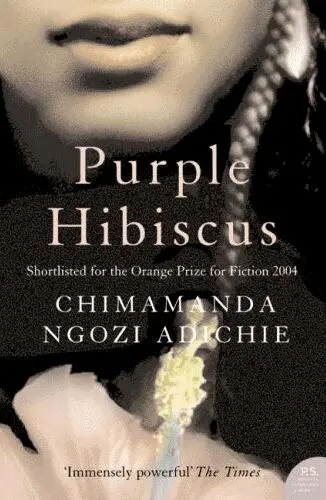
- Название:Purple hibiscus
- Автор:
- Издательство:Algonquin Books of Chapel Hill
- Жанр:
- Год:2003
- ISBN:1-56512-387-5
- Рейтинг книги:5 / 5. Голосов: 1
-
Избранное:Добавить в избранное
- Отзывы:
-
Ваша оценка:
Purple hibiscus: краткое содержание, описание и аннотация
Предлагаем к чтению аннотацию, описание, краткое содержание или предисловие (зависит от того, что написал сам автор книги «Purple hibiscus»). Если вы не нашли необходимую информацию о книге — напишите в комментариях, мы постараемся отыскать её.
Purple hibiscus — читать онлайн ознакомительный отрывок
Ниже представлен текст книги, разбитый по страницам. Система сохранения места последней прочитанной страницы, позволяет с удобством читать онлайн бесплатно книгу «Purple hibiscus», без необходимости каждый раз заново искать на чём Вы остановились. Поставьте закладку, и сможете в любой момент перейти на страницу, на которой закончили чтение.
Интервал:
Закладка:
"Did you hear what happened to Professor Okafor's son?" Aunty Ifeoma's friend finally asked. She spoke more Igbo than English, but all her English words came out with a consistent British accent, not like Papa's, which came on only when he was with white people and sometimes skipped a few words so that half a sentence sounded Nigerian and the other half British.
"Which Okafor?" Aunty Ifeoma asked. "Okafor who lives on Fulton Avenue. His son, Chidifu."
"The one who is Obiora's friend?"
"Yes, that one. He stole his father's exam papers and sold them to his father's students."
"Ekwuzina! That small boy?"
"Yes. Now that the university is closed, the students came to the house, to harass the boy for the money. Of course he had spent it. Okafor beat his son's front tooth out yesterday. Yet this is the same Okafor who will not speak out about what is going wrong in this university, who will do anything to win favor with the Big Men in Abuja. He is the one who makes the list of lecturers who are disloyal. I hear he included my name and yours."
"I heard that, too. Mana, what does it have to do with Chidifu?"
"Do you try to treat cancer sores or the cancer itself? We cannot afford to give pocket money to our children. We cannot afford to eat meat. We cannot afford bread. So your child steals and you turn to him in surprise? You must try to heal the cancer because the sores will keep coming back."
"Mba, Chiaku. You cannot justify theft."
"I do not justify it. What I am saying is that Okafor should not be surprised and should not waste his energy breaking a stick on his poor son's body. It is what happens when you sit back and do nothing about tyranny. Your child becomes what you cannot recognize."
Aunty Ifeoma sighed heavily and looked at Obiora, perhaps wondering if he, too, could turn into something she would not recognize. "I talked to Phillipa the other day," she said.
"Oh? How is she, how is oyinbo land treating her?"
"She is well."
"And life as a second-class citizen in America?"
"Chiaku. your sarcasm is unbecoming."
"But it is true. All my years in Cambridge, I was a monkey who had developed the ability to reason."
"It is not that bad now."
"That is what they tell you. Every day our doctors go there and end up washing plates for oyinbo because oyinbo does not think we study medicine right. Our lawyers go and drive taxis because oyinbo does not trust how we train them in law."
Aunty Ifeoma cut in, quickly, interrupting her friend. "I sent my CV to Phillipa."
Her friend brought the ends of her boubou together and tucked them in, between her stretched-out legs. She looked out into the dark night, her eyes narrowed, either in thought or maybe in an attempt to figure exactly how far away the crickets were. "So you, too, Ifeoma," she finally said.
"It is not about me, Chiaku." Aunty Ifeoma paused. "Who will teach Amaka and Obiora in university?"
"The educated ones leave, the ones with the potential to right the wrongs. They leave the weak behind. The tyrants continue to reign because the weak cannot resist. Do you not see that it is a cycle? Who will break that cycle?"
"That is simply unrealistic pep-rally nonsense, Aunty Chiaku," Obiora said. I saw the tension fall from the sky and envelop us all.
A child's crying upstairs interrupted the silence. "Go into my room and wait for me, Obiora," Aunty Ifeoma said. Obiora stood up and left. He looked grave, as if he had only just realized what he had done. Aunty Ifeoma apologized to her friend. But it was different after that. The insult of a child-a fourteen-year-old-hung between them, made their tongues heavy so that speech became a labor.
Her friend left soon afterward, and Aunty Ifeoma stormed inside, nearly knocking a lamp over. I heard the thud of a slap and then her raised voice. "I do not quarrel with your disagreeing with my friend. I quarrel with how you have disagreed. I do not raise disrespectful children in this house, do you hear me? You are not the only child who has skipped a class in school. I will not tolerate this rubbish from you! / na-anu?" She lowered her voice then. I heard the click of her bedroom door closing.
"I always got the stick on my palm," Amaka said, joining me on the verandah. "And Obiora got his on his buttocks. I think Mom felt giving it to me on my buttocks would somehow affect me and maybe I would end up not growing breasts or something. I preferred the stick to her slaps, though, because her hand is made of metal, ezi oktoum." Amaka laughed. "Afterward we would talk about it for hours. I hated that. Just give me the lashes and let me out. But no, she explained why you had been flogged, what she expected you to do not to get flogged again. That's what she's doing with Obiora."
I looked away. Amaka took my hand in hers. It felt warm, like the hand of someone just recovering from malaria. She did not speak, but I felt as though we were thinking the same thing-how different it was for Jaja and me.
I cleared my throat. "Obiora must really want to leave Nigeria."
"He's stupid," Amaka said. She squeezed my hand tight before letting go.
Aunty Ifeoma was cleaning out the freezer, which had started to smell because of the incessant power outages. She wiped up the puddle of wine-colored foul water that had leaked to the floor and then brought out the bags of meat and laid them in a bowl. The tiny beef pieces had turned a mottled brown. The pieces of the chicken Jaja had killed had turned a deep yellow.
"So much wasted meat," I said.
Aunty Ifeoma laughed. "Wasted, kwa? I will boil it well with spices and cook away the spoilage."
"Mom, she is talking like a Big Man's daughter," Amaka said, and I was grateful that she did not sneer at me, that she echoed her mother's laughter instead.
We were on the verandah, picking the stones out of rice. We sat on mats on the floor, beyond the shade so we could feel the mild morning sun emerging after the rain. The dirty and clean rice were in two careful mounds on the enamel trays before us, with the stones placed on the mat. Amaka would divide the rice into smaller portions to blow the chaff out afterward.
"The problem with this kind of cheap rice is that it cooks into a pudding, no matter how little water you put in. You start to wonder if it is garri or rice that you are eating," Amaka muttered, when Aunty Ifeoma left. I smiled. I had never felt the companionship I felt sitting next to her, listening to her Fela and Onyeka cassettes on the tiny tape-player-radio, which she had put batteries into. I had never felt the comfortable silence we shared as we cleaned the rice, carefully, because the grains were stunted and sometimes looked like the glassy stones. Even the air seemed still, slowly rousing itself after the rain. The clouds were just starting to clear, like cotton-wool tufts reluctantly letting go of one another.
The sound of a car driving toward the flat disrupted our peace. I knew Father Amadi had office hours that morning at the chaplaincy, yet I still hoped it was him. I imagined him walking up to the verandah, holding his soutane in one hand so he could run up the short stairs, smiling.
Amaka turned to look. "Aunty Beatrice!"
I whipped around. Mama was climbing out of a yellow unsteady-looking taxi. What was she doing here? What had happened? Why was she wearing her rubber slippers all the way from Enugu?
She walked slowly, holding on to her wrapper that seemed so loose it would slip off her waist any minute. Her blouse did not look ironed. "Mama, o gini? Did something happen?" I asked, hugging her quickly so I could stand back and examine her face. Her hand was cold.
Amaka hugged her and took her handbag. "Aunty Beatrice, nno."
Aunty Ifeoma came hurrying out to the verandah, drying her hands in front of her shorts. She hugged Mama and then led her into the living room, supporting her as one would support a cripple.
Читать дальшеИнтервал:
Закладка:
Похожие книги на «Purple hibiscus»
Представляем Вашему вниманию похожие книги на «Purple hibiscus» списком для выбора. Мы отобрали схожую по названию и смыслу литературу в надежде предоставить читателям больше вариантов отыскать новые, интересные, ещё непрочитанные произведения.



![О Генри - Пурпурное платье [The Purple Dress]](/books/405339/o-genri-purpurnoe-plate-the-purple-dress-thumb.webp)




Обсуждение, отзывы о книге «Purple hibiscus» и просто собственные мнения читателей. Оставьте ваши комментарии, напишите, что Вы думаете о произведении, его смысле или главных героях. Укажите что конкретно понравилось, а что нет, и почему Вы так считаете.