Чимаманда Адичи - Purple hibiscus
Здесь есть возможность читать онлайн «Чимаманда Адичи - Purple hibiscus» — ознакомительный отрывок электронной книги совершенно бесплатно, а после прочтения отрывка купить полную версию. В некоторых случаях можно слушать аудио, скачать через торрент в формате fb2 и присутствует краткое содержание. Год выпуска: 2003, ISBN: 2003, Издательство: Algonquin Books of Chapel Hill, Жанр: Современная проза, на английском языке. Описание произведения, (предисловие) а так же отзывы посетителей доступны на портале библиотеки ЛибКат.
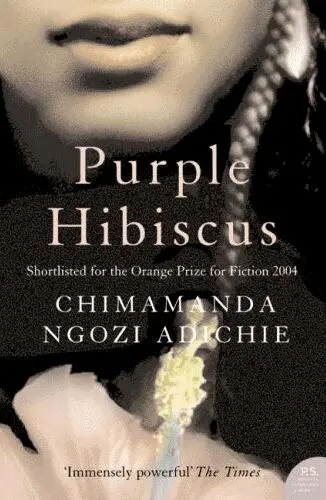
- Название:Purple hibiscus
- Автор:
- Издательство:Algonquin Books of Chapel Hill
- Жанр:
- Год:2003
- ISBN:1-56512-387-5
- Рейтинг книги:5 / 5. Голосов: 1
-
Избранное:Добавить в избранное
- Отзывы:
-
Ваша оценка:
Purple hibiscus: краткое содержание, описание и аннотация
Предлагаем к чтению аннотацию, описание, краткое содержание или предисловие (зависит от того, что написал сам автор книги «Purple hibiscus»). Если вы не нашли необходимую информацию о книге — напишите в комментариях, мы постараемся отыскать её.
Purple hibiscus — читать онлайн ознакомительный отрывок
Ниже представлен текст книги, разбитый по страницам. Система сохранения места последней прочитанной страницы, позволяет с удобством читать онлайн бесплатно книгу «Purple hibiscus», без необходимости каждый раз заново искать на чём Вы остановились. Поставьте закладку, и сможете в любой момент перейти на страницу, на которой закончили чтение.
Интервал:
Закладка:
She said nothing else to me until her friends came over that afternoon, when Aunty Ifeoma and Jaja were in the garden and the boys were playing football out front. "Kambili, these are my friends from school," she said, casually. The two girls said hello, and I smiled. They had hair as short as Amaka's, wore shiny lipstick and trousers so tight I knew they would walk differently if they were wearing something more comfortable. I watched them examine themselves in the mirror, pore over an American magazine with a brown skinned, honey-haired woman on the cover, and talk about a math teacher who didn't know the answers to his own tests, a girl who wore a miniskirt to evening lesson even though she had fat yams on her legs, and a boy who was fine.
"Fine, sha, not attractive," one of them stressed. She wore a dangling earring on one ear and a shiny, false gold stud on the other.
"Is it all your hair?" the other one asked, and I did not realize she was referring to me, until Amaka said, "Kambili!" I wanted to tell the girl that it was all my hair, that there were no attachments, but the words would not come. I knew they were still talking about hair, how long and thick mine looked. I wanted to talk with them, to laugh with them so much that I would start to jump up and down in one place the way they did, but my lips held stubbornly together. I did not want to stutter, so I started to cough and then ran out and into the toilet.
That evening, as I set the table for dinner, I heard Amaka say, "Are you sure they're not abnormal, Mom? Kambili just behaved like an atulu when my friends came." Amaka had neither raised nor lowered her voice, and it drifted clearly in from the kitchen.
"Amaka, you are free to have your opinions, but you must treat your cousin with respect. Do you understand that?" Aunty Ifeoma replied in English, her voice firm.
"I was just asking a question."
"Showing respect is not calling your cousin a sheep."
"She behaves funny. Even Jaja is strange. Something is not right with them."
My hand shook as I tried to straighten a piece of the table surface that had cracked and curled tightly around itself. A line of tiny ginger-colored ants marched near it. Aunty Ifeoma had told me not to bother the ants, since they hurt no one and you could never really get rid of them anyway; they were as old as the building itself.
I looked across at the living room to see if Jaja had heard Amaka over the sound of the television. But he was engrossed in the images on the screen, lying on the floor next to Obiora. He looked as though he had been lying there watching TV his whole life. It was the same way he looked in Aunty Ifeoma's garden the next morning, as though it were something he had been doing for a long time rather than the few days we had been here.
Aunty Ifeoma asked me to join them in the garden, to carefully pick out leaves that had started to wilt on the croton plants. "Aren't they pretty?" Aunty Ifeoma asked. "Look at that, green and pink and yellow on the leaves. Like God playing with paint brushes."
"Yes," I said.
Aunty Ifeoma was looking at me, and I wondered if she was thinking that my voice lacked the enthusiasm of Jaja's when she talked about her garden.
Some of the children from the flats upstairs came down and stood watching us. They were about five, all a blur of food stained clothes and fast words. They talked to one another and to Aunty Ifeoma, and then one of them turned and asked me what school I went to in Enugu. I stuttered and gripped hard at some fresh croton leaves, pulling them off, watching the viscous liquid drip from their stalks.
After that, Aunty Ifeoma said I could go inside if I wanted to. She told me about a book she had just finished reading: it was on the table in her room and she was sure I would like it. So I went in her room and took a book with a faded blue cover, called Equiano's Travels, or the Life of Gustavus Vassa the African. I sat on the verandah, with the book on my lap, watching one of the children chase a butterfly in the front yard. The butterfly dipped up and down, and its black-spotted yellow wings flapped slowly, as if teasing the little girl. The girl's hair, held atop her head like a ball of wool, bounced as she ran. Obiora was sitting on the verandah, too, but outside the shade, so he squinted behind his thick glasses to keep the sun out of his eyes. He was watching the girl and the butterfly while repeating the name Jaja slowly, placing the stress on both syllables, then on the first, then on the second. "Aja means sand or oracle, but Jaja? What kind of name is Jaja? It is not Igbo," he finally pronounced.
"My name is actually Chukwuka. Jaja is a childhood nickname that stuck." Jaja was on his knees. He wore only a pair of denim shorts, and the muscles on his back rippled, smooth and long like the ridges he weeded.
"When he was a baby, all he could say was Ja-Ja. So everybody called him Jaja," Aunty Ifeoma said. She turned to Jaja and added, "I told your mother that it was an appropriate nickname, that you would take after Jaja of Opobo."
"Jaja of Opobo? The stubborn king?" Obiora asked.
"Defiant," Aunt Ifeoma said. "He was a defiant king."
"What does defiant mean, Mommy? What did the king do?" Chima asked. He was in the garden, doing something on his knees, too, although Aunty Ifeoma often told him "Kwusia, don't do that" or "If you do that again, I will give you a knock."
"He was king of the Opobo people," Aunty Ifeoma said, "and when the British came, he refused to let them control all the trade. He did not sell his soul for a bit of gunpowder like the other kings did, so the British exiled him to the West Indies. He never returned to Opobo."
Aunt Ifeoma continued watering the row of tiny banana-colored flowers that clustered in bunches. She held a metal watering can in her hand, tilting it to let the water out through the nozzle. She had already used up the biggest container of water we fetched in the morning, "That's sad. Maybe he should not have been defiant," Chima said. He moved closer to squat next to Jaja. I wondered if he understood what "exiled" and "sold his soul for a bit of gunpowder" meant.
Aunty Ifeoma spoke as though she expected that he did. "Being defiant can be a good thing sometimes," Aunty Ifeoma said. "Defiance is like marijuana-it is not a bad thing when it is used right."
The solemn tone, more than the sacrilege of what she said, made me look up. Her conversation was with Chima and Obiora, but she was looking at Jaja.
Obiora smiled and pushed his glasses up. "Jaja of Opobo was no saint, anyway. He sold his people into slavery, and besides, the British won in the end. So much for the defiance."
"The British won the war, but they lost many battles," Jaja said, and my eyes skipped over the rows of text on the page. How did Jaja do it? How could he speak so easily? Didn't he have the same bubbles of air in his throat, keeping the words back, letting out only a stutter at best? I looked up to watch him, to watch his dark skin covered with beads of sweat that gleamed in the sun. I had never seen his arm move this way, never seen this piercing light in his eyes that appeared when he was in Aunty Ifeoma's garden.
"What happened to your little finger?" Chima asked.
Jaja looked down, too, as if he were just then noticing the gnarled finger, deformed like a dried stick. "Jaja had an accident," Aunty Ifeoma said, quickly. "Chima, go and get me the container of water. It is almost empty, so you can carry it."
I stared at Aunty Ifeoma, and when her eyes met mine, I looked away. She knew. She knew what had happened to Jaja's finger. When he was ten, he had missed two questions on his catechism test and was not named the best in his First Holy Communion class. Papa took him upstairs and locked the door. Jaja, in tears, came out supporting his left hand with his right, and Papa drove him to St. Agnes hospital. Papa was crying, too, as he carried Jaja in his arms like a baby all the way to the car. Later, Jaja told me that Papa had avoided his right hand because it is the hand he writes with.
Читать дальшеИнтервал:
Закладка:
Похожие книги на «Purple hibiscus»
Представляем Вашему вниманию похожие книги на «Purple hibiscus» списком для выбора. Мы отобрали схожую по названию и смыслу литературу в надежде предоставить читателям больше вариантов отыскать новые, интересные, ещё непрочитанные произведения.




![О Генри - Пурпурное платье [The Purple Dress]](/books/405339/o-genri-purpurnoe-plate-the-purple-dress-thumb.webp)




Обсуждение, отзывы о книге «Purple hibiscus» и просто собственные мнения читателей. Оставьте ваши комментарии, напишите, что Вы думаете о произведении, его смысле или главных героях. Укажите что конкретно понравилось, а что нет, и почему Вы так считаете.