Чимаманда Адичи - Purple hibiscus
Здесь есть возможность читать онлайн «Чимаманда Адичи - Purple hibiscus» — ознакомительный отрывок электронной книги совершенно бесплатно, а после прочтения отрывка купить полную версию. В некоторых случаях можно слушать аудио, скачать через торрент в формате fb2 и присутствует краткое содержание. Год выпуска: 2003, ISBN: 2003, Издательство: Algonquin Books of Chapel Hill, Жанр: Современная проза, на английском языке. Описание произведения, (предисловие) а так же отзывы посетителей доступны на портале библиотеки ЛибКат.
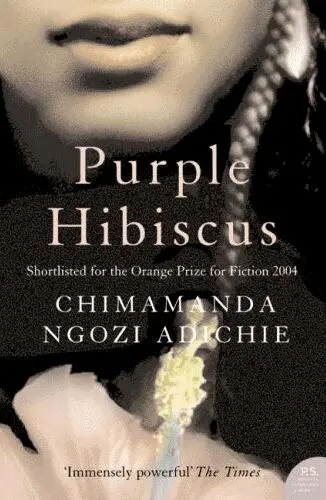
- Название:Purple hibiscus
- Автор:
- Издательство:Algonquin Books of Chapel Hill
- Жанр:
- Год:2003
- ISBN:1-56512-387-5
- Рейтинг книги:5 / 5. Голосов: 1
-
Избранное:Добавить в избранное
- Отзывы:
-
Ваша оценка:
Purple hibiscus: краткое содержание, описание и аннотация
Предлагаем к чтению аннотацию, описание, краткое содержание или предисловие (зависит от того, что написал сам автор книги «Purple hibiscus»). Если вы не нашли необходимую информацию о книге — напишите в комментариях, мы постараемся отыскать её.
Purple hibiscus — читать онлайн ознакомительный отрывок
Ниже представлен текст книги, разбитый по страницам. Система сохранения места последней прочитанной страницы, позволяет с удобством читать онлайн бесплатно книгу «Purple hibiscus», без необходимости каждый раз заново искать на чём Вы остановились. Поставьте закладку, и сможете в любой момент перейти на страницу, на которой закончили чтение.
Интервал:
Закладка:
"This is what our people say to the High God, the Chuktvu," papa-Nnukwu said. "Give me both wealth and a child, but if I must choose one, give me a child because when my child grows, so will my wealth."
Papa-Nnukwu stopped, turned to look back toward our house. "Nekenem, look at me. My son owns that house that can fit in every man in Abba, and yet many times I have nothing to put on my plate. I should not have let him follow those missionaries."
"Nna anyi," Aunty Ifeoma said. "It was not the missionaries. Did I not go to the missionary school, too?"
"But you are a woman. You do not count."
"Eh? So I don't count? Has Eugene ever asked about your aching leg? If I do not count, then I will stop asking if you rose well in the morning."
Papa-Nnukwu chuckled. "Then my spirit will haunt you when I join the ancestors."
"It will haunt Eugene first."
"I joke with you, nwa m. Where would I be today if my chi had not given me a daughter?" Papa Nnukwu paused. "My spirit will intercede for you, so that Chuktvu will send a good man to take care of you and the children."
"Let your spirit ask Chukwu to hasten my promotion to senior lecturer, that is all I ask," Aunty Ifeoma said.
Papa-Nnukwu did not reply for a while, and I wondered if the mix of high life music from the car radio and the rattling of the loose screws and the harmattan haze had eased him into sleep.
"Still, I say it was the missionaries that misled my son," said, startling me.
"We have heard this many times. Tell us something elsej Aunty Ifeoma said.
But Papa-Nnukwu kept talking as thoug he had not heard her. "I remember the first one that came to Abba, the one the called Fada John. His face was red like palm oil; they say our type of sun does not shine in the white man's land. He had a helper, a man from Nimo called Jude. In the afternoon they gathered the children under the ukwa tree in the mission and taught them their religion. I did not join them, kpa, but I went sometimes to see what they were doing. One day I said to them, Where is this god you worship? They said he was like Chuki that he was in the sky. I asked then, Who is the person that was killed, the person that hangs on the wood outside the mission? They said he was the son, but that the son and the father; equal. It was then that I knew that the white man was mad.' father and the son are equal? Tufia! Do you not see? That is why Eugene can disregard me, because he thinks we are equal."
My cousins chuckled. So did Aunty Ifeoma, who soon stopped and said to Papa-Nnukwu, "It is enough, close your mouth; rest. We are almost there and you will need your energy to te the children about the mmuo."
"Papa-Nnukwu, are you comfortable?" Amaka asked, leaning across toward the front seat. "Do you want me to adjust your seat, to make more room for you?"
"No, I am fine. I am an old man now and my height is gone. I would not have fit in this car in my prime. In those days, I plucked icheku from the trees by just reaching out high; I did not need to climb."
"Of course," Aunty Ifeoma said, laughing again. "And could you not reach out and touch the sky, too?" She laughed so easily, so often. They all did, even little Chima.
When we got to Ezi Icheke, cars lined the road almost bumper to bumper. The crowds that pressed around the cars were so dense there was no space between people and they blended into one another, wrappers blended into Tshirts, trousers into skirts, dresses into shirts. Aunty Ifeoma finally found a spot and eased the station wagon in. The mmuo had started to walk past, and often a long line of cars waited for an mmuo to walk past so they could drive on. Hawkers were at every corner, with glass-enclosed cases of akara and suya and browned chicken drumsticks, with trays of peeled oranges, with coolers the size of bathtubs full of Walls banana ice cream. It was like a vibrant painting that had come alive. I had never been to see mmuo, to sit in a stationary car alongside thousands of people who had all come to watch. Papa had driven us past the crowds at Ezi Icheke once, some years ago, and he muttered about ignorant people participating in the ritual of pagan masquerades. He said that the stories about mmuo, that they were spirits who had climbed out of ant holes, that they could make chairs run and baskets hold water, were all devilish folklore. Devilish Folklore. It sounded dangerous the way Papa said it.
"Look at this," Papa-Nnukwu said. "This is a woman spirit, and the women mmuo are harmless. They do not even go near the big ones at the festival."
The mmuo he pointed to was small; its carved wooden face had angular, pretty features and rouged lips. It stopped often to dance, wiggling this way and that, so that the string of beads around its waist swayed and rippled. The crowds nearby cheered, and some people threw money toward it. Little boys-the followers of the mmuo who were playing music with metal ogenes and wooden ichakas-5j picked up the crumpled naira notes. They had hardly passed us when Papa Nnukwu shouted, "Look away! Women cannot look at this one!"
The mmuo making its way down the road was surrounded by a few elderly men who rang a shrill bell as the mmuo walked. Its mask was a real, grimacing human skull with sunken eye sockets. A squirming tortoise was tied to its forehead. A snake and three dead chickens hung from its grass-covered body, swinging as the mmuo walked. The crowds near the road moved back quickly, fearfully. A few women turned and dashed into nearby compounds.
Aunty Ifeoma looked amused, but she turned her head away. "Don't look, girls. Let's humor your grandfather," she said in English. Amaka had already looked away. I looked away, too, toward the crowd of people that pressed around the car. It was sinful, deferring to a heathen masquerade. But at least I had looked at it very briefly, so maybe it would technically not be deferring to a heathen masquerade.
"That is our agwonatumbe," Papa-Nnukwu said, proudly, after the mmuo had walked past. "It is the most powerful mrral in our parts, and all the neighboring villages fear Abba because of it. At last year's Aro festival, agwonatumbe raised a staff and all the other mmuo turned and ran! They didn't even wait to see what would happen!"
"Look!" Obiora pointed at another mmuo moving down the road. It was like a floating white cloth, flat, taller than the huji avocado tree in our yard in Enugu.
Papa-Nnukwu grunted as the mmuo went by. It was eerie, watching it, and I thought then of chairs running, their four legs knocking together, of water being held in a basket, of human forms climbing out of ant holes. "How do they do that, Papa-Nnukwu? How do people get inside that one?" Jaja asked.
"Shh! These are mmuo, spirits! Don't speak like a woman!" Papa-Nnukwu snapped, turning to glare at Jaja.
Aunty Ifeoma laughed and spoke in English. "Jaja, you're not supposed to say there are people in there. Didn't you know that?"
"No," Jaja said.
She was watching Jaja. "You didn't do the ima mmuo, did you? Obiora did it two years ago in his father's hometown."
"No, I didn't," Jaja mumbled.
I looked at Jaja and wondered if the dimness in his eyes was shame. I suddenly wished, for him, that he had done the ima mmuo, the initiation into the spirit world. I knew very little about it; women were not supposed to know anything at all, since it was the first step toward the initiation to manhood. But Jaja once told me that he heard that boys were flogged and made to bathe in the presence of a taunting crowd. The only time Papa had talked about ima mmuo was to say that the Christians who let their sons do it were confused, that they would end up in hellfire.
We left Ezi Icheke soon afterward. Aunty Ifeoma dropped off a sleepy Papa-Nnukwu first; his good eye was half closed while his going-blind eye stayed open, the film covering it looked thicker now, like concentrated milk. When Aunty Ifeoma stopped inside our compound, she asked her children if the wanted to come into the house, and Amaka said no, in a low voice that seemed to prompt her brothers to say the same. Aunty Ifeoma took us in, waved to Papa, who was in the middle of a meeting, and hugged Jaja and me in her tight way before leaving.
Читать дальшеИнтервал:
Закладка:
Похожие книги на «Purple hibiscus»
Представляем Вашему вниманию похожие книги на «Purple hibiscus» списком для выбора. Мы отобрали схожую по названию и смыслу литературу в надежде предоставить читателям больше вариантов отыскать новые, интересные, ещё непрочитанные произведения.



![О Генри - Пурпурное платье [The Purple Dress]](/books/405339/o-genri-purpurnoe-plate-the-purple-dress-thumb.webp)





Обсуждение, отзывы о книге «Purple hibiscus» и просто собственные мнения читателей. Оставьте ваши комментарии, напишите, что Вы думаете о произведении, его смысле или главных героях. Укажите что конкретно понравилось, а что нет, и почему Вы так считаете.