Чимаманда Адичи - Purple hibiscus
Здесь есть возможность читать онлайн «Чимаманда Адичи - Purple hibiscus» — ознакомительный отрывок электронной книги совершенно бесплатно, а после прочтения отрывка купить полную версию. В некоторых случаях можно слушать аудио, скачать через торрент в формате fb2 и присутствует краткое содержание. Год выпуска: 2003, ISBN: 2003, Издательство: Algonquin Books of Chapel Hill, Жанр: Современная проза, на английском языке. Описание произведения, (предисловие) а так же отзывы посетителей доступны на портале библиотеки ЛибКат.
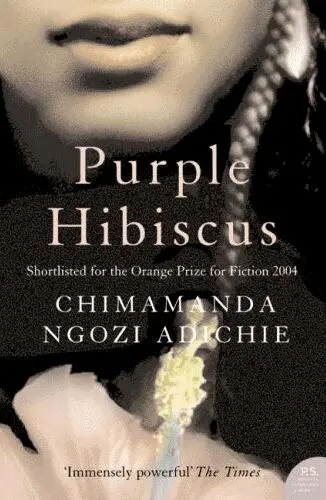
- Название:Purple hibiscus
- Автор:
- Издательство:Algonquin Books of Chapel Hill
- Жанр:
- Год:2003
- ISBN:1-56512-387-5
- Рейтинг книги:5 / 5. Голосов: 1
-
Избранное:Добавить в избранное
- Отзывы:
-
Ваша оценка:
Purple hibiscus: краткое содержание, описание и аннотация
Предлагаем к чтению аннотацию, описание, краткое содержание или предисловие (зависит от того, что написал сам автор книги «Purple hibiscus»). Если вы не нашли необходимую информацию о книге — напишите в комментариях, мы постараемся отыскать её.
Purple hibiscus — читать онлайн ознакомительный отрывок
Ниже представлен текст книги, разбитый по страницам. Система сохранения места последней прочитанной страницы, позволяет с удобством читать онлайн бесплатно книгу «Purple hibiscus», без необходимости каждый раз заново искать на чём Вы остановились. Поставьте закладку, и сможете в любой момент перейти на страницу, на которой закончили чтение.
Интервал:
Закладка:
Papa looked at me and then at Mama, searched our faces as if looking for letters beneath our noses, above our foreheads, on our lips, that would spell something he would not like.
"Okay. They can go with you, but you know I do not want my children near anything ungodly. If you drive past mmuo, keep your windows up."
"I have heard you, Eugene," Aunty Ifeoma said, with an exaggerated formality.
"Why don't we all have lunch on Christmas day?" Papa asked. "The children can spend time together then."
"You know that the children and I spend Christmas day with their Papa-Nnukwu."
"What do idol worshipers know about Christmas?"
"Eugene…" Aunty Ifeoma took a deep breath. "Okay the children and I will come on Christmas day."
Papa had gone back downstairs, and I was still sitting on the sofa, watching Aunty Ifeoma talk to Mama, when my cousins arrived. Amaka was a thinner, teenage copy of her mother. She walked and talked even faster and with more purpose tha Aunty Ifeoma did. Only her eyes were different; they did not have the unconditional warmth of Aunty Ifeoma's. They were quizzical eyes, eyes that asked many questions and did not accept many answers. Obiora was a year younger, very light-skinned, with honey-colored eyes behind thick glasses, and hisl mouth turned up at the sides in a perpetual smile. Chima had skin as dark as the bottom of a burnt pot of rice, and was tall for a boy of seven. They all laughed alike: throaty, cackling sounds pushed out with enthusiasm. They greeted Papa, and when he gave them money for igbal krismas, Amaka and Obiora thanked him, holding out the two thick wads of naira notes. Their eyes were politely surprised, to show that they were not presumptuous, that they had not expected money.
"You have satellite here, don't you?" Amaka asked me. It was the first thing she said after we greeted each other. Her hair was cut short, higher at the front and gradually reducing in an arch until it got to the back of her head, where there was little hair.
"Yes."
"Can we watch CNN?"
I forced a cough out of my throat; I hoped I would not stutter.
"Maybe tomorrow," Amaka continued, "because right now I think we're going to visit my dad's family in Ukpo."
"We don't watch a lot of TV," I said.
"Why?" Amaka asked. It was so unlikely that we were the same age, fifteen. She seemed so much older, or maybe it was her striking resemblance to Aunty Ifeoma or the way she stared me right in the eyes. "Because you're bored with it? If only we all had satellite so everybody could be bored with it."
I wanted to say I was sorry, that I did not want her to dislike us for not watching satellite. I wanted to tell her that although huge satellite dishes lounged on top of the houses in Enugu and here, we did not watch TV. Papa did not pencil in TV time on our schedules.
But Amaka had turned to her mother, who was sitting hunched with Mama. "Mom, if we are going to Ukpo, we should leave soon so we can get back before Papa-Nnukwu falls asleep."
Aunty Ifeoma rose. "Yes, nne, we should leave." She held Chima's hand as they all walked downstairs. Amaka said something, pointing at our banister, with its heavy hand carved detail, and Obiora laughed. She did not turn to say good-bye to me, although the boys did and Aunty Ifeoma waved and said, "I'll see you and Jaja tomorrow."
Aunty Ifeoma drove into the compound just as we finished breakfast. When she barged into the dining room upstairs, I imagined a proud ancient forebear, walking miles to fetch water in homemade clay pots, nursing babies until they walked and talked, fighting wars with machetes sharpened on sun-warmed stone. She filled a room. "Are you ready, Jaja and Kambili?" she asked. "Nuwnye m, will you not come with us?"
Mama shook her head. "You know Eugene likes me to stay around."
"Kambili, I think you will be more comfortable in trousers," Aunty Ifeoma said as we walked to the car.
"I'm fine, Aunty," I said. I wondered why I did not tell her that all my skirts stopped well past my knees, that I did not own any trousers because it was sinful for a woman to wear trousers. Her Peugeot 504 station wagon was white and rusted to an unpleasant brown at the fenders. Amaka was seated in the front; Obiora and Chima were in the back seat. Jaja and I climbed into the middle seats. Mama stood watching until the car disappeared from her sight. I knew because I felt her eyes and felt her presence. The car made rattling sounds as if some bolts had come loose and were shaking with every rise and fall of the bumpy road. There were gaping rectangular spaces on the dashboard instead of air-conditioner vents, so the windows were kept down. Dust sailed across my mouth, into my eyes and nose.
"We're going to pick up Papa-Nnukwu, he will come with us," Aunty Ifeoma said.
I felt a lurch in my stomach and I glanced at Jaja. His eyes met mine. What would we tell Papa? Jaja looked away; he did not have an answer.
Before Aunty Ifeoma stopped the engine in front of the mud-and-thatch-enclosed compound, Amaka had opened the front door and bounded out. "I'll fetch Papa-Nnukwu!" The boys climbed out of the car and followed Amaka past the small wooden gate.
"Don't you want to come out?" Aunty Ifeoma asked, turning to Jaja and me.
I looked away. Jaja was sitting as still as I was. "You don't want to come into your Papa-Nnukwus compound? But didn't you come to greet him two days ago?" Aunty Ifeoma widened her eyes to stare at us.
"We are not allowed to come here after we've greeted him," Jaja said.
"What kind of nonsense is that, eh?" Aunty Ifeoma stopped then, perhaps remembering that the rules were not ours. "Tell me, why do you think your father doesn't want you here?"
"I don't know," Jaja said.
I sucked my tongue to unfreeze it, tasting the gritty dust. "Because Papa-Nnukwu is a pagan." Papa would be proud that I had said that.
"Your Papa-Nnukwu is not a pagan, Kambili, he is a traditionalist," Aunty Ifeoma said.
I stared at her. Pagan, traditionalist, what did it matter? He was not Catholic, that was all; he was not of the faith. He was one of the people whose conversion we prayed for so that they did not end in the everlasting torment of hellfire.
We sat silently until the gate swung open and Amaka came out, walking close enough to Papa-Nnukwu to support him if he needed it. The boys walked behind them. Papa-Nnukwu wore a loose print shirt and a pair of knee-length khaki shorts. I had never seen him in anything but the threadbare wrappers that were wound around his body when we visited him. "I got him those shorts," Aunty Ifeoma said, with a laugh. "See how he looks so youthful, who would believe he's eighty?"
Amaka helped Papa-Nnukwu get into the front seat, and then she got in the middle with us.
"Papa-Nnukwu, good afternoon sir," Jaja and I greeted.
"Kambili, Jaja, I see you again before you go back to the city? Ehye, it is a sign that I am going soon to meet the ancestors."
"Nna anyi, are you not tired of predicting your death?" Aunty Ifeoma said, starting the engine. "Let us hear something new!" She called him nna anyi, our father. I wondered if Papa used to call him that and what Papa would call him now if they spoke to each other.
"He likes to talk about dying soon," Amaka said, in amused English. "He thinks that will get us to do things for him."
"Dying soon indeed. He'll be here when we are as old as he is now," Obiora said, in equally amused English.
"What are those children saying, gbo, Ifeoma?" Papa Nnukwu asked. "Are they conspiring to share my gold and many lands? Will they not wait for me to go first?"
"If you had gold and lands, we would have killed you ourselves years ago," Aunty Ifeoma said. My cousins laughed, and Amaka glanced at Jaja and me, perhaps wondering why we did not laugh, too. I wanted smile, but we were driving past our house just then, and the sight of the looming black gates and white walls stiffened my lips.
Читать дальшеИнтервал:
Закладка:
Похожие книги на «Purple hibiscus»
Представляем Вашему вниманию похожие книги на «Purple hibiscus» списком для выбора. Мы отобрали схожую по названию и смыслу литературу в надежде предоставить читателям больше вариантов отыскать новые, интересные, ещё непрочитанные произведения.



![О Генри - Пурпурное платье [The Purple Dress]](/books/405339/o-genri-purpurnoe-plate-the-purple-dress-thumb.webp)






Обсуждение, отзывы о книге «Purple hibiscus» и просто собственные мнения читателей. Оставьте ваши комментарии, напишите, что Вы думаете о произведении, его смысле или главных героях. Укажите что конкретно понравилось, а что нет, и почему Вы так считаете.