Naguib Mahfouz - Cairo Modern
Здесь есть возможность читать онлайн «Naguib Mahfouz - Cairo Modern» весь текст электронной книги совершенно бесплатно (целиком полную версию без сокращений). В некоторых случаях можно слушать аудио, скачать через торрент в формате fb2 и присутствует краткое содержание. ISBN: , Жанр: Современная проза, на английском языке. Описание произведения, (предисловие) а так же отзывы посетителей доступны на портале библиотеки ЛибКат.
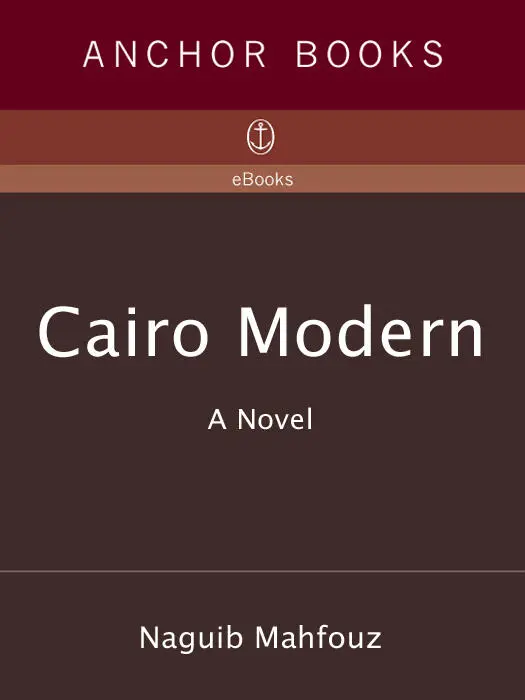
- Название:Cairo Modern
- Автор:
- Жанр:
- Год:неизвестен
- ISBN:978-0-307-78085-0
- Рейтинг книги:4 / 5. Голосов: 1
-
Избранное:Добавить в избранное
- Отзывы:
-
Ваша оценка:
Cairo Modern: краткое содержание, описание и аннотация
Предлагаем к чтению аннотацию, описание, краткое содержание или предисловие (зависит от того, что написал сам автор книги «Cairo Modern»). Если вы не нашли необходимую информацию о книге — напишите в комментариях, мы постараемся отыскать её.
Cairo Modern — читать онлайн бесплатно полную книгу (весь текст) целиком
Ниже представлен текст книги, разбитый по страницам. Система сохранения места последней прочитанной страницы, позволяет с удобством читать онлайн бесплатно книгу «Cairo Modern», без необходимости каждый раз заново искать на чём Вы остановились. Поставьте закладку, и сможете в любой момент перейти на страницу, на которой закончили чтение.
Интервал:
Закладка:
When the beauty pageant was announced next, a tremor of desire and interest traveled through the audience. Onlookers were pervaded by an amazing delight. The panel of judges appeared on the stage. The pageant was the most enjoyable part of the soirée; in fact it was the only segment that aroused universal interest. After scrutinizing the judges carefully, Ahmad Badir smiled ironically and extracted from his pocket a card on which a word or two was written. He folded it till it looked like a twig and slipped it into Mahgub’s pocket, saying, “Keep this card till the winner is announced. When you unfold it, you’ll find the name of the beauty queen.”
Mahgub asked with astonishment, “How do you know?”
“Hush! Pay attention!”
Everyone’s eyes were directed to one place as the first contestant was called. She rose on the stage’s firmament like a luminous star; she was that brilliant and elegant. She paraded past in a gown of white silk, smiling quietly and graciously, although she failed to disguise her anxiety.
Ahmad Badir remarked regretfully, “In Europe, the contestants are nude! We’re satisfied with judging the trappings.”
As ironic as ever, Mahgub inquired, “Why don’t they choose judges who have inside experience?”
Everyone stared and some held binoculars. Others jotted down their observations in notebooks. The presentation and scrutiny continued without anyone being troubled by weariness or boredom. Faces as beautiful as the moon passed by in succession. Then the panel of judges disappeared for their consultation. A hubbub ensued as debate grew animated and many wagers were placed. The panel soon returned and announced the winner’s name: Miss Huda Haydar. Everyone applauded, her father the loudest of all. Mahgub drew the card from his pocket, unfolded it, and found that the winner’s name — Huda Haydar — was clearly inscribed on it. With an astonished expression on his face he asked his companion, “What’s the meaning of this?”
Ahmad Badir smiled — proud of his prognostication and his behind-the-scenes knowledge. He wanted to leave his friend in the dark, but Mahgub gave him such a hard time he felt compelled to silence him. So he said in a voice that was in no way exultant, “I learned this by accident. I saw the winner at the foot of the Great Pyramid two days ago with the journalists who are on the panel of judges. Does it astonish you?”
Mahgub Abd al-Da’im hated to be truly astonished. So he reined himself in and commented sullenly, “Of course not; nothing astonishes me. The appointment of government officials is rigged, the award of contracts is rigged, and elections themselves are rigged; so why shouldn’t the choice of a beauty queen also be rigged?”
The party was almost over when Mahgub remembered why he had come. He saw Mr. Salim al-Ikhshidi heading toward one of the doors. So he said goodbye to his friend and chased after al-Ikhshidi. The gentleman had forgotten all about him. They shook hands and walked together into the next room, which was large and magnificently furnished. Mrs. Nayruz was presiding over a small group of friends. Mahgub summoned his daring to keep from feeling awkward. Together with his patron he approached the distinguished lady. Al-Ikhshidi bent humbly over her hand and introduced him to her in his calm, resolute voice: “Mr. Mahgub Abd al-Da’im, representing The Star! A university graduate, he admires the astounding renaissance Your Excellency has orchestrated.”
Mahgub bowed to her, and she extended her hand, saying, “I’m proud of the new generation.” Then she concluded in French, “The vase is full of dirty water and must be cleansed and refilled.”
Mahgub replied in French, “That’s true, my lady.”
Al-Ikhshidi provided publicity for her in some newspapers, either personally or through the resources of friends. He hoped to add whatever Mahgub might produce to his previous credits. The lady directed some questions to the young man to gauge his cultural acuity, specialization, and aspirations. Mahgub answered suavely. When the conversation veered in a different direction, al-Ikhshidi excused himself and his protégé. As he left the premises, when saying goodbye to Mahgub, he told him, “It’s all up to your pen.”
Really? Did the realization of his hopes depend on his article about the charity event today? He returned to Giza, lost in thought and under the sway of his dreams. He passed a sleepless night like those back when hunger had kept him awake nights in February. He wandered through a valley of dreams and hopes. Then he recalled at length the soirée where he had spent half of his evening — how lovely luxury was: the spectacular affluence, beauty’s manifestations, the splendor of passion, and the insanity of licentiousness. This was the dazzling life for which his spirit pined.
22
The next day, late in the morning, he was pacing back and forth in his tiny room, thinking about this all-important article. What should he say? How should he begin? What would his conclusion be? Then he challenged himself to select the key points. Finally his reasoning led him to an elegant method of displaying these significant points. He spread out a piece of paper, divided it down the center with a line, and gave a title to each section.
The Truth
1. Ikram Nayruz is the daughter of a man who profited from the British occupation of Egypt.
2. She loves young men.
3. She is proficient in French but weak in Arabic.
4. The Society for Blind Women is a saloon.
5. Her guests are just like her.
6. These guests are interested in everything except blind women.
What I Should Write
1. Ikram Nayruz’s family has a long, patriotic history.
2. She is a loyal wife and a devoted mother.
3. At home in Arab and French cultures.
4. Her philanthropic projects.
5. Her guests are just like her.
6. Her benevolence.
In this way he educed the key points for this important topic. Then he sat at his desk, preparing to write. He had scarcely picked up his pen, though, when he heard a knock on the door, for the first time since he had moved there from the hostel. Upset and angry, he rose and opened the door. A huge body was blocking the doorway. Then he recognized the man and his heart pounded with terror. It was Salim al-Ikhshidi’s messenger — in the flesh. He looked up at the man inquisitively and eagerly. The smiling man told him — albeit in a gruff voice, “His Excellency the Bey wants to see you now.”
“Salim Bey?”
“Yes.”
“Where?”
“In his office at the ministry.” Then the man told him how he had gone as ordered by his boss to the hostel and how the doorman there had described the location of Mahgub’s new dwelling. But Mahgub heard none of this. He was dressing quickly and asking himself, “What is it? Is it possible? But so quickly? This is flat-out magic! The woman is an empress. No, a she-devil. Say, instead, a goddess. Oh, how I fear the summons is for something else and that this insane delight will be in vain. But why would he summon me if not for this?”
They set off for the ministry, reaching it around 12:30. He went to the office of al-Ikhshidi, who welcomed him with unprecedented graciousness. He then ordered the messenger to admit no one to the office until he said so. Mahgub sat down near him and the other man turned his calm, triangular face toward Mahgub, but this time the calmness was a mask concealing violent emotions. Smiling, he said, “I’ve summoned you about an issue relating to your future.”
That was what he wanted to hear! His delight would not be stillborn. Emotion got the best of him as he replied in a quavering voice, “I haven’t finished the article yet.”
Читать дальшеИнтервал:
Закладка:
Похожие книги на «Cairo Modern»
Представляем Вашему вниманию похожие книги на «Cairo Modern» списком для выбора. Мы отобрали схожую по названию и смыслу литературу в надежде предоставить читателям больше вариантов отыскать новые, интересные, ещё непрочитанные произведения.







Обсуждение, отзывы о книге «Cairo Modern» и просто собственные мнения читателей. Оставьте ваши комментарии, напишите, что Вы думаете о произведении, его смысле или главных героях. Укажите что конкретно понравилось, а что нет, и почему Вы так считаете.