Naguib Mahfouz - Cairo Modern
Здесь есть возможность читать онлайн «Naguib Mahfouz - Cairo Modern» весь текст электронной книги совершенно бесплатно (целиком полную версию без сокращений). В некоторых случаях можно слушать аудио, скачать через торрент в формате fb2 и присутствует краткое содержание. ISBN: , Жанр: Современная проза, на английском языке. Описание произведения, (предисловие) а так же отзывы посетителей доступны на портале библиотеки ЛибКат.
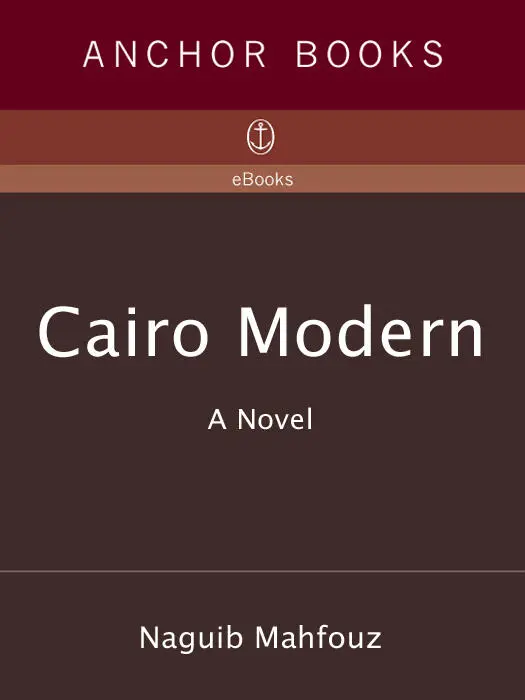
- Название:Cairo Modern
- Автор:
- Жанр:
- Год:неизвестен
- ISBN:978-0-307-78085-0
- Рейтинг книги:4 / 5. Голосов: 1
-
Избранное:Добавить в избранное
- Отзывы:
-
Ваша оценка:
Cairo Modern: краткое содержание, описание и аннотация
Предлагаем к чтению аннотацию, описание, краткое содержание или предисловие (зависит от того, что написал сам автор книги «Cairo Modern»). Если вы не нашли необходимую информацию о книге — напишите в комментариях, мы постараемся отыскать её.
Cairo Modern — читать онлайн бесплатно полную книгу (весь текст) целиком
Ниже представлен текст книги, разбитый по страницам. Система сохранения места последней прочитанной страницы, позволяет с удобством читать онлайн бесплатно книгу «Cairo Modern», без необходимости каждый раз заново искать на чём Вы остановились. Поставьте закладку, и сможете в любой момент перейти на страницу, на которой закончили чтение.
Интервал:
Закладка:
Ahmad Badir continued, “She’s an old woman but fond of young men!”
Realizing that Ahmad Badir would be chattier than usual, Mahgub actually was delighted, because it was vexing to plunge into a new world without a guide. Meanwhile Mrs. Ikram Nayruz was delivering her introductory remarks in a calm, melodious, and lovely voice. She welcomed her guests, praising the benevolence that had nested in their bosoms. Then she discussed the Society for Blind Women and its lofty goals. She delivered her speech in Arabic, but there was scarcely a sentence that lacked a grammatical error or an ill-chosen word. The two friends exchanged a smile.
Ahmad remarked, “There’s no cause for concern. There’s no one here who could detect a mistake.”
Mahgub pretended to defend her: “Her mistakes can be forgiven. Isn’t she speaking a foreign tongue?”
The audience watched a scene from a play by Molière. Madame Thérèse sang a French song that made a profound impression. Next everyone was invited to another room, a circular chamber that had been cleared for dancing. At the back of the room was an Italian band. Tables were set out on either side of the chamber. Music played, dancers danced, and drinks were passed around. The two friends stood chatting at the entrance to one of the balconies as they watched the dancing. Mahgub had never witnessed social dancing before, and it excited his astonished admiration. He saw chests that almost touched breasts and arms that encircled waists. He was amazed that these people could control their impulses. He wished he were dancing. Scrutinizing faces with anxious bulging eyes, he whispered to himself, “Wealth. Wealth equals sovereignty and power. It’s everything in the world.” His eyes happened upon a swelling bosom that almost made him dream it would poke through the diaphanous white gown. His lust aroused, he raised his eyes to discover his sweetheart’s face. What he found was an ugly crone, even if she was a coquette. He nudged his companion, directing his attention to the woman as he whispered, “How can an old woman have such breasts?”
Ahmad Badir examined the woman carefully. He smiled mockingly and then replied, “And how can this charity event take place in a bar?”
Mahgub frowned in anger or mock-anger and replied, “Let the blind women go to hell! A bar’s better and longer lasting.”
His eyes made the rounds once more and he noticed Tahiya Hamdis. He spotted her dancing with a handsome young man with rippling muscles. He was as tall as Ma’mun Radwan and as powerfully built as Ali Taha. He sensed that he — that other young man — could floor him with a single punch. He scowled and asked Ahmad Badir about him.
His friend said, “A deputy attorney and a nationally ranked tennis player.”
Mahgub sighed. Had he been able to become great then — even by a crime for which he would be put to death — he would not have hesitated. What stopped him from being one of these young people? The whole world! The existential forces that shaped history, established social classes, and apportioned fortunes had made Abd al-Da’im Effendi his father and al-Qanatir his place of birth. Then he heard Ahmad Badir whisper urgently to him, “Look at the balcony!” Turning his head that way he saw a lady whose face was almost hidden by a fan of ostrich feathers. Bowing over her hand was a man well advanced in years. When he straightened up, Mahgub recognized him from photos published in the papers from time to time.
Ahmad Badir commented, “This is Anis Bey Ibrahim’s wife and the pasha is one of her admirers. She’s said to be finagling to have her husband named a pasha.”
The music stopped, and many people scampered to the balconies and garden. So the two young men withdrew to the balcony. Ahmad Badir said, “When I first started attending these social affairs, my status brought me endless suffering. I imagined that everyone had nothing to do except to examine me from head to foot. How about you?”
As Mahgub considered his outfit and pale, withered face, blood rushed to his cheeks. Soon, however, he was able to tap into his brashness and insolence. Then he replied calmly, “As we stand here, I feel I’m a man wandering through a herd of cattle!”
He had barely finished his statement when he found himself face to face with Hamdis Bey. His heart pounded violently. He favored his relative with a glance that he wholeheartedly attempted to cleanse of fear and anxiety. He wondered how the man would address him. What would he say? What would he do?
Hamdis Bey recognized him, smiled, and held out his hand, saying, “How are you, Mahgub?”
They shook hands and parted without incident. Astonishment overwhelmed him. Tahiya must have kept the affair to herself! He had never thought that possible. He realized that Ahmad Badir was asking him a second time, “Do you know Hamdis Bey?”
He answered proudly, “Of course, naturally. He’s my mother’s paternal uncle’s son.”
“Why haven’t you ever told us about this distinguished relative?”
As though still buoyed by his delightful salvation, Mahgub replied in the same tone, “Tuzz!”
They descended the steps to the garden, and his eyes kept searching for Salim al-Ikhshidi. When would he introduce him to the lady? Was there any benefit to be hoped for? He passed clusters of women and men and examined an elite group of celebrities, some of whom were reserved while others were quite vivacious. A strange-looking individual attracted his attention. The gentleman had a huge, ill-proportioned body and a potbelly. He seemed animate matter that had yet to be molded into anything. He walked with his legs splayed apart as though disabled. All the same, he appeared to be esteemed, loved, and honored. He chatted with the high and mighty with an easy familiarity, teasing them and nonchalantly raising his voice while conversing with them or guffawing loudly. Mahgub was amazed and asked, “Since you know everything about everyone, who’s that?”
Ahmad Badir laughed and said, “How could you not know him? Azuz Darim was once a respected government official. Then he was forced to resign on a morals charge. So he worked in the private sector. He knew influential people and was returned to government service, prospering there without relinquishing his private enterprise.”
“How can he do both?”
“His business is his elegant apartment, which contains a gaming table and superbly endowed young women.”
Mahgub thought for a time, feeling depressed and disturbed. How could he excel in such a society? These people surpassed him in his own cynical principles, even without having to reason through them. They were just as irresponsible and daring as he was. So what was the use? Wouldn’t it be better for him to become a reformer like Ma’mun Radwan or Ali Taha? His reflections were interrupted by the appearance of a young man as handsome as the full moon. He was slender, extraordinarily good looking, smooth-complexioned, possessed of fascinating eyes, attractive features, and gleaming hair. He moved like a gazelle, exuding charm that was both feminine and masculine at once.
Mahgub could not keep himself from stammering, “My God! How handsome he is! Do you know him?”
Smiling, Ahmad Badir said, “Ahmad Midhat. He’s universally celebrated. They quite rightly call him ‘The Star of the East.’ ”
“A government official?”
“Bank of Egypt. He graduated from law school last year. His salary is thirty pounds.”
“Thirty pounds! Who is his sponsor?”
Badir laughed. “Idiot, he’s his own sponsor.”
The bell rang to call the guests, who were scattered throughout the garden, back to the recital hall. They all returned to take their seats in a calm and orderly fashion. The curtain soon rose to reveal a troupe of upper-class maidens in ravishing pharaonic costumes. They danced together a fascinating tableau that was sensitively expressed and that stole everyone’s heart. Even Ahmad Badir sang softly a line from Sayyid Darwish’s song, “Don’t let anyone disparage Egyptian women.” The audience applauded enthusiastically and appreciatively for the dancers.
Читать дальшеИнтервал:
Закладка:
Похожие книги на «Cairo Modern»
Представляем Вашему вниманию похожие книги на «Cairo Modern» списком для выбора. Мы отобрали схожую по названию и смыслу литературу в надежде предоставить читателям больше вариантов отыскать новые, интересные, ещё непрочитанные произведения.







Обсуждение, отзывы о книге «Cairo Modern» и просто собственные мнения читателей. Оставьте ваши комментарии, напишите, что Вы думаете о произведении, его смысле или главных героях. Укажите что конкретно понравилось, а что нет, и почему Вы так считаете.