Naguib Mahfouz - Cairo Modern
Здесь есть возможность читать онлайн «Naguib Mahfouz - Cairo Modern» весь текст электронной книги совершенно бесплатно (целиком полную версию без сокращений). В некоторых случаях можно слушать аудио, скачать через торрент в формате fb2 и присутствует краткое содержание. ISBN: , Жанр: Современная проза, на английском языке. Описание произведения, (предисловие) а так же отзывы посетителей доступны на портале библиотеки ЛибКат.
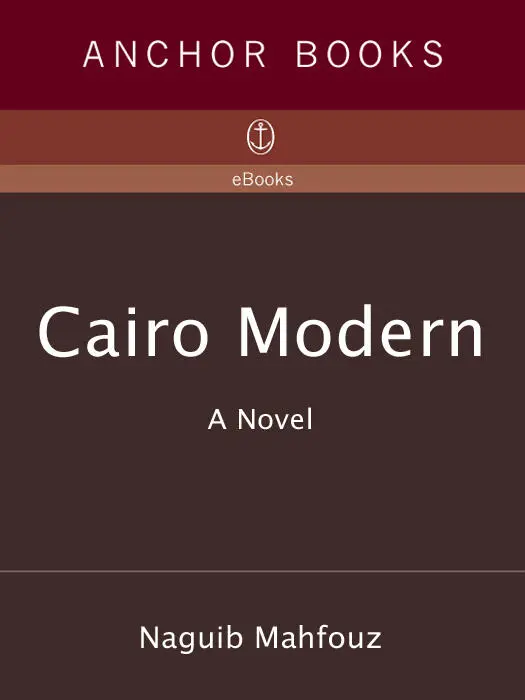
- Название:Cairo Modern
- Автор:
- Жанр:
- Год:неизвестен
- ISBN:978-0-307-78085-0
- Рейтинг книги:4 / 5. Голосов: 1
-
Избранное:Добавить в избранное
- Отзывы:
-
Ваша оценка:
Cairo Modern: краткое содержание, описание и аннотация
Предлагаем к чтению аннотацию, описание, краткое содержание или предисловие (зависит от того, что написал сам автор книги «Cairo Modern»). Если вы не нашли необходимую информацию о книге — напишите в комментариях, мы постараемся отыскать её.
Cairo Modern — читать онлайн бесплатно полную книгу (весь текст) целиком
Ниже представлен текст книги, разбитый по страницам. Система сохранения места последней прочитанной страницы, позволяет с удобством читать онлайн бесплатно книгу «Cairo Modern», без необходимости каждый раз заново искать на чём Вы остановились. Поставьте закладку, и сможете в любой момент перейти на страницу, на которой закончили чтение.
Интервал:
Закладка:
Ali said, “I told her that her transformation would drive me insane. Then she said that meeting me really did drive her crazy. She told me that our hopes were destined to expire and that we should tend our sorrow sagely, satisfying ourselves with the inevitable conclusion. Should I agree to suffer without any attempt to defend myself? Should I forsake my happiness without asking why? She told me that it was her parents’ desire and that she had given up attempting to change their minds after trying everything possible. She finally begged me to withdraw so I wouldn’t add to her suffering.”
The young man looked at Mahgub for a long time till he lost some of the intoxication of his recital. Then he blushed and asked, “Why am I boring you? Everything’s over. My hopes are shattered. Studying wisdom is pointless.”
Mahgub was totally amazed. Why would Uncle Shihata Turki, a cigarette vendor, reject Mr. Ali Taha? Did he think the young man wasn’t fit to marry into his family? Or did the man want his daughter to finish her studies and support his family? Then something occurred to him. He asked his friend, “Isn’t it possible that some rich and prominent fellow wants the girl and her father would like to marry her to him?”
Ali raised his eyebrows anxiously but said nothing. Remembering the original goal of his visit, Mahgub now wished to pave the way for it. Ali’s confession delighted his soul, which felt energized and joyful. All the same, he told his friend, employing a preacher’s jargon, “In any event, you shouldn’t surrender to sorrow. I tell you that no matter what the true motive for this rupture was, your girl no doubt played some role. So consider her something that never existed and toss the whole affair — cause and effect — into the wastebasket.”
Ali protested sorrowfully, “The wound hasn’t healed yet!”
“This is what you get for yielding to your theory about love. Don’t you see that dogs deal with love in a way that’s more conducive to happiness and contentment? We’re always responsible for our own suffering.”
Ali remained silent. So the preacher continued, “Forgetfulness … forgetfulness. Do you want to turn into one of those maniacs whose lives were ruined by love?”
Silence prevailed. A powerful reason for him to loathe Ali Taha had now been erased. He no longer hated him the way he had. The weight of his aversion was lightened and he began to ask himself: What harm does it do him to lose Ihsan? He still has his job, youth, and good looks. Since Ihsan had long set Mahgub’s emotions on fire, it was a relief that his rival had not won her — even if a third party had. He stood up, preparing to obtain what he wanted. Leaning toward his friend as they shook hands, he said in a scarcely audible voice, “Mr. Ali, your brother needs fifty piasters till the end of the month.”
Ali thrust a hand in his pocket and then handed Mahgub the money. Mahgub took it, saying, “Thank you, thank you, dear friend.”
He left the library feeling good, asking himself as he tugged at his left eyebrow: When will my pocket be filled with the government’s money?
21
He made his preparations. He bathed, ironed his suit, shirt, and fez, shined his shoes, shaved, and combed his hair. He looked like a new person, even if he was still skinny and his complexion sallow.
He arrived rather early at the home of the Society for Blind Women and found it to be a large, elegant house surrounded by a luxuriant and heavily shaded garden. He entered a large hall with a big stage at the end. Rows of green chairs were squeezed together. On either side, balcony doors overlooked the garden. Only a few guests were present when he made his entry. So he calmly selected a seat and started examining the place with jaded eyes. He wondered whether his trip through this house would actually lead him into the government. An unbroken flow of people was arriving. They were greeted by a group of lovely young women. After sitting there for twenty minutes, he found that the number of guests had increased substantially as women and men crowded together wearing the most splendid frocks and magnificent suits. Beauty was everywhere and fragrant perfumes spread throughout the room. Mahgub’s field of vision wandered as his protruding eyes hesitated between pretty faces, radiant throats, high backs, and swelling breasts. His blood rushed through his veins with renewed vitality as anxiety shot through his nervous system. He marveled at this dazzling world. Where had it been hiding? The fine clothes and precious jewelry, of which a single piece would suffice to support all the students at the university and all these women — how many there were and how beautiful. It was truly unfortunate that at least one man hovered around each of them. Most were speaking French fluently — these fallen Muslims! It almost seemed that French was the house’s official language. How did they communicate with the blind women? Sarcasm (blended with spite) washed over him, but not because he felt chauvinistic about his country’s language. He was merely trying to marshal reasons for an instinctive hatred. He wondered where His Excellency, Mrs. Umm Salim’s son, might be. He glanced toward the entrance in time to catch the arrival of a dazzlingly beautiful lady, whom he recognized at first sight. He remembered al-Qanatir in a bygone era and recalled the youthful engineer of al-Qanatir and his gorgeous wife. Yes, it was Hamdis Bey’s wife, and no one else. Behind her came the bey, followed by Tahiya and Fadil. He trained his eyes on the family as they made their way to their seats in the front row. His pale face reddened as he remembered their trip to the Pyramids. He imagined he heard the car door clanging shut again, leaving him outside. Clenching his teeth, he felt an infernal desire to assault this elegant, haughty maiden. Oh, if only one of these beautiful women would take his arm, allowing him to parade past his “relative’s” family! That noble family had taken the trouble to visit this chamber in order to be charitable and merciful. He must prevail, unrestrained by any impediment or law, prick of conscience or moral maxim. When would he sit with them in the front rows? In a magnificent tuxedo, not a journalist’s suit! Before leaving this reverie, he spotted in the distance Mr. Salim al-Ikhshidi, who was moving forward with his customary composure and leisurely gait, as if alone in the chamber. He recognized with a nod of his head many of the upper echelon — women and men. Mahgub’s eyes followed him till he sat down. Mahgub was filled with admiration and envy. This was a real life, an enjoyable life, a life to satisfy all of a person’s drives. Al-Ikhshidi was his role model, and what an ideal role model he was. Then he felt a hand on his shoulder. Turning to his right he saw Mr. Ahmad Badir seated beside him. They shook hands warmly, and Mahgub asked, “Sir, what has brought you here?”
The young man looked at him as if to say: What brings you? He answered with astonishment, “My work! Aren’t I a reporter?”
Mahgub told him, “I’m a reporter too — for The Star magazine.”
They both laughed. Ahmad Badir was about to ask his companion whether he planned to become a professional journalist when the curtain rose. A distinguished lady with a shining forehead and a round, dignified face appeared on the stage. Although almost sixty, she had retained vestiges of her beauty. She was greeted with animated, long-lasting applause, which she received with the serenity of a person accustomed to it. She bowed her head to greet her admirers and then spread out a piece of paper. Mahgub studied her for a long time. He heard Ahmad Badir say in a low voice, “Mrs. Ikram Nayruz, founder of the home.”
Right. He had grasped that intuitively. He wondered what role she would play in his life.
Читать дальшеИнтервал:
Закладка:
Похожие книги на «Cairo Modern»
Представляем Вашему вниманию похожие книги на «Cairo Modern» списком для выбора. Мы отобрали схожую по названию и смыслу литературу в надежде предоставить читателям больше вариантов отыскать новые, интересные, ещё непрочитанные произведения.








Обсуждение, отзывы о книге «Cairo Modern» и просто собственные мнения читателей. Оставьте ваши комментарии, напишите, что Вы думаете о произведении, его смысле или главных героях. Укажите что конкретно понравилось, а что нет, и почему Вы так считаете.