Naguib Mahfouz - Cairo Modern
Здесь есть возможность читать онлайн «Naguib Mahfouz - Cairo Modern» весь текст электронной книги совершенно бесплатно (целиком полную версию без сокращений). В некоторых случаях можно слушать аудио, скачать через торрент в формате fb2 и присутствует краткое содержание. ISBN: , Жанр: Современная проза, на английском языке. Описание произведения, (предисловие) а так же отзывы посетителей доступны на портале библиотеки ЛибКат.
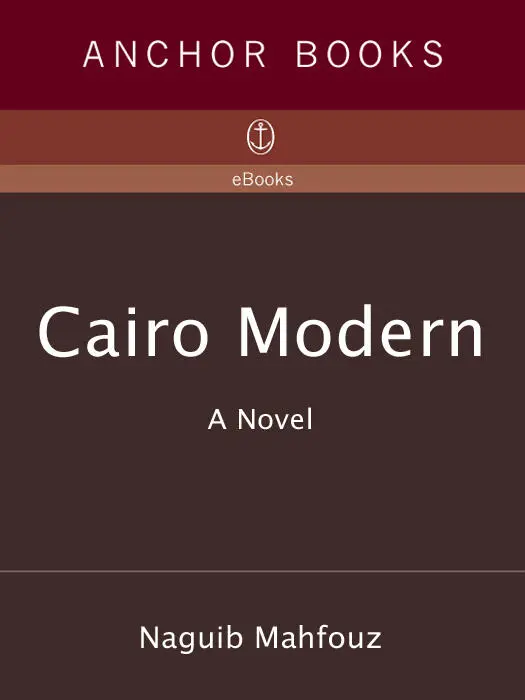
- Название:Cairo Modern
- Автор:
- Жанр:
- Год:неизвестен
- ISBN:978-0-307-78085-0
- Рейтинг книги:4 / 5. Голосов: 1
-
Избранное:Добавить в избранное
- Отзывы:
-
Ваша оценка:
Cairo Modern: краткое содержание, описание и аннотация
Предлагаем к чтению аннотацию, описание, краткое содержание или предисловие (зависит от того, что написал сам автор книги «Cairo Modern»). Если вы не нашли необходимую информацию о книге — напишите в комментариях, мы постараемся отыскать её.
Cairo Modern — читать онлайн бесплатно полную книгу (весь текст) целиком
Ниже представлен текст книги, разбитый по страницам. Система сохранения места последней прочитанной страницы, позволяет с удобством читать онлайн бесплатно книгу «Cairo Modern», без необходимости каждый раз заново искать на чём Вы остановились. Поставьте закладку, и сможете в любой момент перейти на страницу, на которой закончили чтение.
Интервал:
Закладка:
Mahgub, who smiled to reassure himself, replied, “As you can see, bey.”
He glanced at al-Ikhshidi and detected nothing to justify his previous veneration for him. Deep inside, he felt a desire to challenge and demean the man.
Al-Ikhshidi said, “The ma’dhun will arrive shortly.”
“An Islamic marriage clerk!” Mahgub smiled incredulously.
Al-Ikhshidi, who was smiling too, said, “My friend, you’re entering a different world. Now allow me to introduce you to the bride and her parents.” With a pounding heart, he followed al-Ikhshidi, an inquisitive look of embarrassment and hesitation in his eyes. He kept appealing to his daring and insolence as his eyes flashed ahead to catch sight of his future. Al-Ikhshidi preceded him into the room, saying, “Here’s a new member for your honorable family.”
He entered next. His eyes fell on an unexpected face, for he saw Ihsan Shihata, Ihsan Shihata Turki herself, not anyone else. Their eyes turned away.
25
It really was Ihsan Shihata, but not the pure girl Ali Taha had loved so deeply that they had pledged to love and marry each other. Her new story had begun with a single look, which was followed by other things. That had happened when she was returning from school one afternoon, at the corner of Rashad Pasha Street and Giza Street, in front of the mansion known as the “Green Villa.” How often she had passed this villa going each way for years! But this day, two handsome and discerning eyes lit on her. They were infatuated with all her comely beauty, and the girl felt the piercing gaze, which left an imprint on her. She saw a distinguished gentleman — if not a pasha surely a bey — of elegant appearance, with a handsome face and a charming, tiny mustache. He looked quite grand and handsome, even though his body was diminutive and he was rather short. Perhaps that fact alone explains why she glanced back after she was several paces beyond him. Then she found he was looking at her. She felt his eyes’ penetration and heat with embarrassment. The villa had belonged to an Italian firm’s manager, who had sold it to this bey a few months before. It was said at the time that he was an important government official. Some people had jocularly praised him, but she had forgotten all about that. By the time she reached her dilapidated house, she had almost forgotten the bey and his gaze. The afternoon of the following day — also as she returned from school — she saw him in the same place as before. The two comely eyes devoured her as she approached and followed her once she passed. She wondered whether he was there this time by coincidence as on the previous day or whether he had made a point of waiting for her. She walked by without looking back, although she pondered the matter. Halfway down the street, she sensed that an automobile was approaching from behind. She turned her head left and saw a car almost beside her. It was a magnificent vehicle — like a villa on wheels. Gleaming through its windows were the bey’s eyes, which directed toward her a curious look that combined a veiled smile, frank admiration, and scandalous impudence. The automobile slowed to her pace. She felt embarrassed and perplexed. She quickened her steps and moved inside on the sidewalk. When she reached the student hostel, the car sped off, turning onto the road to the university and disappearing from sight. Her doubts were discarded. He was flirting with her. Delight and conceit filled her heart. A lightness of spirit and a coquetry she had inherited from her mother overwhelmed her. She sang to herself: The taxi’s waiting for me at the door. Then she told herself: This isn’t a taxi. It’s a limo! Even so, hers was an innocent feeling caused by youthful vanity. The imposing, handsome gentleman, for his part, did not hold his fire. In fact, he carried his flirtation further day by day. So she felt obliged to show him her disapproval and displeasure. Her eyes told him, “This is inappropriate behavior.” But he paid no attention to her warning. One day she saw sitting beside him in the automobile a second person with a triangular face and circular eyes. Then the pursuit continued and intensified until the girl grew anxious. She loved Ali Taha and thought it logical that she should end this importunate pursuit. On the other hand, the handsome bey had not made a bad impression on her. To the contrary — her soul rejoiced at his desire and the look of his attractive eyes. She told herself with pain that even though the man was older than Ali he was better looking and more awe-inspiring. She said to herself: If I allowed my heart to speak, I wouldn’t know how to discourage it from choosing the mighty owner of the limousine. She began to wonder with rage: Has he repented? When will he get out of my sight? When will he stop dogging my steps? But was she sincere? Or, how sincere was she? She had no candid response to this question. She continued to feel perplexed about what she herself wanted. She began to tell herself almost apologetically that she was pleased he was chasing her. Her feminine conceit and her reaction to his high position in society could have explained that. But one day her father asked her in an insinuating tone, on her return from school, “Haven’t you returned to your senses yet?”
Her heart was troubled, and she blushed. Did the man know what was happening on Rashad Pasha Street? Good Lord! Was he still spying on her? She gave him an inquisitive, innocent look. So he said, as her mother joined him, “A man whose status is comparable to a government minister’s, although he himself is wealthier and more venerable. Haven’t you seen his automobile? Haven’t you seen his mansion? What do you want?”
The girl retorted sharply, “What does he want?”
In an unusually gruff voice, which frightened her, Master Shihata Turki replied, “The bey wishes you well. He wishes us well. God wants to raise you to the class of gentlemen and ladies and to proffer sustenance to your starving brothers. His office manager, whom I’ve known since he was a schoolboy, talked to me. He will marry you. Yes, why not? You’re beautiful, and I come from an excellent lineage. God curse these times. How long will you curl your lip? Open your eyes. Your father begs you to help. Your mother implores you. Your brothers cry out for your assistance!” He spoke at length and her mother joined in. That night she did not sleep a wink till dawn. She tossed and turned all night, brooding. The afternoon of the following day, at the usual time, the automobile approached and its door opened. She hesitated a little. Then she climbed in.
How did that happen? Didn’t she love Ali Taha? Of course she did. But that hadn’t been the type of love that blinds and deafens a person. It was not a love that could withstand fierce trials and violent temptations. She also loved splendor and hated poverty. She groaned under her family’s heavy load. The villa was an extraordinary vision. The limousine was a precious treasure. The bey was a god of gold and sovereignty. She had resisted the young law student because it was the first time. Then her parents had kept harping on this and, since that first experience, had left her at risk for any subsequent licentiousness. In fact, they had placed her honor in her own hands. Had it not been for Ali, she would have fallen and ended the debate long before. All the same, privately, she did not want to acknowledge her own weakness. During her sleepless night, she was torn between multiple vows and conflicting emotions. She vacillated between the bey and Ali Taha, between an instant spouse and one in the distant future, between comfort and fatigue, between a life of composure and reassurance and a life of toil and struggle, between an opulent existence for her and her family and one that for the most part would be an endless battle against poverty and ever-present want. Then, with tears in her eyes and a pounding heart, she reached a decision. She convinced herself that she was sacrificing her own happiness for that of the others and that the night that had received her as a tormented maiden would leave her a martyr. She told herself: I love Ali, but I also love my brothers. It’s not right to sacrifice my brothers to my ego. Therefore — and for no other reason — I must yield to my father. I don’t love the bey. I don’t love splendor. God knows! Thus she climbed into the limousine that had continued to pursue her obstinately and importunately. The automobile was a magic charm and its owner a sorcerer. Ali Taha was both a lover and a critic at once. He loved her but also criticized, instructed, and guided her too, whereas the bey was a charming man of handsome appearance. His words were pleasant and his flirtation insanely entrancing. His eyes might well have been a hypnotist’s. When he gazed into her beautiful eyes and spoke to her, she felt mesmerized into sleepy submission. God fully repaid the patience of Master Shihata Turki, because one day a delivery van from the Cicurel Store arrived and emptied its load of fine clothes. Umm Ihsan swayed her head like a torch singer and sang, “Turn aside and come to us.” Delight shone in Ihsan’s eyes as she studied the silk samples from which she was to choose whatever she liked. Thus began a new page in her history. A few weeks later came an excursion to the Pyramids. The limousine shot away with the distinguished bey and, to his right, a half-moon so beautiful she would have driven anyone crazy. In fact, Ihsan, once decked out and fully accessorized, now that the elegant Cicurel Store and Mme. Grégoire were at her beck and call, became, as the bey put it, “an official insanity.” On that day, something was afoot. The automobile broke down and the two passengers got out. The bey said he had a villa nearby and suggested that they should relax there until the vehicle was repaired. They strolled to a beautiful villa surrounded by a luxuriant garden. Then the bey said that since she had graced his country house, he would need to celebrate her auspicious visit. He issued some orders to a servant, and a spread of apples and champagne was set out. He peeled an apple for her and presented her with a glass of champagne, telling her it is a delicious drink and not intoxicating. It was late in the afternoon, and life was at its finest. The window overlooked mellow verdure where the eye could wander endlessly. The sky was blushing with twilight’s rouge, and a kite wheeled around overhead, turning away, beating its wings. The cushions of the large chair received her in an affectionate embrace and her feet sank into the thick carpet. The champagne warmed her mind, which then acquired a magical power that transported her from the sensible world to one of spiritual fantasies free of fear, worry, or sorrows. As enchanted fingers tapped on her wrist, tickling her senses and sending thrilling messages through her blood, she heard an amiable whisper more tantalizing than effusive hopes. Hot puffs of breath, repeated like the stabs of a needle, penetrated the area from the pocket of her dress to her cleavage and down between her breasts. She began to resist with listless arms, but eventually despaired and embraced him with them.
Читать дальшеИнтервал:
Закладка:
Похожие книги на «Cairo Modern»
Представляем Вашему вниманию похожие книги на «Cairo Modern» списком для выбора. Мы отобрали схожую по названию и смыслу литературу в надежде предоставить читателям больше вариантов отыскать новые, интересные, ещё непрочитанные произведения.










Обсуждение, отзывы о книге «Cairo Modern» и просто собственные мнения читателей. Оставьте ваши комментарии, напишите, что Вы думаете о произведении, его смысле или главных героях. Укажите что конкретно понравилось, а что нет, и почему Вы так считаете.