Hermann Hesse - The Glass Bead Game
Здесь есть возможность читать онлайн «Hermann Hesse - The Glass Bead Game» весь текст электронной книги совершенно бесплатно (целиком полную версию без сокращений). В некоторых случаях можно слушать аудио, скачать через торрент в формате fb2 и присутствует краткое содержание. Год выпуска: 1969, Жанр: Современная проза, Социально-психологическая фантастика, на английском языке. Описание произведения, (предисловие) а так же отзывы посетителей доступны на портале библиотеки ЛибКат.
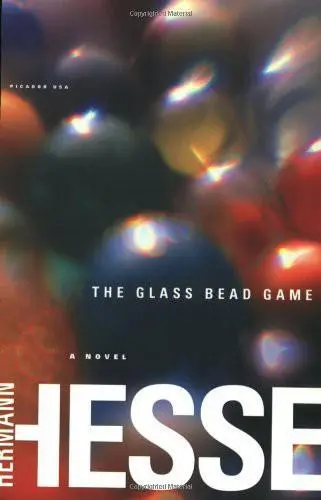
- Название:The Glass Bead Game
- Автор:
- Жанр:
- Год:1969
- ISBN:нет данных
- Рейтинг книги:4 / 5. Голосов: 2
-
Избранное:Добавить в избранное
- Отзывы:
-
Ваша оценка:
The Glass Bead Game: краткое содержание, описание и аннотация
Предлагаем к чтению аннотацию, описание, краткое содержание или предисловие (зависит от того, что написал сам автор книги «The Glass Bead Game»). Если вы не нашли необходимую информацию о книге — напишите в комментариях, мы постараемся отыскать её.
Something like chess but far more intricate, the game of Magister Ludi known as the Glass Bead Game is thought in its purest form, a synthesis through which philosophy, art, music and scientific law are appreciated simultaneously. The scholar-players are isolated within Castalia, an autonomous elite institution devoted wholly to the mind and the imagination…
The Glass Bead Game — читать онлайн бесплатно полную книгу (весь текст) целиком
Ниже представлен текст книги, разбитый по страницам. Система сохранения места последней прочитанной страницы, позволяет с удобством читать онлайн бесплатно книгу «The Glass Bead Game», без необходимости каждый раз заново искать на чём Вы остановились. Поставьте закладку, и сможете в любой момент перейти на страницу, на которой закончили чтение.
Интервал:
Закладка:
“Oh,” Tegularius said, “he could allow it — it’s a question of not having the courage.”
Laughing, Knecht placed a hand on his shoulder.
“As far as courage goes, my boy, I might be guilty of worse pranks than that. Good night, old grumbler.”
Gaily, he left the cell. But on the way out through the deserted corridors and courtyards of the Vicus Lusorum his seriousness returned, the seriousness of parting. Leave-takings always stir memories. Now, on this nocturnal walk, he remembered that first time he had strolled through Waldzell and the Vicus Lusorum as a boy, a newly arrived Waldzell pupil, filled with misgivings and hopes. Only now, moving through the coolness of the night in the midst of silent trees and buildings, did he realize with painful sharpness that he was seeing all this for the last time, listening for the last time to silence and slumber stealing over the Players’ Village, by day so lively; for the last time seeing the little light above the gatekeeper’s lodge reflected in the basin of the fountain; for the last time watching the clouds in the night sky sailing over the trees of his Magister’s garden. Slowly, he went over all the paths and into all the nooks and corners of the Players’ Village. He felt an impulse to open the gate of his garden once more and enter it, but he did not have the key with him, and that fact swiftly sobered him and caused him to collect himself. He returned to his apartment, wrote a few letters, including one to Designori announcing his arrival in the capital, and then spent some time in careful meditation to calm his intense emotions, for he wanted to be strong in the morning for his last task in Castalia, the interview with the Head of the Order.
The following morning the Magister rose at his accustomed hour, ordered his car, and drove off; only a few persons noticed his departure and none gave it any thought. The morning seemed to be drowning in the mists of early autumn as he drove toward Hirsland. He arrived toward noon and asked to be announced to Magister Alexander, the President of the Order. Under his arm he carried, wrapped in a cloth, a handsome metal casket normally kept in a secret compartment in his office. It contained the insignia of his office, the seals and the keys.
He was received with some surprise in the “main” office of the Order. It was almost unprecedented for a Magister to appear there unannounced and uninvited. On instructions from the President of the Order he was given lunch, then shown to a rest cell in the old cloisters and informed that His Excellency hoped to be able to find time for him in two or three hours. He asked for a copy of the rules of the Order, settled down with it and read through the entire booklet, to assure himself once more of the simplicity and legality of his plan. Nevertheless, even at this late hour he could not see how to put into words its meaning and its psychological justification.
There was a paragraph in the rules that had once been assigned to him as a subject for meditation, in the last days of his youthful freedom. That had been shortly before his admission into the Order. Now, reading the paragraph again, he meditated on it once more, and while doing so he became aware of how utterly different a person he was now from the rather anxious young tutor he had then been. “If the High Board summons you to a post,” the passage read, “know this: Each upward step on the ladder of officialdom is not a step into freedom, but into constraint. The greater the power of the office, the stricter the servitude. The stronger the personality, the more forbidden is the arbitrary exercise of will.” How final and unequivocal all that had once sounded, but how greatly the meaning of so many of the words had changed, especially such insidious words as “constraint,” “personality,” “will.” And yet how beautifully clear, how well-formed and admirably suggestive these sentences were; how absolute, timeless, and incontestably true they could appear to a young mind! Ah yes, and so they would have been, if only Castalia were the world, the whole multifarious but indivisible world, instead of being merely a tiny world within the greater, or a section boldly and violently carved out of it. If the earth were an elite school, if the Order were the community of all men and the Head of the Order God, how perfect these sentences would be, and how flawless the entire Rule. Ah, if only that had been so, how lovely, how fecund and innocently beautiful life would be. And once that had really been so; once he had been able to see it that way: the Order and the Castalian spirit as equivalent to the divine and the absolute, the Province as the world, Castalians as mankind, and the non-Castalian sphere as a kind of children’s world, a threshold to the Province, virgin soil still awaiting cultivation and ultimate redemption, a world looking reverently up to Castalia and every so often sending charming visitors such as young Plinio.
How strange was his own situation, how strange the nature of Joseph Knecht’s own mind! In former days, and in fact only yesterday, had he not considered his own special kind of perception — that way of experiencing reality which he called “awakening” — as a slow, step-by-step penetration into the heart of the universe, into the core of truth; as something in itself absolute, a continuous path or progression which nevertheless had to be achieved gradually? In his youth he had thought it right and essential to acknowledge the validity of the outside world as Plinio represented it, but at the same time deliberately to hold aloof from it. At that time it had seemed to him progress, awakening, to make himself a Castalian. And again it had been progress, and his own truth, when after years of doubting he had decided in favor of the Glass Bead Game and the life of Waldzell. It had been the same again when at Master Thomas’s command he entered the service, was inducted into the Order by the Music Master, and later when he accepted the appointment as Magister. Each time he had taken a larger or smaller step on a seemingly straight road — and yet he now stood at the end of this road, by no means at the heart of the universe and the innermost core of truth. Rather, his present awakening, too, was no more than a brief opening of his eyes, a finding himself in a new situation, a fitting into new constellations. The same strict, clear, unequivocal, straight path that had brought him to Waldzell, to Mariafels, into the Order, into the office of Magister Ludi, was now leading him out again. What had been a consequence of acts of awakening had likewise been a consequence of partings. Castalia, the Game, the magistracy — each had been a theme which needed to be developed and dismissed; each had been a space to pass through, to transcend. Already they lay behind him. And evidently, even in times past when he had thought and done the opposite of the things he was thinking and doing today, he had somehow known or at least dimly divined the dubiousness of it all. Had he not, in that poem written in his student days and dealing with stages and partings, placed above it the imperative title “Transcend!”?
Thus his path had been a circle, or an ellipse or spiral or whatever, but certainly not straight; straight lines evidently belonged only to geometry, not to nature and life. Yet he had faithfully obeyed the exhortation and self-encouragement of his poem, even after he had long forgotten the poem and the awakening he had then experienced. Granted, he had not obeyed perfectly, not without falterings, doubts, temptations, and struggles. But he had courageously passed through stage upon stage, space upon space, composedly and with reasonable serenity — not with such radiant cheerfulness as the old Music Master, but without weariness and dejection, without disloyalty and defection. And if at this point he had at last become a defector from the Castalian point of view, if he were flouting all the morality of the Order, seemingly serving only the needs of his own individuality — still, this too would be done in the spirit of courage and of music. No matter how it turned out, he would do it with serenity and a clean tempo. If only he had been able to clarify to Master Alexander what seemed so clear to him; if only he had been able to prove that the apparent willfulness of his present action was in reality service and obedience, that he was moving not toward freedom, but toward new, strange, and hitherto unknown ties; that he was not a fugitive, but a man responding to a summons; not headstrong, but obedient; not master, but sacrifice!
Читать дальшеИнтервал:
Закладка:
Похожие книги на «The Glass Bead Game»
Представляем Вашему вниманию похожие книги на «The Glass Bead Game» списком для выбора. Мы отобрали схожую по названию и смыслу литературу в надежде предоставить читателям больше вариантов отыскать новые, интересные, ещё непрочитанные произведения.





Обсуждение, отзывы о книге «The Glass Bead Game» и просто собственные мнения читателей. Оставьте ваши комментарии, напишите, что Вы думаете о произведении, его смысле или главных героях. Укажите что конкретно понравилось, а что нет, и почему Вы так считаете.