Hermann Hesse - The Glass Bead Game
Здесь есть возможность читать онлайн «Hermann Hesse - The Glass Bead Game» весь текст электронной книги совершенно бесплатно (целиком полную версию без сокращений). В некоторых случаях можно слушать аудио, скачать через торрент в формате fb2 и присутствует краткое содержание. Год выпуска: 1969, Жанр: Современная проза, Социально-психологическая фантастика, на английском языке. Описание произведения, (предисловие) а так же отзывы посетителей доступны на портале библиотеки ЛибКат.
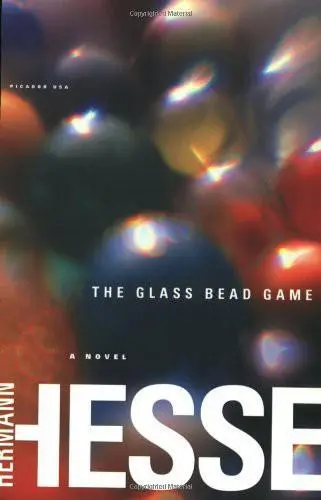
- Название:The Glass Bead Game
- Автор:
- Жанр:
- Год:1969
- ISBN:нет данных
- Рейтинг книги:4 / 5. Голосов: 2
-
Избранное:Добавить в избранное
- Отзывы:
-
Ваша оценка:
The Glass Bead Game: краткое содержание, описание и аннотация
Предлагаем к чтению аннотацию, описание, краткое содержание или предисловие (зависит от того, что написал сам автор книги «The Glass Bead Game»). Если вы не нашли необходимую информацию о книге — напишите в комментариях, мы постараемся отыскать её.
Something like chess but far more intricate, the game of Magister Ludi known as the Glass Bead Game is thought in its purest form, a synthesis through which philosophy, art, music and scientific law are appreciated simultaneously. The scholar-players are isolated within Castalia, an autonomous elite institution devoted wholly to the mind and the imagination…
The Glass Bead Game — читать онлайн бесплатно полную книгу (весь текст) целиком
Ниже представлен текст книги, разбитый по страницам. Система сохранения места последней прочитанной страницы, позволяет с удобством читать онлайн бесплатно книгу «The Glass Bead Game», без необходимости каждый раз заново искать на чём Вы остановились. Поставьте закладку, и сможете в любой момент перейти на страницу, на которой закончили чтение.
Интервал:
Закладка:
While he went his way, longing for abstract thought but living far more in the senses, in the spell of the moon, in the pungency of an herb, the saltiness of a root, the taste of a piece of bark, in cultivating simples, blending salves, submitting to the whims of weather and atmosphere, he developed many abilities within himself, including some that we of a later generation no longer possess and only half understand. The most important of these abilities was, of course, rainmaking. Although there were a good many special times when the sky stayed obdurate and seemed to mock his efforts, Knecht nevertheless made rain hundreds of times, and almost every time in a slightly different way. He would, of course, never have dared to make the slightest change or omission in the sacrifices and the rite of processions, conjurations, and drumming. But that was only the official, the public part of his work, the priestly side, which was for show; and undoubtedly it was very fine and produced a fine exalted feeling when after a day of sacrifices and processions the sky gave way in the evening, the horizon clouded over, the wind began to smell damp, the first drops of rain splattered down. But it had taken the Weathermaker’s art to choose the day well, not to strive blindly when the prospects were poor. You could implore the powers, even besiege them, but you had to do so with feeling and moderation, with submission to their will. Even more than those glorious triumphant experiences of felicitous intercession he preferred certain others that no one but himself knew about, and even he knew about them only timorously, more with his senses than his understanding. There were weather conditions, tensions of the atmosphere and of heat, cloud formations and winds, smells of water and earth and dust, threats and promises, moods and whims of the weather demons, which Knecht detected in advance with his skin, his hair, with all his senses, so that he could not be surprised by anything, could not be disappointed. He concentrated the very vibrations of the weather within himself, holding them within him in such a way that he could command the clouds and the winds — not, to be sure, just as he pleased, but out of the very intimacy and attachment he had with them, which totally erased the difference between him and the world, between inside and outside. At such times he could stand rapt, listening, or crouch rapt, with all his pores open, and not only feel the life of the winds and clouds within his own self, but also direct and engender it, somewhat in the way we can awaken and reproduce within ourselves a phrase of music that we know by heart. Then he needed only to hold his breath — and the wind or the thunder stopped; he needed only to nod or shake his head — and the hail pelted down or ceased; he needed only to express by a smile the balance of the conflicting forces within himself — and the billows of clouds would part, revealing the thin, bright blueness. There were many times of unusually pure harmony and composure in his soul when he carried the weather of the next few days within himself with infallible foreknowledge, as if the whole score were already written in his blood in such a way that the outside world must play every note exactly as it stood. Those were his best days, his reward, his delight.
But when this intimate connection with the outside was broken, when the weather and the world were unfamiliar, incomprehensible, and unpredictable, then currents were interrupted and derangements occurred within him. Then he felt that he was not a real Rainmaker, that his responsibility for weather and crops was an error and nuisance. At such times he was domestic, behaved obediently and helpfully toward Ada, sedulously shared the household tasks with her, made toys and tools for the children, pottered about preparing medicines, craved love and wanted nothing better than to differ as little as possible from other men, to conform wholly to them in customs and morals, and even to listen to the otherwise vexatious gossip of his wife and the neighboring women about the life, health, and conduct of others. But in good times his family saw little of him, for then he roamed, fished, hunted, searched for roots, lay in the grass or crouched in trees, sniffed, listened, imitated the voices of animals, kindled little fires and compared the shapes of the smoke clouds with the clouds in the sky, drenched his skin and hair with fog, rain, air, sun, or moonlight, and incidentally gathered, as his Master and predecessor Turu had done in his lifetime, objects whose inner character and outward form seemed to belong to different realms, in which the wisdom or whimsicality of nature seemed to reveal some fragment of her rules and secrets of creation, objects which seemed to unite symbolically widely disparate ideas: gnarled branches with the faces of men or animals, water-polished pebbles grained like wood, petrified animals of the primordial world, misshapen or twinned fruit pits, stones shaped like kidneys or hearts. He read the veinings of a leaf, the pattern on a mushroom cap, and divined mysteries, relations, futures, possibilities: the magic of symbols, the foreshadowing of numbers and writing, the reduction of infinitudes and multiplicities to simplicity, to system, to concept. For all these ways of comprehending the world through the mind no doubt lay within him, nameless, unnamed, but not inconceivable, not beyond the bounds of presentiment, still in the germ, but essential to his nature, part of him, growing organically within him. And if we were to go still further back beyond this Rainmaker and his time which to us seems so early and primitive, if we were to go several thousands of years further back into the past, wherever we found man we would still find — this is our firm belief — the mind of man, that Mind which has no beginning and always has contained everything that it later produces.
The Weathermaker was not destined to win immortality by any one of his premonitions, or to come any closer to proving their validity. For him, indeed, they scarcely needed proof. He did not become one of the many inventors of writing, nor of geometry, nor of medicine or astronomy. He remained an unknown link in the chain, but a link as indispensable as any other. He passed on what he had received, and he added what he had newly acquired by his own struggles. For he too had disciples. In the course of the years he trained two apprentices to be Rainmakers, one of whom was later to become his successor.
For long years he had gone about his affairs and practiced his craft alone and unobserved. Then, shortly after a great crop failure and time of famine, a boy started appearing, watching him, spying on him, adoring him, and generally skulking about — one who was drawn to rainmaking and the Master. With a strange, sorrowful tug at his heart he sensed the recurrence and reversal of the great experience of his youth, and at the same time had that austere feeling, at once constricting and stirring, that afternoon had set in, that youth was gone and noonday passed, that the blossom had become a fruit. And to his own surprise he behaved toward the boy exactly as old Turu had once behaved toward him. The stiff rebuff, the delaying, wait-and-see attitude, came of its own accord; it was neither an imitation of his deceased Master nor did it spring from moralistic and pedagogic considerations that a young man must be tested for a long time to see whether he is serious enough, that initiation into mysteries should not be made easy, and similar theories. On the contrary, Knecht simply behaved toward his apprentices the way every somewhat aging solitary and learned eccentric behaves toward admirers and disciples. He was embarrassed, shy, distant, ready for flight, fearful for his lovely solitude and his freedom to roam in the wilderness, to go hunting and collecting alone, to dream and listen. He was full of a jealous love for all his habits and hobbies, his secrets and meditations. There could be no question of his embracing the timid youth who approached him with worshipful curiosity, no question of helping him overcome this timidity by encouraging him, no question of his rejoicing and having a sense of reward, appreciation, and pleasant success because the world of the others was at last sending him an emissary and a declaration of love, because someone was courting him, someone felt drawn to him, and like himself called to the service of mysteries. On the contrary, at first he felt it merely as a troublesome disturbance, infringement on his rights and habits, loss of his independence. For the first time he realized how much he prized that independence. He resisted the wooing and became clever at outwitting the boy and hiding himself, at covering his tracks, evading and escaping. But what had happened to Turu now happened to him also: the boy’s long, mute courtship slowly softened his heart, slowly, slowly wore down his resistance, so that the more the boy gained ground, the more Knecht learned to turn to him and open his mind to him, approve his longing, accept his courtship, and eventually come to regard the new and often vexatious duty of teaching and having a disciple as inevitable, imposed by fate, one of the requirements of a life of thought. More and more he had to bid farewell to the dream, the feeling and the pleasure of infinite potentialities, of a multiplicity of futures. Instead of the dream of unending progress, of the sum of all wisdom, his pupil stood by, a small, near, demanding reality, an intruder and nuisance, but no longer to be rebuffed or evaded. For the boy represented, after all, the only way into the real future, the one most important duty, the one narrow path along which the Rainmaker’s life and acts, principles, thoughts, and glimmerings could be saved from death and continue their life in a small new bud. Sighing, gnashing his teeth, and smiling, he accepted the burden.
Читать дальшеИнтервал:
Закладка:
Похожие книги на «The Glass Bead Game»
Представляем Вашему вниманию похожие книги на «The Glass Bead Game» списком для выбора. Мы отобрали схожую по названию и смыслу литературу в надежде предоставить читателям больше вариантов отыскать новые, интересные, ещё непрочитанные произведения.









Обсуждение, отзывы о книге «The Glass Bead Game» и просто собственные мнения читателей. Оставьте ваши комментарии, напишите, что Вы думаете о произведении, его смысле или главных героях. Укажите что конкретно понравилось, а что нет, и почему Вы так считаете.