Michael Chabon - Telegraph Avenue
Здесь есть возможность читать онлайн «Michael Chabon - Telegraph Avenue» — ознакомительный отрывок электронной книги совершенно бесплатно, а после прочтения отрывка купить полную версию. В некоторых случаях можно слушать аудио, скачать через торрент в формате fb2 и присутствует краткое содержание. Город: New York, Год выпуска: 2012, ISBN: 2012, Издательство: Harper, Жанр: Современная проза, на английском языке. Описание произведения, (предисловие) а так же отзывы посетителей доступны на портале библиотеки ЛибКат.
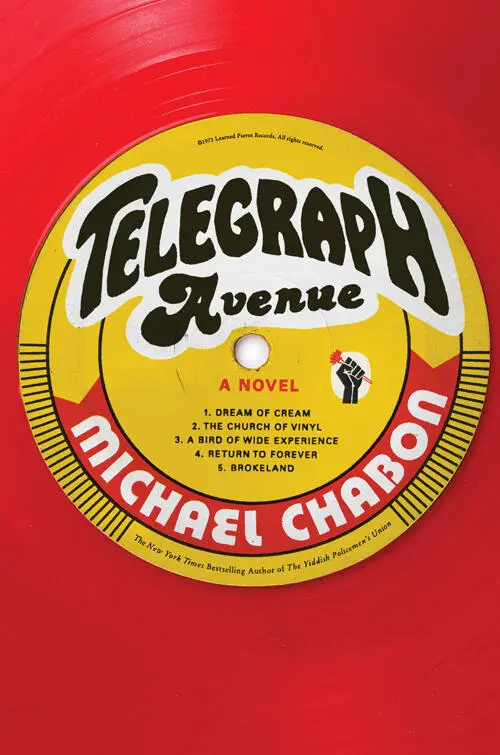
- Название:Telegraph Avenue
- Автор:
- Издательство:Harper
- Жанр:
- Год:2012
- Город:New York
- ISBN:978-0-06-149334-8
- Рейтинг книги:3.5 / 5. Голосов: 2
-
Избранное:Добавить в избранное
- Отзывы:
-
Ваша оценка:
Telegraph Avenue: краткое содержание, описание и аннотация
Предлагаем к чтению аннотацию, описание, краткое содержание или предисловие (зависит от того, что написал сам автор книги «Telegraph Avenue»). Если вы не нашли необходимую информацию о книге — напишите в комментариях, мы постараемся отыскать её.
When ex–NFL quarterback Gibson Goode, the fifth-richest black man in America, announces plans to build his latest Dogpile megastore on a nearby stretch of Telegraph Avenue, Nat and Archy fear it means certain doom for their vulnerable little enterprise. Meanwhile, Aviva and Gwen also find themselves caught up in a battle for their professional existence, one that tests the limits of their friendship. Adding another layer of complication to the couples’ already tangled lives is the surprise appearance of Titus Joyner, the teenage son Archy has never acknowledged and the love of fifteen-year-old Julius Jaffe’s life.
An intimate epic, a NorCal
set to the funky beat of classic vinyl soul-jazz and pulsing with a virtuosic, pyrotechnical style all its own,
is the great American novel we’ve been waiting for. Generous, imaginative, funny, moving, thrilling, humane, triumphant, it is Michael Chabon’s most dazzling book yet.
Telegraph Avenue — читать онлайн ознакомительный отрывок
Ниже представлен текст книги, разбитый по страницам. Система сохранения места последней прочитанной страницы, позволяет с удобством читать онлайн бесплатно книгу «Telegraph Avenue», без необходимости каждый раз заново искать на чём Вы остановились. Поставьте закладку, и сможете в любой момент перейти на страницу, на которой закончили чтение.
Интервал:
Закладка:
The smile winked out like a drop of water on a hot range. “No, ma’am.”
“Uh, his mom passed away,” said Julie. “A long time ago.”
The throb of jealousy subsided, and Gwen’s heart, taking its first tentative steps since Aviva had unlocked the office door, went out to Titus, who suddenly looked closer to twelve than fifteen.
“Titus is staying with us,” Aviva said. “At the moment.”
“ What? Since when?”
“Since Friday. Gwen, I’m sorry. I was respecting Archy’s wishes. God only knows why. He said he was going to tell you. He said he needed a little time to sort things out.”
So this, and not his grief over Mr. Jones, or his shame at being caught with the Queen of Sheba, or cancer, was the secret that Archy had been keeping from her, the hollow underlying his physical presence in the room, the delay in replying to her questions. Not that he had a son but that said fruit of his loins was going to be moving in with them. Then Gwen would be responsible for three babies instead of the two she had ordered.
“You should have just let that bus hit me,” Gwen said. “You should have ridden right on by.”
Gnat. In his ear, born with it. Hearing the current of his own blood, neural crackle, the omnipresent pulse of the worldwide electro-industrial power and information grid, the unheard music. His head a dish to pull down cosmic background radiation, sines and signals, diminished sevenths coming through the wires of time and space to vibrate secret membranes. Hearing something . His moods (unmedicated at the present) prone to act as filters on the input. Melodies on the up days, harmonic structures, polyrhythms, samples and snatches, phrases and hooks, discrete musical ideas. On the down days or in a mixed state, only that rhythmic humming, theorized by one of his many former psychiatrists to be—what else—a dim dull echo of his ma, deceased when Nat was not yet two. A lullaby in the darkness, a steady soothing pat on the diapered behind. Yeah, whatever. But always, inside, beneath, interlaced with the auditory hallucination du jour, that constant invariant tone, at once low and sharp, infuriating, precious, steady as a handrail. On the menu for this morning, a looping Maceo-style fill, a joyous stab of horn, today shaping up to be an up day, oh, fuck yes, bee-da-lee-dop ba-deeda-la- dee !
Also on the menu: fried chicken, Richmond-style. Biscuits. Beans and rice. And most assuredly, greens. Greens the secret weapon, the skeleton key to the soul of a man of Garnet Singletary’s age and provenance. Collards the thing to catch the conscience of the King of Bling.
But the kitchen, oy, the kitchen. Ba-deeda-la- dee -dop! A fucking disaster area. Nat recalled with a pang how his stepmother, Opal, a bookkeeper in the billing department of Thalhimer’s department store, would always stay on top of the disorder, cleaning up after herself in measured intervals, a logic in the steps of her preparations, scraping the trimmed-away ribs and veins of the collards into the garbage while the leaves came to a low simmer in their pot of fatback liquor; the bowl in which the beans had been put to soak the night before washed and sparkling in the wire dish rack as they boiled; the biscuits mixed—the recipe, passed down from the lifelong employer of Opal’s mother, a Mrs. Portman, calling for both yeast and baking soda—then left all night to rise under a damp towel in the refrigerator, nothing to be done but roll them out and cut them, put them in the oven ten minutes before you rang the dinner bell. Opal Starrett, aleha hasholem , rendered justice with her Scotch Brite pad to every pot, pan, and dish along the way, wiping down every surface to a laboratory shine, leaving herself to contend at the end only with the baking sheets, the big cast-iron skillet, and the blast radius of spat fat on the stovetop.
As with so many other things about her, Nat admired the orderly progression of his stepmother’s kitchen, but he could never hope to emulate it. He came wired, like Julius the First, to do everything all at once. Puffs of flour escaping from the requisite brown paper bag in which, with cracked black pepper, cayenne, and salt, he shook the pieces of chicken—legs and thighs, as today’s clientele required. A whole weather system, storm fronts of flour moving across the kitchen from west to east. A scatter of dried beans underfoot, their comrades steeped for an hour in boiling water in lieu of the overnight soak rendered impossible by his impulsive play for the King of Bling’s support. The lard—another secret weapon in the battle for the soul of Garnet Singletary—starting to mutter and pop in the skillet. It was Opal’s skillet, inherited along with her Panzer-plate baking sheets on which half the projected three dozen biscuits lay in domino-spot arrangements, and the big gray Magnalite pot that held Nat’s simmering collards, their trimmings piled on the counter alongside peeled onion wrappers, a cut-away strap of fatback rind, the arctic landscape of Nat’s uncompleted biscuit rolling. Better not to think about the rice, Christ, the rice, some of it duly sucked up into the belly of the dead-battery DustBuster that was lying abandoned on the floor in the middle of all the unsucked rest of it. All that rice, raining down when he yanked the bag from the pantry shelf, someone, likely Nat, having put it back with its wire tie very loosely twisted. Though it was kind of remarkable the way the sound of raining rice seemed to lay itself down so sweetly over the horn riff in his head, a shimmer of steel brushes on a hi-hat.
At 9:45 A.M. the first batch of chicken parts sank, to the sound of applause, into the pig fat. The fat set about its great work, coaxing that beautiful Maillard reaction out of the seasoned flour, the smell of golden brownness mingling with the warm, dense, bay-leafy, somehow bodily funk of the beans, and with the summertime sourness of the greens like the memory of white Keds stained at the toes with fresh-cut grass, Nat stepped through the time portal that opened within the ring of seasoned iron. Riding the kitchen time machine. Turning the pieces of chicken with a pair of tongs, his hum, which he did not even know he was emitting, like the steady press of massaging fingers at the back of his neck, he remembered Opal standing at the ancient Hotpoint on East Broad Street in high heels and a Marimekko apron patterned with big coral poppies, cursing out Julius the First, furious over some fresh piece of poor judgment, some dud of a snack cake, that Monument Liquor and News was now stuck for to the tune of ten cases, some no-account relative of Opal’s to whom Nat’s father had, against her emphatic instructions, loaned three hundred and fifty dollars they could ill afford, while in the lower sash of the casement window behind the stove, a pair of tiny electric fans executed a broad parody of Nat’s father (and for that matter, prefiguratively, of Nat himself) going around and around and around, with unimpeachable intentions, to no effect at all. At last with her chicken pieces neatly mounded and her biscuits tumbled into a basket lined with a clean dish towel, Opal would knock on down the back hall in those high heels to the crazed wooden stairway, barrel staves and bent nails, something out of a Popeye cartoon, bolted to the back of their row house, throw open the door, and stand there on the landing, fanning up a hopeful breeze with her manicured brown hands, unimprisoning her soft dark dove-winged hair from its head scarf, saying in that wild negro Yiddish of hers, “That is sure enough a mechiah. ” Thirty, almost thirty-five years ago that would have been, Nat’s professional expertise wanting to sweeten the memory with maybe some fresh-minted Isaac Hayes filtering in from the stereo in the living room, or the first Minnie Riperton album, Come to My Garden . Opal had been into poor sweet Minnie in a big way.
Читать дальшеИнтервал:
Закладка:
Похожие книги на «Telegraph Avenue»
Представляем Вашему вниманию похожие книги на «Telegraph Avenue» списком для выбора. Мы отобрали схожую по названию и смыслу литературу в надежде предоставить читателям больше вариантов отыскать новые, интересные, ещё непрочитанные произведения.











Обсуждение, отзывы о книге «Telegraph Avenue» и просто собственные мнения читателей. Оставьте ваши комментарии, напишите, что Вы думаете о произведении, его смысле или главных героях. Укажите что конкретно понравилось, а что нет, и почему Вы так считаете.