Michael Chabon - Telegraph Avenue
Здесь есть возможность читать онлайн «Michael Chabon - Telegraph Avenue» — ознакомительный отрывок электронной книги совершенно бесплатно, а после прочтения отрывка купить полную версию. В некоторых случаях можно слушать аудио, скачать через торрент в формате fb2 и присутствует краткое содержание. Город: New York, Год выпуска: 2012, ISBN: 2012, Издательство: Harper, Жанр: Современная проза, на английском языке. Описание произведения, (предисловие) а так же отзывы посетителей доступны на портале библиотеки ЛибКат.
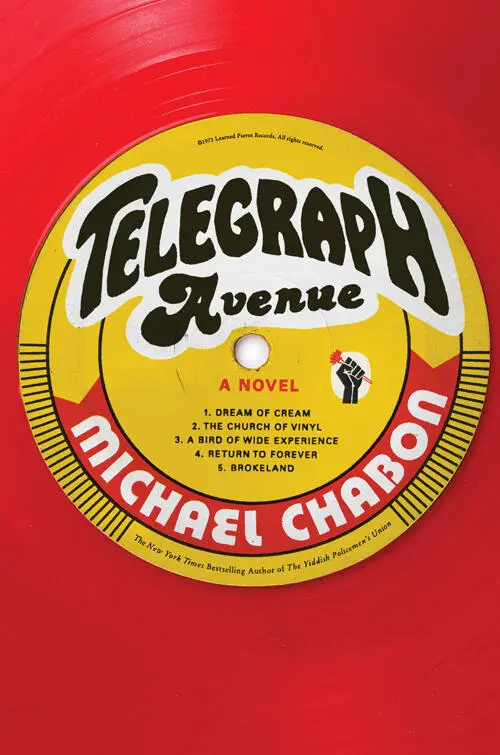
- Название:Telegraph Avenue
- Автор:
- Издательство:Harper
- Жанр:
- Год:2012
- Город:New York
- ISBN:978-0-06-149334-8
- Рейтинг книги:3.5 / 5. Голосов: 2
-
Избранное:Добавить в избранное
- Отзывы:
-
Ваша оценка:
Telegraph Avenue: краткое содержание, описание и аннотация
Предлагаем к чтению аннотацию, описание, краткое содержание или предисловие (зависит от того, что написал сам автор книги «Telegraph Avenue»). Если вы не нашли необходимую информацию о книге — напишите в комментариях, мы постараемся отыскать её.
When ex–NFL quarterback Gibson Goode, the fifth-richest black man in America, announces plans to build his latest Dogpile megastore on a nearby stretch of Telegraph Avenue, Nat and Archy fear it means certain doom for their vulnerable little enterprise. Meanwhile, Aviva and Gwen also find themselves caught up in a battle for their professional existence, one that tests the limits of their friendship. Adding another layer of complication to the couples’ already tangled lives is the surprise appearance of Titus Joyner, the teenage son Archy has never acknowledged and the love of fifteen-year-old Julius Jaffe’s life.
An intimate epic, a NorCal
set to the funky beat of classic vinyl soul-jazz and pulsing with a virtuosic, pyrotechnical style all its own,
is the great American novel we’ve been waiting for. Generous, imaginative, funny, moving, thrilling, humane, triumphant, it is Michael Chabon’s most dazzling book yet.
Telegraph Avenue — читать онлайн ознакомительный отрывок
Ниже представлен текст книги, разбитый по страницам. Система сохранения места последней прочитанной страницы, позволяет с удобством читать онлайн бесплатно книгу «Telegraph Avenue», без необходимости каждый раз заново искать на чём Вы остановились. Поставьте закладку, и сможете в любой момент перейти на страницу, на которой закончили чтение.
Интервал:
Закладка:
“You know your wife how long?” Mr. Jones said.
“Ten years.”
“Uh-huh.”
The pipe was dead, and Mr. Jones passed it to the bird. The bird nipped onto the pipe stem with a click of its beak, then flew off the perch and into the morning. Knock-knocking it against the sidewalk. Probably dropping its mess while it was out there, bird better housebroken than a child of five. A few seconds later, the bird came flustering back to light on Mr. Jones’s shoulder. Passed back the pipe with its freshly emptied bowl. Fifty-Eight had come equipped with that trick by some owner before Mr. Jones, before Marcus Stubbs, who had lost the bird to Mr. Jones in a poker game and who did not smoke a pipe and who furthermore could not have trained a shark to favor steak. Mr. Jones took the pipe, and the bird hopped back up onto the makeshift perch.
“I didn’t tell my wife yet, by the way,” Archy said. “Case you were wondering.”
“You didn’t know you had a son before now?”
“I knew, but I mean, we never had, like, contact. Boy was off in Texas somewheres, uh, Tyler, I think it is.”
“I know it.” Gigging at some corrugated-shack crossroads bar and grill, the night dense and humid and haunted by a smell of roses. Idris Muhammad on the drums back when he was a kid named Leo Morris. Going on half a century ago.
“Boy had his granny, the mom’s mom, living there,” Archy said. “The old lady sent me a picture one time.”
“Uh-huh.”
Mr. Jones poked another hank of his favorite perique into the bowl of his pipe, tamped it down with a finger.
“Nobody ever asked me to be a daddy to the boy,” Archy said. “And I didn’t… you know. Volunteer.”
“Uh-huh.”
“Yesterday, boy shows up in my store, and I still don’t really understand why, but. He’s with Julie, you know.”
“Julie?
“Julie Jaffe.”
“I didn’t know that boy had any friends.”
“Julie got a full-on crush on the motherfucker.”
“Oh,” Mr. Jones said. “So he’s like that?”
“I do believe that he is,” Archy said.
Nothing in that to disturb Mr. Jones. When it came to lifestyles and behaviors, Mr. Jones played it strictly live and let live. Gays, Wiccans, people who wanted to punch a metal grommet in their earflaps. But somehow it made Mr. Jones sad, without surprising him, to learn that Julie Jaffe had come out a homosexual. That felt to him like something too complicated, too heavy, for a boy so young to lay on himself. He did not disapprove, but he could not see any reward in it. “Boy that age,” he said, shaking his head. “Smart, too.”
The bird beeped like Mr. Jones’s microwave, four times. Popcorn, popped. Then, following its own inscrutable logic, it began to articulate Groove Holmes’s version of the chorus to “American Pie.” A ghostly rotor whirring in its throat.
“Said they met up at some film class,” Archy said, setting the woofer drum into place in the lower story of the Leslie. “Over at the Southside Senior Center.”
“Is that right?” Mr. Jones said, staring at the parrot as if to warn it to hold his tongue about that evening in June.
“It’s a Quentin Tarantino class. I don’t know, I guess they’re studying Kill Bill or some shit, watching a bunch of kung fu movies, B movies. Surprised you didn’t sign up for it, loving that Pulp Fiction like you do.”
“Only I did sign up for it,” said Mr. Jones. “Sounds like you got to be talking about my boy Titus. No shit, that’s your son?”
Archy raised up slow and careful. Came around on Mr. Jones a little at a time, like he expected to find himself looking down the barrel of a gun. “You know him?”
Whenever Mr. Jones, again in the characteristic style of useless old men, wished to contemplate the brokenness of the world, or at least that part of the world bounded by the Grove-Shafter Freeway and Telegraph Avenue on Forty-second Street, he had only to look across and up two doors to the home of his neighbor Mrs. Wiggins. The woman already seemed old when he and Francesca first moved in with Francesca’s mother back in 1967. But Mrs. Wiggins was strong then, furious and churchgoing, pleased to be known for and to advertise her own iron rule over the tribes of loose children who flowed like migrants through her door—the late Jamila Joyner among them—taking what she could pay them in love and beatdowns, in clean clothes, food on the table. Years, decades, Mrs. Wiggins went on and on, like one of those Japanese soldiers who kept fighting in the Solomon Islands or wherever, nobody ever showing up to reinforce her, tell the poor woman to surrender. But time, crime, and misery in all its many morphologies had at last ground old Mrs. Wiggins down. Though she lived still, she was a gibbering ghost of herself. You had to pity any child who found himself consigned by the high court of bad luck to her care. When Mr. Jones was growing up in Oklahoma City, he had been taken to a carnival whose sideshow featured a man purported to be John C. Frémont and a hundred and twenty-odd years old. Bone hands, a mat of hair, and a pair of filmy eyes peering out from a heap of blankets, shivering. All around the staring thing, in the shadowed tent, stirred the freaks and bodily horrors, sly, embittered, and cavorting. That was how Mr. Jones thought of old Mrs. Wiggins now, in that little house across the street.
“I might be the cause of this particular distraction coming your way,” Mr. Jones said. “Titus stays with Mrs. Wiggins. You know that house across the street from me?”
“Yeah, okay. She was Jamila’s, like, auntie.”
“I see the boy come out the house one day, something about him seemed familiar, you know? Boy had on a little sweater vest. Hair in order, crease in his jeans.”
“He does present a neat appearance, I will give you that.”
“We started talking.”
In those three words, Mr. Jones condensed a two-week history of passing nods. The boy coming and going on his bicycle at any given time of the day or night, Mr. Jones looking for signs of creeping doom on the child but observing, day after day, nothing of note except a small and fiercely maintained repertoire of button-downs and blazing white tees. Then, all at once, a blast of conversation, Titus drawn in by a burst of eerie parrot zitherings coming through Mr. Jones’s kitchen window, KQED having shown The Third Man the night before.
“Boy told me he wants to be a movie director,” Mr. Jones said. “Talking about Walter Hill, Sam Peckinpah, Stanley Kubrick. I’m thinking, well, all right .”
“He has taste.”
“Then he mentions how he likes Tarantino. So I told him about the class. Only when we got there, this one dude in a wheelchair.” Mr. Jones broke off, pressed his lips together. Took a deep breath, shaking his head in furious sorrow. “Says he has a bird allergy .”
According to Dr. Hanselius at the Niebyl-Proctor Marxist Library, bird allergies were, quote, extremely uncommon, unquote, and something in the lingering sting of humiliation that Mr. Jones had felt that night, a sense that he and the bird had been the victims of some esoteric form of bigotry, fed the anger that had been mounting in him since finding out that the Leslie wasn’t ready for tonight’s gig; since being thrown out of the Tarantino class; since the assassination of Marcus Foster or Dr. King; since 1953, 1938.
“Son of a bitch probably sleeps on a feather pillow every motherfucking night,” Mr. Jones said.
He looked at the bird, feathers giving off that faint parrot smell of scorched newspaper, in whom all his loneliness and outrage were distilled. Fifty-Eight screamed like a slide whistle.
“So I had to leave,” Mr. Jones said, aware that his explanation of his role in bringing Archy his son had fallen somewhat off track. “Titus stayed. And Nat’s boy was, like, sitting right there.”
Читать дальшеИнтервал:
Закладка:
Похожие книги на «Telegraph Avenue»
Представляем Вашему вниманию похожие книги на «Telegraph Avenue» списком для выбора. Мы отобрали схожую по названию и смыслу литературу в надежде предоставить читателям больше вариантов отыскать новые, интересные, ещё непрочитанные произведения.








Обсуждение, отзывы о книге «Telegraph Avenue» и просто собственные мнения читателей. Оставьте ваши комментарии, напишите, что Вы думаете о произведении, его смысле или главных героях. Укажите что конкретно понравилось, а что нет, и почему Вы так считаете.