Michael Chabon - Telegraph Avenue
Здесь есть возможность читать онлайн «Michael Chabon - Telegraph Avenue» — ознакомительный отрывок электронной книги совершенно бесплатно, а после прочтения отрывка купить полную версию. В некоторых случаях можно слушать аудио, скачать через торрент в формате fb2 и присутствует краткое содержание. Город: New York, Год выпуска: 2012, ISBN: 2012, Издательство: Harper, Жанр: Современная проза, на английском языке. Описание произведения, (предисловие) а так же отзывы посетителей доступны на портале библиотеки ЛибКат.
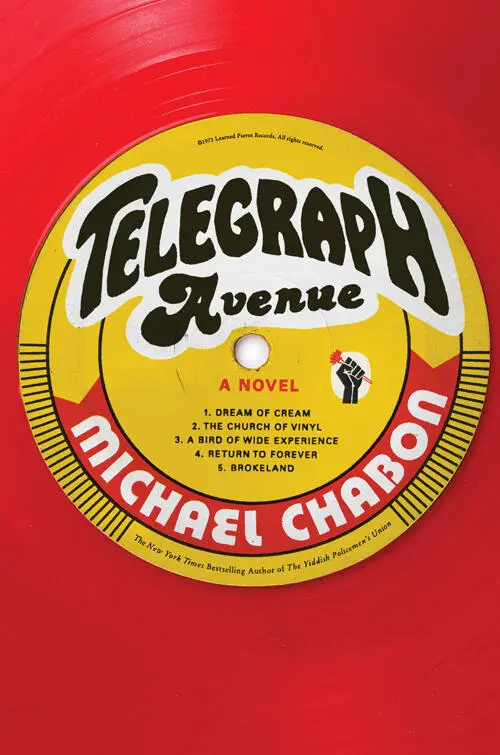
- Название:Telegraph Avenue
- Автор:
- Издательство:Harper
- Жанр:
- Год:2012
- Город:New York
- ISBN:978-0-06-149334-8
- Рейтинг книги:3.5 / 5. Голосов: 2
-
Избранное:Добавить в избранное
- Отзывы:
-
Ваша оценка:
Telegraph Avenue: краткое содержание, описание и аннотация
Предлагаем к чтению аннотацию, описание, краткое содержание или предисловие (зависит от того, что написал сам автор книги «Telegraph Avenue»). Если вы не нашли необходимую информацию о книге — напишите в комментариях, мы постараемся отыскать её.
When ex–NFL quarterback Gibson Goode, the fifth-richest black man in America, announces plans to build his latest Dogpile megastore on a nearby stretch of Telegraph Avenue, Nat and Archy fear it means certain doom for their vulnerable little enterprise. Meanwhile, Aviva and Gwen also find themselves caught up in a battle for their professional existence, one that tests the limits of their friendship. Adding another layer of complication to the couples’ already tangled lives is the surprise appearance of Titus Joyner, the teenage son Archy has never acknowledged and the love of fifteen-year-old Julius Jaffe’s life.
An intimate epic, a NorCal
set to the funky beat of classic vinyl soul-jazz and pulsing with a virtuosic, pyrotechnical style all its own,
is the great American novel we’ve been waiting for. Generous, imaginative, funny, moving, thrilling, humane, triumphant, it is Michael Chabon’s most dazzling book yet.
Telegraph Avenue — читать онлайн ознакомительный отрывок
Ниже представлен текст книги, разбитый по страницам. Система сохранения места последней прочитанной страницы, позволяет с удобством читать онлайн бесплатно книгу «Telegraph Avenue», без необходимости каждый раз заново искать на чём Вы остановились. Поставьте закладку, и сможете в любой момент перейти на страницу, на которой закончили чтение.
Интервал:
Закладка:
Archy parked and got out of the El Camino. In the same spirit of research that made him borrow Rolando (he hadn’t gotten the chance to tell Gwen about that, to show her he was capable, willing, and at this point, telling her would be like dropping a penny in a parking meter), Archy applied himself to the study of this slab of failure hewn from the greater zone of vicissitude that was his hometown. He tried to see it the way a successful businessman and top-ranked rich person like Gibson Goode was seeing it: as something that, unlike a plastic houseplant, could be made to grow. He studied the boarded-up plate windows, the rusting iron barrier around the empty cart corral. The mysteriously virginal circle of white concrete where, at the nexus of all earthly desire, there had stood a coin-operated peewee carousel with fiberglass horses, grinding around their tiny orbit in a way that only a kid could have found magical. As he ambled toward the back of the building to the shuttered and chained loading dock, he saw a pudgy man wearing a turquoise tracksuit and sneakers like a pair of tropical birds, murmuring into a cell phone. Big sunglasses made of turquoise plastic concealed the upper part of the man’s face, but the lower part gathered itself into a troubled pout. The man said softly, “Hey.”
“Tsup,” Archy said, fixating his connoisseurial attention on the completely featureless and uninteresting cinder-block backside of the building. He stroked his chin and nodded as if confirming some rumor about the building’s construction, as if noting that the ratio between the width and height of the cinder blocks echoed information that had been hidden by God in the works of Pythagoras, in the radio pulsing of the stars. Slowly, he walked on without giving the man in the bright kicks a second glance, heading down Forty-first Street toward Highway 24 like he had some proper business to attend to.
Forty-first was all sky and wires and broken rooflines and, like a lot of streets that had been cut in two by the construction of the Grove-Shafter Freeway, after all these years it still had a dazed feel, a man who had taken a blow to the head staggering hatless down from Telegraph, face-planting at the overpass. Archy felt a balloon of failure inflating in his rib cage. Between the days of peewee carousels and hectic stolen packages of Ding Dongs and this afternoon in the wasteland of the Golden State parking lot, there seemed to lie an unbridgeable gulf. As if his history were not his own but the history of someone more worthy of it, someone who had not betrayed it. He felt, not for the first time today, that he had not made a good decision in his personal or professional life since 1989, when he had accepted an impromptu one-night invitation to play a Funkadelic show at the Warfield (Archy was, at the time, a member of a P-Funk tribute band called Bop Gun) after Boogie Mosson was laid up with a case of food poisoning. That was no decision at all, since a request from George Clinton was an incontrovertible voice from the top of a very high mountain. Archy was tired of Nat, and he was tired of Gwen and of her pregnancy with all the unsuspected depths of his insufficiency that it threatened to reveal. He was tired of Brokeland, and of black people, and of white people, and of all their schemes and grudges, their frontings, hustles, and corruptions. Most of all, he was tired of being a holdout, a sole survivor, the last coconut hanging on the last palm tree on the last little atoll in the path of the great wave of late-modern capitalism, waiting to be hammered flat.
He followed Forty-first as it bent around to run into Forty-second, then turned right and found himself, speaking of sole survivors and the fatal path of the tsunami, in front of Neldam’s bakery. A lint-bearded geezer of the type known in Archy’s childhood as a wino sat on an overturned milk crate just beyond the entrance, making his way with evident contentment through a sack of Swedish rolls.
“Pretty good rolls,” Archy remembered.
The wino stopped chewing and looked at Archy, his expression bleary but somehow astute, most likely trying to decide whether Archy was trying to menace or cadge a roll off him.
“This here my lunch,” he said apologetically. “Breakfas’, too.”
“I have no intention to molest your lunch, brother,” Archy said. “I was always a Dream of Cream man myself.”
When he was a boy, a Dream of Cream from Neldam’s—crumbly chocolate cake interglaciating floes and tundras of whipped cream, the outside armored in a jagged tectonics of wide chocolate shavings—was a prodigy, a work of wonder, five dollars no one could spare spent annually by stingy but cake-loving ladies to celebrate the coming into the world of a fatherless and motherless fatboy.
“Well, then, go on in and get yourself one,” the wino said. “Look like you might could need it.”
“Maybe I could,” Archy allowed.
He entered the bakery, with its curvy display cases and its pallid eighties palette of gray and pink. He breathed very deep, and the smell of the place, the olfactory ghosts of Pine-Sol and caramel and long-vanished dreams of cream, filled him with a sense of loss so powerful that it almost knocked him down. The cakes and cookies at Neldam’s were not first-rate, but they had an old-fashioned sincerity, a humble brand of fabulousness, that touched Archy in this time when everything good in life was either synthesized in transgenic cyborg vats or shade-grown in small batches by a Buddhist collective of blind ex-Carmelite Wiccans. And now word was that Neldam’s, too, was slated to close its doors.
“I need a Dream of Cream,” he told the woman working the counter.
She was a hard-eyed little Filipina lady with no time or patience for his sorrow. “Big one or small?” she said.
Archy said, “Are those my only choices?”
He ate half the enormous cake in the car, using a spork from Vik’s Chaat, stained yellow with turmeric, that he exhumed from the deepest stratum of his glove compartment. He shoveled freely, emitting bearish sighs and exclamations, and found that the Dream of Cream was, like so few things in this world, almost as good as he remembered. This discovery, along with the anticipated charms of sugar, fat, and chocolate, buoyed his spirits and steeled him sufficiently to confront with customary heedlessness his melancholy retail fate. He left the half a cake not yet required in its pink cardboard containment unit, under a stack of newspapers on the passenger seat, and wiped his mouth on the back of a parking ticket that had, like the fate of Brokeland Records, fallen victim to the Stallings moral code of studied negligence.
“Whatever,” he told himself.
The open-closed sign hanging from the door of Brokeland was spun for the third time that day. Archy went back behind the counter and prepared to resume his lonely inventory of the musical remains of the late Benezra. He was aware, as he did so, of a poignant air of tragic dedication in all his actions, the dutiful routines of a doomed picket manning his lonely watch as, beyond the next range of hills, the barbarian horde mounted its conquering ponies. Then the shop door banged open, and those toucan-bill Adidas came walking right into Brokeland, their occupant lagging, as always, a fraction of a second behind and listing three degrees to the right.
“Damn, Turtle,” said the cantilevered man with a show of bitterness. “You hurt my feelings.”
Archy had been present, throughout the late 1970s, as that gait was first propounded and then painstakingly crafted to serve as a pedestrian variation on the Gangster Lean as specified by William DeVaughn, in his song “Be Thankful for What You Got” (Roxbury, 1974), as a necessary precondition for Digging the Scene. “Rubbing that Velcro you got stuck onto your chin. Acting all ‘Heavens, what a interesting example of commercial urban vernacular, I must consult my notes.’ Like you didn’t even see me there.”
Читать дальшеИнтервал:
Закладка:
Похожие книги на «Telegraph Avenue»
Представляем Вашему вниманию похожие книги на «Telegraph Avenue» списком для выбора. Мы отобрали схожую по названию и смыслу литературу в надежде предоставить читателям больше вариантов отыскать новые, интересные, ещё непрочитанные произведения.







Обсуждение, отзывы о книге «Telegraph Avenue» и просто собственные мнения читателей. Оставьте ваши комментарии, напишите, что Вы думаете о произведении, его смысле или главных героях. Укажите что конкретно понравилось, а что нет, и почему Вы так считаете.